
Cobblestone Aprons and Edging in Northborough, MA
Northborough’s housing stock splits roughly two ways. Older homes sit close to the main road network with frontages that were never designed with a car in mind, and newer subdivisions give you long, straight drives on larger lots that run fifty or more feet before they reach a garage. Both situations have the same weak point: the place where the driveway meets the street, or the raw edge where asphalt simply stops and gravel or lawn takes over. A cobblestone apron and matching edge detail solves that transition properly, and it does it as a finish detail, not a repair.
This is not a driveway fix. If your asphalt is cracking or heaving, that’s a separate job. This is about the border and the entry point: the stone apron that frames where you turn in off the road, and the edge restraint that runs the length of the drive to stop the asphalt shoulder from crumbling and spreading into the lawn over a few winters. Done well, it also does something a plain asphalt edge never can: it reads as a deliberate, finished line from the street, which matters more than people expect when a home is on the market or simply when neighbors are judging curb appeal.
What’s happening below the surface
The reason a cobblestone edge holds its line for years, or goes wavy within a couple of seasons, is almost entirely about what’s underneath it. The visible stone is maybe two inches of a system that includes excavation to a stable depth, a compacted aggregate base, a bedding layer that lets the stones sit level and tight, and a restraint – usually a concrete or aggregate haunch – that keeps the whole row from migrating outward under traffic and frost.
Massachusetts frost is the detail nobody skips without paying for it later. Water gets into the joints and the base, freezes, expands, and pushes the stones. Without a restrained edge and a base that drains rather than holds water, that movement is cumulative. One winter it’s a slightly proud stone. A few winters in, it’s a gap-toothed border that plow blades catch and widen every time they pass. Jointing material matters here too – a polymeric sand or similarly stabilized fill resists washout far better than loose sand, which plows and sprinklers will slowly empty out of the gaps over a season or two.


What Our Clients Say

What the work involves below the surface
The stone is the last and smallest part of the job. A cobblestone apron stays flat or goes wavy depending on what is underneath it.
Material choice
Granite cobblestone costs more upfront but shrugs off Northborough’s freeze-thaw winters with barely any weathering. Concrete pavers cost less and age faster, though individual units are easy to lift and swap if one cracks or settles unevenly over time.
Reclaimed vs new stone
Reclaimed granite cobbles arrive with rounded, weathered edges that suit an older Northborough home and its mature stonework. New-cut stone reads sharper and more uniform, complementing newer subdivision builds.
Edge restraint methods
A concrete haunch behind the stones holds the line hardest against Northborough’s frost heave and winter freeze-thaw cycles. A compacted aggregate restraint flexes more, settles naturally, and proves simpler to lift, adjust and repair later if your cobblestone apron shifts.
Drainage and pitch
Every apron and edge run needs a pitch away from the house and garage. Water that sits against a foundation or pools at a seam will find its way under the base eventually, especially through Northborough’s freeze-thaw winters.
Matching what's already there
Stone colour, texture and joint pattern should echo existing walls, steps or planting beds around Northborough properties, so new cobblestone aprons and edging read as original features.
Materials and the trade-offs
Why material choice isn't a simple upgrade
Granite cobblestone, concrete paver edging and poured concrete curbing all do the job, but they age differently, and that’s the real decision. Granite costs the most and changes the least over decades; it chips rather than cracks, and a chipped stone can be turned or swapped without disturbing its neighbours. Concrete pavers cost less upfront and come in more colours and shapes, but they fade and can spall faster through repeated freeze-thaw, especially if unsealed or set on a thin base. Poured concrete curbing is cheapest for a straight run but cracks as one continuous piece, meaning you replace a section rather than lift and reset a few units.
- Granite: highest cost, most durable, repairs piece by piece
- Pavers: lower cost, more design options, more freeze-thaw wear
- Poured curbing: cheapest, but cracks mean section replacement
None of these is wrong for every Northborough property. A straight subdivision drive may not need granite’s durability, while an older home with fieldstone walls usually looks better with it.


Drainage, grade and tying into what exists
Adding a hard apron or a continuous stone edge changes how water moves across that part of the property. Pitch away from the house isn’t optional; it’s the difference between water reaching a lawn or drain and water finding the nearest low point, which on many Northborough lots is the foundation or garage slab. On the longer, straighter drives common in the newer subdivisions, grade over fifty-plus feet needs checking before any stone goes in, since a small pitch error compounds over that distance. On older lots nearer the main roads, the apron often has to match an existing curb cut or sidewalk edge, which limits how much the grade can be adjusted and puts more weight on getting the base and drainage right the first time.
The other half of the job is visual continuity: matching new stone to an existing wall, granite steps, or planting bed border so the edge reads as original rather than added on. That’s a judgment call as much as a technical one, and it’s easiest to get right when apron and edging are designed together rather than as separate projects.
Where to start
If you’re looking at a Northborough property with a long plain drive, a cracked old apron near the road, or an edge that’s been losing stone and gravel into the lawn for a few seasons, the fix starts with a look at what’s underneath, not just what shows. Northborough’s mix of older colonials near downtown and newer builds off routes 20 and 135 means soil conditions, drainage, and existing base material vary a lot from one lot to the next, so the first real step is digging a test section to see what’s holding (or not holding) the apron or edge in place now. From there we talk through cobblestone options — granite versus concrete versus reclaimed stone, running bond versus soldier course — and how the apron should tie into your existing driveway material and the town’s curb cut at the street.
We’ve been doing hardscape and driveway work across Worcester and Middlesex counties since 1988, as a family-run crew that still does the estimates and the work itself. Call (413) 337-3772 to talk through what your property needs and get a straight answer on scope before anything is dug up.
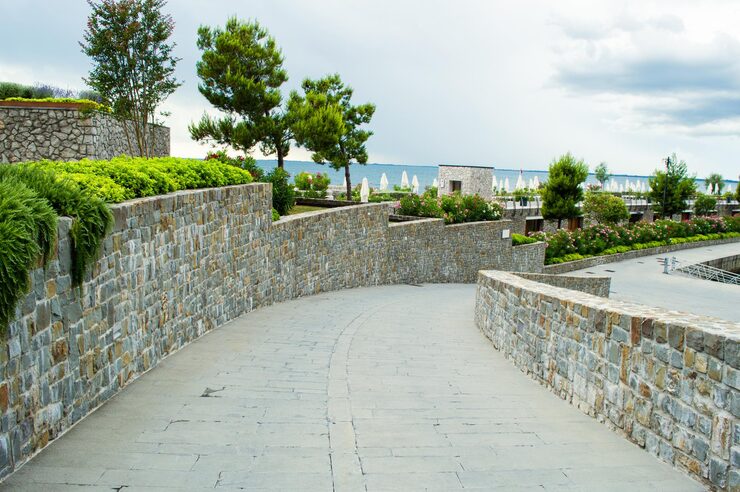
Where this suits Northborough properties
Long straight subdivision drives
Newer Northborough lots with long asphalt runs benefit from a cobblestone apron that breaks up the approach and gives the entry a defined edge where the drive meets the road.
Older homes on the main road network
Houses closer to Northborough's older roads often have narrow or uneven frontages where a fitted stone apron squares off the transition without widening the cut into the street.
Curved or multi-level entries
Where a drive bends or steps down toward a garage, cobblestone edging holds the line through the curve and keeps the grade change visually clean instead of just functional.
So tar and chip suits a longer, gentler Northborough drive with some room around it. It is a poor match for a short, steep or shared one, or one that opens straight onto the walk.
Questions we hear
Does a cobblestone apron need its own permit in Northborough?
If the apron ties into a town-accepted road, the curb cut and apron area are the town's concern and usually need sign-off before work starts. On a private way or shared drive, it is between the owners involved. We can tell you which applies once we see the property.
Will cobblestone edging stop my asphalt from spreading at the edges?
A properly bedded and restrained edge resists the outward creep that loose, unedged asphalt shoulders show over time. The restraint has to be set on compacted base, not just set into loose soil, or it will move with the same frost cycles it is meant to resist.
Can cobblestone edging be added to an existing driveway without redoing the whole drive?
Yes, in most cases. The edge and apron are excavated and rebuilt as their own section, tied into the existing asphalt or concrete edge. The rest of the driveway surface is not disturbed.
How does cobblestone handle a Massachusetts winter compared to poured concrete edging?
Individual stones set in a flexible bed can move slightly with frost and settle back, where a continuous poured edge has nowhere to flex and is more likely to crack along one line. The trade-off is that cobblestone needs a joint check now and then; concrete doesn't, until it fails.
What is the difference between an apron and edging?
The apron is the paved transition area where the driveway meets the street or sidewalk. Edging is the border material running along the sides of the drive or around planting beds. Many Northborough projects use cobblestone for both so the two details match.
Next step
Call us at (413) 337-3772. Tell us about the lot, the slope and what you want the frontage to look like. We have been working in this area since 1988, and we will tell you plainly what suits your property.