


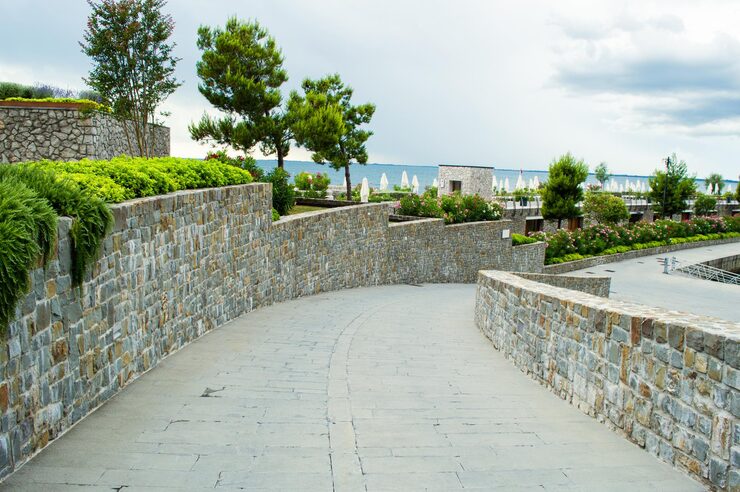

Most driveways in Walpole are straight, level, and already functional. The asphalt does its job. What’s missing is the finish at the street and along the edges, the part a visitor actually sees before they reach the garage. A cobblestone apron at the end of the drive, or a cobblestone border running its length, is the difference between a driveway that simply works and one that looks like it belongs to the house behind it. On the newer subdivision lots around Walpole this usually means framing a straight run with a clean border. On the older rural roads in the outer parts of town, it often means tying a drive into a property that already has stone walls, mature plantings, or a fieldstone foundation worth matching.
This is not a repair job and it is not about fixing failed asphalt. It is an upgrade to the parts of the property that get noticed: the apron where the drive meets the road, the border that keeps the edge crisp, and the transition into a front walk or entry. Done well, it reads as a single deliberate decision rather than an add-on, which is exactly what buyers and visitors register even if they couldn’t say why.
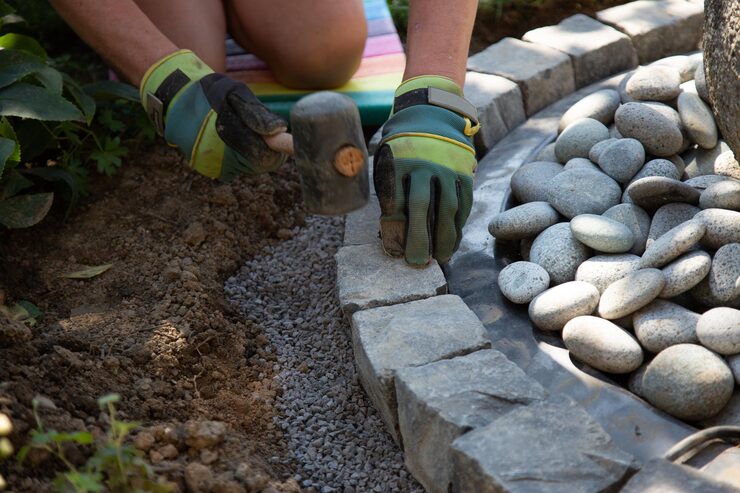
The visible cobblestone is the easy part to picture. What determines whether it stays flat for years or starts heaving and gapping within a season or two is the work nobody sees: excavation to a consistent depth, a compacted base, a proper bedding layer, and edge restraint that actually holds the outermost row in place. Massachusetts frost moves water in the soil through repeated freeze-thaw cycles all winter. If the base under a cobblestone border isn’t compacted evenly, or if the edge restraint is thin or poorly anchored, that movement pushes individual stones out of line one freeze at a time. A wavy, uneven cobblestone edge after a winter or two almost always traces back to shortcuts taken below grade, not to the stone itself.
Edge restraint matters more with cobblestone than with almost any other hardscape material, because the whole visual effect depends on straight, tight joints. A restraint system that holds its line is what keeps that look intact season after season.
A few details worth getting right before work starts:
The stone is the last and smallest part of the job. A cobblestone apron stays flat or goes wavy depending on what is underneath it.
placeholder
So tar and chip suits a longer, gentler Walpole drive with some room around it. It is a poor match for a short, steep or shared one, or one that opens straight onto the walk.
placeholder
Call us at (413) 337-3772. Tell us about the lot, the slope and what you want the frontage to look like. We have been working in this area since 1988, and we will tell you plainly what suits your property.