
Cobblestone Aprons and Edging in Westwood, MA
Westwood lots tend to give you room to work with. Generous frontage, a drive that curves in past mature trees rather than running straight at the street, and a house old enough that a straight asphalt edge looks wrong against it. A cobblestone apron at the street and a cobblestone edge running the length of the drive does a specific job: it marks where the property starts, it protects the asphalt or the lawn from plow damage, and it gives the whole approach a finished look that a painted line or a raw asphalt edge can’t.
None of that is visible once the job is done well, which is the point. What you see is stone sitting flat and tight, year after year. What makes that happen is underneath.
What’s under the stone
Cobblestone edging and aprons fail the same way bad asphalt fails: from below. The installation starts with excavation deep enough to get below the zone that freezes and thaws each winter, then a compacted base of crushed stone that lets water drain through instead of sitting under the stones and heaving them. The cobbles themselves sit on a bedding layer, set tight against each other, with edge restraint behind the outer row so the whole line can’t creep outward under frost pressure or the weight of a plow blade.
Skip any one of those steps and you get the result everyone’s seen on an older property: stones that have rotated, gaps that have opened, a line that was straight five years ago and now wanders. On Westwood’s wooded lots, tree roots add another variable. A root running under an edge line will lift it eventually, so where mature trees sit close to the drive, the base depth and the routing of the edge line both need to account for it.


What Our Clients Say

What the work involves below the surface
The stone is the last and smallest part of the job. A cobblestone apron stays flat or goes wavy depending on what is underneath it.
Granite cobblestone holds its edge and its color for decades, costs more up front, and is simple to lift and reset if a section ever moves. It is the material most often chosen for aprons on older Westwood homes.
Concrete cobble pavers cost less and come in more finishes, but the surface color wears thinner over time and a cracked unit usually gets replaced rather than reset.
Belgian block sits heavier and lower than cobble, working well as a mowing edge or driveway border for Westwood properties.
Reclaimed granite cobble, where it’s available, carries a worn, settled look that matches a pre-war house immediately, at a premium over new-cut stone.
Every material choice here trades differently against frost heave, repair cost, and how it looks at ten years versus thirty. There’s no single right answer, only the right one for the house and the budget.
Materials and the trade-offs
Drainage and grade
Any hard edge or apron changes how water moves across a yard, even a narrow one. Water that used to soak into grass at the edge of a drive now hits stone and has to go somewhere. On a flat Westwood lot that usually means a shallow swale or a slight pitch built into the bedding layer so water sheds away from the house and off toward the street or a low point in the yard, not pooling against the foundation or the garage slab.
On lots with any real slope, which is common where drives curve down through trees to reach a house set back from the road, the apron at the bottom becomes a collection point whether anyone plans for it or not. Getting the pitch right there, and tying the edging into it so it channels water rather than damming it, is not optional. It is the difference between a dry garage floor and a wet one every spring thaw.


Tying into what's already there
Westwood’s older neighborhoods rarely have a blank slate to work with. There is usually a stone wall along part of the property, planting beds established decades ago, a front walk that was laid at a different time than the driveway. New cobblestone work has to sit alongside all of that without looking bolted on.
That means matching stone tone to existing walls where possible, or deliberately contrasting if the existing stone is a poor match. It means setting the apron width and the curve of the edge line to follow the drive’s existing geometry rather than imposing a new one. And it means thinking about the entry itself, since an apron that stops short of where the walkway meets the drive looks unfinished, while one that’s planned with that junction in mind reads as a single continuous piece of work rather than two separate projects.
Getting this coordination right is most of what separates a hardscape job that looks like it belongs from one that looks added on.
Where this fits Westwood specifically
The towns bordering Westwood, places like Dover and Dedham, share a lot of this same housing stock and lot pattern, so the same reasoning applies across that part of Norfolk County. Within Westwood itself, the properties that benefit most from cobblestone aprons and edging are the ones with real frontage to work with and mature trees already shaping how the drive curves in from the street.
Where a lot is heavily wooded, the apron and edge line double as root protection, keeping heavy vehicle weight off the soil directly over a tree’s root zone near the street. Where a drive is long enough to need a visual anchor partway along its length, a stone edge gives it one without requiring a full re-pave. And on corner lots or properties with two points of access, matching cobblestone across both aprons ties the whole frontage together in a way that asphalt alone never quite does.
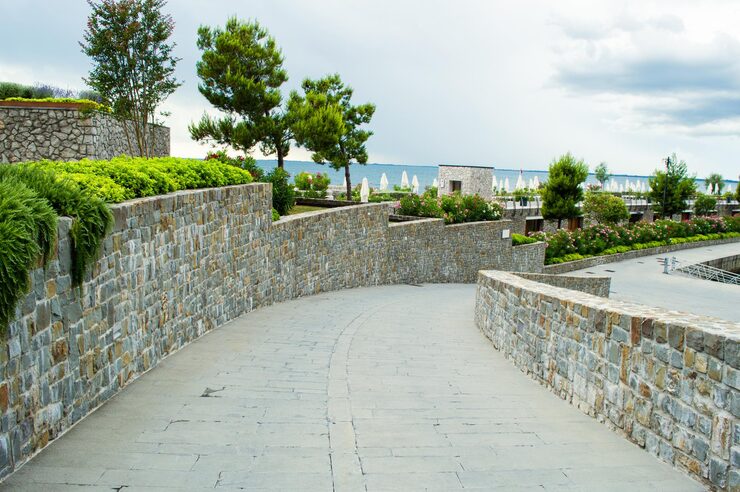
Where this suits Westwood properties
Wooded frontage lots
Long curving drives passing under mature oaks and maples benefit from edge lines that define the route and protect root zones from vehicle weight near the street.
Older homes with existing stonework
Properties with established stone walls or granite walkways gain the most from cobblestone that matches or deliberately complements what's already on site.
Corner and dual-access lots
Properties with two points of entry from the street tie together visually when matching cobblestone runs across both aprons instead of treating each separately.
So tar and chip suits a longer, gentler Westwood drive with some room around it. It is a poor match for a short, steep or shared one, or one that opens straight onto the walk.
Questions we hear
Is cobblestone edging just decorative, or does it serve a function?
Both. It defines the drive against the lawn or street, and a properly restrained edge line stops asphalt from spreading or crumbling at the margin, especially where plows catch an unprotected edge each winter.
Will tree roots eventually push up a cobblestone apron?
A root growing directly under an edge line can lift it over time. Where mature trees sit close to the drive, routing the edge line and setting base depth to account for likely root growth reduces the risk.
Can cobblestone edging be added without redoing the whole driveway?
Yes. Edging and an apron can be installed along an existing asphalt or gravel drive as a separate project, as long as the base beneath the new edge is properly excavated and compacted on its own.
How does this work differ from a standard driveway repair?
This is hardscape work focused on the street-to-drive transition and the edge detail, not a response to a failing driveway surface. The goals are drainage, appearance, and longevity rather than fixing cracks or potholes.
Next step
Call us at (413) 337-3772. Tell us about the lot, the slope and what you want the frontage to look like. We have been working in this area since 1988, and we will tell you plainly what suits your property.