
Walkway Installation in Bellingham, MA
A new front walk in Bellingham usually starts with one of two problems. On the newer subdivision streets, the builder-grade walk is a narrow slab of concrete dropped in as an afterthought, out of proportion with a wide drive and a bigger lot. On the older roads toward the Rhode Island and Woonsocket side of town, the original walk has heaved, cracked, or simply worn down over decades of frost cycles, and it no longer matches a house that has otherwise been updated. Both situations call for the same underlying work, even though the end result looks different.
A walkway is a small structure, not a surface. What holds it flat for years is almost entirely invisible once the job is done: how much soil was removed, what replaced it, how well that base was compacted, and how the edges are restrained so the whole thing cannot creep sideways. Skip any one of those steps and the walk will tell on itself within a few winters, usually as a dip near a joint or a slab that has tilted where one corner lost support.
Why this matters more in Massachusetts than it looks like it should
Ground here freezes and thaws repeatedly over a winter, not once. Water in the soil under a walkway expands as it freezes and pulls back as it thaws, and anything sitting on inconsistent support rides along with that movement. A base built to shed water and resist frost heave keeps the surface still. A base that traps water does the opposite, and no amount of surface material fixes that after the fact.
On the newer lots in Bellingham, the soil under a recently graded yard is often disturbed fill rather than settled native ground, which means it compacts unevenly unless that is addressed directly during excavation. On older lots, the original grading may be decades old and generally more settled, but mature trees and shifted plantings bring their own root pressure into the equation.
Either way, the work below the surface decides whether the walkway still looks installed, rather than repaired, five or ten winters from now. That starts with excavating deep enough to get past the topsoil and organic material that will never compact reliably, then building up a layer of crushed, compactible stone in stages rather than dumping it in all at once. Each lift gets run over with a plate compactor before the next goes down, which is slower but is the difference between a base that behaves like a solid pad and one that behaves like loose gravel with a nice surface on top.
Edge restraint matters just as much, whether the finished walk is poured concrete, dry-laid pavers, or natural stone set in a bed of stone dust. Without something locking the edges in place, paver walks in particular will widen and shift at the joints over a few seasons of foot traffic and freeze-thaw cycling, even if the base underneath was done correctly.


What Our Clients Say
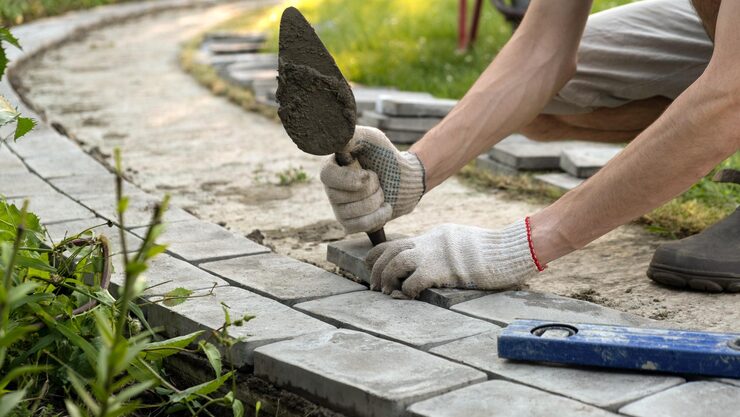
Excavation, base, and compaction
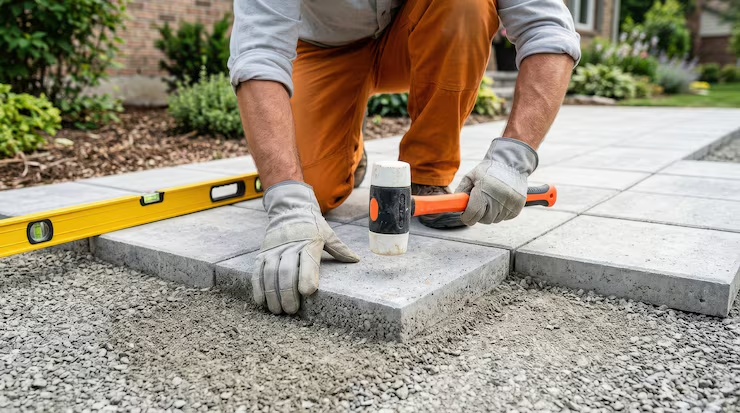
The walk is only as flat as the base beneath it. Excavating to a consistent depth, laying a compactable base material, and compacting it in stages is what resists frost heave and keeps the surface from settling unevenly over time.
Edge restraint stops the drift
Without a restrained edge, pavers and gravel migrate outward under foot traffic and frost movement. A buried edge restraint, matched to the material, holds the line of the walk straight for the long term.
Paver walkways
Pavers handle Bellingham’s freeze-thaw cycles and damp winters well because each unit can shift slightly without cracking. They’re repairable one section at a time, resist moss staining better than concrete, age gracefully, and cost more upfront than a poured walkway.
Poured concrete walkways
Concrete gives a clean, uniform look and costs less to install than pavers. It is rigid, so it needs control joints and a solid base, and a crack usually means replacing the whole panel, not a patch.
Natural stone and irregular paths
Stepping stone or irregular stone paths suit a more informal, older-house look common around Bellingham's craftsman and Victorian homes.
Matching an older Bellingham house
Homes on the older roads toward the state line often carry a simpler, more traditional front elevation.
Choosing a material
The materials are not equal. Each suits some properties and not others.
Working with a newer subdivision layout
Newer Bellingham lots tend to have wider drives and more generous setbacks. That gives more room to widen a walk, add a landing at the door, or curve the path, without crowding the foundation planting.
Pitch and drainage near the foundation
A walkway has to pitch water away from the house, not toward it. Bellingham’s wet winters make this critical—getting it wrong sends runoff straight at the foundation, causing erosion, basement seepage, and settling problems well beyond the walk itself.
Tying into the driveway edge
Where a walk meets the drive, the two surfaces need a clean, flush transition.
Tying into the entry and steps
The walk should land level and square at the front steps or landing. Any grade change at the door needs to be handled deliberately, not left as an awkward lip at the last paver or slab.
Working around trees and root systems
Mature trees on older Bellingham lots push roots under paths over time. A flexible material set on a well-prepared base tolerates minor root movement better than a rigid poured surface in the same spot.


Winter edges and plow damage
Front walks in Bellingham get shoveled and snow-blown rather than plowed, but that’s still enough to chew up a poorly built edge year after year. Snow blower augers, metal shovel lips, and edging tools all catch on pavers or concrete that sit slightly proud of the surrounding soil or lawn, chipping corners and popping units loose over a few winters of repeated use. The fix starts below grade: a properly compacted base and a hidden restraint system keep each edge locked in place so it can’t shift or heave when clearing tools scrape across it. We also set walkway surfaces very slightly recessed relative to adjacent beds and lawn edging, so blades and blower housings ride over the hardscape instead of catching its lip. For concrete walks, we pay close attention to edge thickness and control joints near entry points, since that’s where foot traffic and snow-clearing stress concentrate. The result is a walkway that still looks clean after repeated winters of Bellingham’s wet snow and freeze-thaw swings, instead of one that shows chipped corners and shifted pavers by the second season.
What drives the price
A new walk has to meet several existing things cleanly.
- The entry : The walk must arrive at the door at a sensible height. The threshold sets the finished level, so the work starts at the door and runs outward.
- The drive : Where a walk meets a drive, the levels and the drainage have to agree. A mismatch becomes a trip edge or a puddle.
- Walls and planting : Existing stone walls, foundation beds and mature trees constrain the route. Roots under a path are worked around, not cut through without thought.
- An older house : Scale, colour and pattern should follow the architecture. A narrow, dark stone walk suits an old house differently than a broad paver field does.

Where walkway work fits in Bellingham
Bellingham’s mix of property types makes this a town where walkway work varies more than most. On the newer subdivision streets, lots were graded as a single parcel, drives are wide, and there is usually enough room to build a walk that is proportioned to the house rather than the minimum the builder installed. Soil on these lots is often recently placed fill, which needs real compaction attention rather than an assumption that it will settle on its own.
On the older rural roads toward the Rhode Island line, lots tend to be larger and less uniform, often with mature trees, established plantings, and a walk that was laid decades ago and has since heaved or cracked. Replacing that walk is usually about matching the character of an older home while fixing a base that was never built to modern compaction standards in the first place.
Neither situation is simpler than the other. They just call for different decisions about material, width, and how the new path sits against what already exists on the property.
Before you call
It helps to know:
- Where the walk starts and where it needs to end
- Whether the route crosses a slope or a shared area
- Which material you lean towards, and whether the house is older
- Where water currently runs on the property
Questions people ask
How long does a walkway installation take in Bellingham?
A straightforward front walk can often be done in a short run of consecutive dry days, while a larger path system tying into a patio or drive takes longer. Excavation, base work, and curing time for the material chosen all factor in, and a site visit is the only honest way to scope it.
Can a new walkway be built around existing trees or plantings?
Yes, but roots change the plan. Large surface roots near older plantings on established Bellingham lots sometimes mean shifting the path line slightly or using a material that can be lifted and reset later without a full rebuild.
What is the difference between paver and poured concrete walkways in terms of frost?
Pavers are individual units set on a compacted base with sand joints, so they can move slightly with frost and settle back without cracking. Poured concrete is a rigid slab, so it needs control joints and a solid base or it cracks where the ground moves unevenly beneath it.
Will a new walkway match an older Bellingham home?
It can, with the right material and edge choice. Older homes near the state line often suit a more traditional material and simpler edge line, while newer subdivision homes have more flexibility to take a cleaner, more modern path design.
Next step
Call Driveway Specialists on (413) 337-3772. We are a family-run company in business since 1988, and we will walk the route with you and talk through material, grade and drainage before anything is priced.