
Walkway Installation in Foxborough, MA
Foxborough lots run larger than most of its MetroWest neighbors, and that changes what a front walk needs to do. On a subdivision property, the path is often the longest visible run on the lot — it has to carry the eye from driveway to door without looking like an afterthought. Further south, where the roads get narrower and the grades steepen toward the Rhode Island line, the same walkway has a second job: managing water that’s moving faster across the property because the ground isn’t flat.
This is not driveway work, and it shouldn’t be priced, designed, or built like it. A walkway is a smaller surface carrying foot traffic, not vehicle loads, so the base doesn’t need the depth or compaction a driveway does — but it still has to resist New England frost, and it still has to drain, or it will heave, settle, and crack within a few winters.
What’s Under the Surface Decides Everything
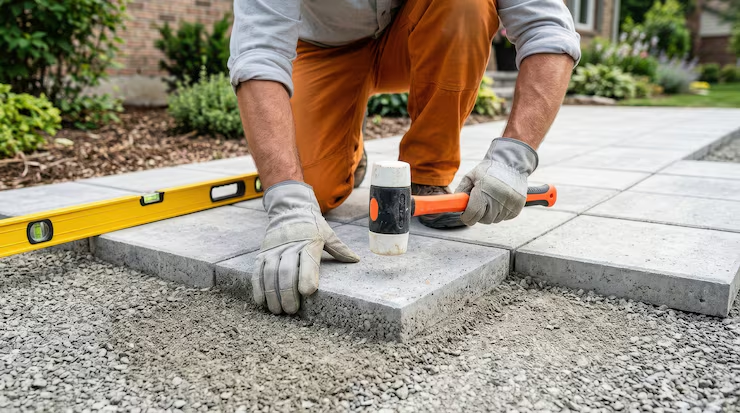
Every walkway failure we get called out to look at in this part of Norfolk County comes down to the same cause: water got under the surface and froze. The fix is built in before a single paver or slab goes down. We excavate to a consistent depth, lay a compacted base that lets water pass through rather than pool, bed the surface material correctly for what it is, and set edge restraint that holds the line instead of letting it creep outward over a few seasons.
Skip any one of those steps and the walkway still looks fine the first year. The frost finds the weak point the second or third winter — a dip where water collected, a lifted edge, a joint that’s opened up. On the sandier soils common across Foxborough’s newer subdivisions, a properly built base drains well and stays put. On the heavier ground found in some of the older, lower-lying parcels, drainage has to be deliberate rather than assumed.
Material choice matters just as much as what’s underneath it, and the materials aren’t interchangeable. Natural stone looks the best as it ages and is the easiest to repair in sections, but it costs more and takes longer to lay well. Pavers give you a consistent, repeatable surface and individual units can be lifted and reset if one settles, which makes long-term maintenance simpler. Poured concrete is the most economical option for a straight, simple run, but it moves as one piece — a single crack runs the full slab, and there’s no fixing one section without redoing the pour.
None of that is a reason to avoid concrete or to assume stone is always right. It’s a reason to match the material to the house, the budget, and how much hands-on upkeep the owner wants to do down the line.


What Our Clients Say
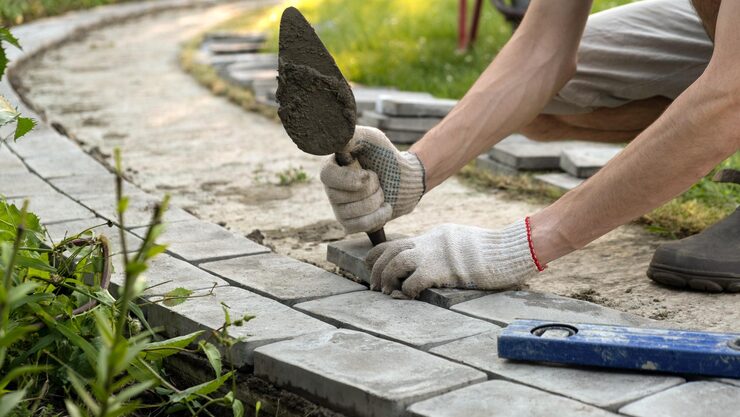
Grade and Drainage Come First
Water always wins, so the walkway has to lose gracefully — pitched away from the house and foundation, never toward it. On Foxborough’s steeper southern grades, that pitch gets planned before excavation starts, not corrected after the base goes in.
Reading the Lot Before Digging
On a flat subdivision yard, grading mistakes are forgiving. On a sloped rural lot, a half-inch of wrong pitch sends water toward the house instead of away from it. We check both before cutting in a base.
Matching an Older Entry
Some Foxborough homes have original stone steps or a mismatched concrete stoop. A new walkway should tie into that entry cleanly, not clash with it, even when the materials being joined were never meant to match.
Tying Into the Driveway
Where the walkway meets the drive, the transition has to be level and the materials have to read as a pair, not a patch. We plan that joint early, before either surface is cut in.
Working Around Mature Trees
Larger Foxborough lots often carry established oaks and maples close to the front walk.
Edge Restraint in Freeze-Thaw
Without a proper edge, pavers migrate outward every winter as Foxborough's clay-heavy soil heaves and settles.
Choosing a material
The materials are not equal. Each suits some properties and not others.
Stone for a Traditional Look
Natural stone suits Foxborough’s older farmhouse-style homes particularly well. Fieldstone and bluestone both weather gracefully rather than wear out, and a cracked or sunken section can be lifted and reset without disturbing or rebuilding the rest of the walkway.
Pavers for Consistency
Concrete pavers give a uniform look across a long run and come in enough finishes to suit a newer Foxborough subdivision build.
Concrete for Simplicity
For Foxborough homeowners wanting a straight, simple path from driveway to door, poured concrete remains the most budget-friendly choice. It’s a single slab, though, so once it cracks, that crack runs the full length—there’s no patching just one section.
Steeper Southern Lots
Toward the rural southern end of Foxborough, grade does more work than material choice.
Subdivision Frontage
On newer subdivision lots, the walkway is often the most visible hardscape on the property. A clean layout and a material that complements the house front matter more here than anywhere else on the lot.


Why the Base Outlasts the Surface
A walkway rarely fails because the surface material was wrong. It fails because what’s underneath it couldn’t handle a Massachusetts winter. Frost doesn’t push evenly — it lifts wherever moisture has collected under the base, which is why a walkway can look perfectly flat in October and show a dip or a raised joint by March. A compacted, well-drained base resists that because there’s no standing water to freeze and expand in the first place.
This is also where corners get cut on cheaper installs. A thin base compacted quickly looks identical to a proper one on installation day. The difference only shows up after the ground has gone through a full freeze-thaw cycle, by which point the work is done and the only fix is to pull up the surface and start again. We build the base to the depth the material and the soil actually call for, not to whatever gets the crew off the job fastest. On Foxborough’s mix of sandy subdivision soil and heavier ground on the older lots, that means reading each site rather than applying one spec everywhere.
What drives the price
A new walk has to meet several existing things cleanly.
- The entry : The walk must arrive at the door at a sensible height. The threshold sets the finished level, so the work starts at the door and runs outward.
- The drive : Where a walk meets a drive, the levels and the drainage have to agree. A mismatch becomes a trip edge or a puddle.
- Walls and planting : Existing stone walls, foundation beds and mature trees constrain the route. Roots under a path are worked around, not cut through without thought.
- An older house : Scale, colour and pattern should follow the architecture. A narrow, dark stone walk suits an old house differently than a broad paver field does.

Getting Started on Your Walkway
A new walkway is a permanent, visible part of the property, so it’s worth getting the planning right before any excavation starts. That means walking the site with you, looking at how the land actually drains, where mature trees sit, and how the new path needs to meet your driveway and entry. It also means an honest conversation about materials — what suits the house, what fits the budget, and what you’re willing to maintain, rather than what looks best in a brochure photo.
Foxborough’s mix of larger subdivision lots and steeper rural grades means no two walkway jobs here look the same. A path that works on a flat quarter-acre lot near the town center can fail within a couple of winters on a sloped property near the Rhode Island line if the drainage plan doesn’t account for the grade. We’ve been doing this kind of hardscape and paving work across Norfolk, Middlesex, and eastern Worcester counties since 1988, as a family-run crew that builds the base first and the surface second, because that’s the order that actually holds up.
Before you call
It helps to know:
- Where the walk starts and where it needs to end
- Whether the route crosses a slope or a shared area
- Which material you lean towards, and whether the house is older
- Where water currently runs on the property
Questions people ask
Can a walk be built on a steep Foxborough lot?
Yes. The route usually changes. It may zigzag, step up in stages or include landings. The base and drainage matter more on a slope, not less.
Do I need the walk pitched away from the house?
Yes. A walk that falls toward the foundation sends water to the wrong place. The pitch is gentle and almost invisible.
Pavers or poured concrete?
Pavers can be lifted and reset if the ground moves. Concrete cannot be repaired cleanly once it cracks. Concrete is simpler for a long straight run, and pavers allow more variety and easier repair.
Can you match a walk to an older house?
Usually. Material, colour, scale and pattern all matter, and we can talk through what suits the architecture before anything is ordered.
Why does the base matter more than the surface?
Frost lifts what sits above it. A deep, well-compacted, free-draining base gives frost nothing to work with, and that is why a well-built walk stays flat.
What does a walkway cost?
It depends on length, material, slope and access. We quote after seeing the site.
Next step
Call Driveway Specialists on (413) 337-3772. We are a family-run company in business since 1988, and we will walk the route with you and talk through material, grade and drainage before anything is priced.