
Walkway Installation in Framingham, MA
Framingham doesn’t have one kind of front yard, and that’s the point. North of the Pike, two-family houses sit close to the sidewalk with barely a strip of lawn between porch and street. The post-war subdivisions in the middle of town have the standard setback and a straight shot from driveway to door. South toward Saxonville and the Sudbury line, lots open up and a front walk can mean thirty or forty feet of path across real grade. A walkway that works on one of these does not automatically work on another, and that’s before you get to what’s underneath any of them.
Most people call about a walkway because the existing one has gone wavy, sunk at the joints, or never matched the house to begin with. A few are planning new landscaping and want the path designed before the planting goes in. Others are dealing with a walkway that was poured or laid by whoever built the house decades ago, with no base to speak of, and it’s finally failing in ways patching can’t fix. Either way, the decision that matters most happens before any material gets chosen: what goes in the ground, and how it’s built to move with New England frost instead of against it.
What’s actually under a good walkway
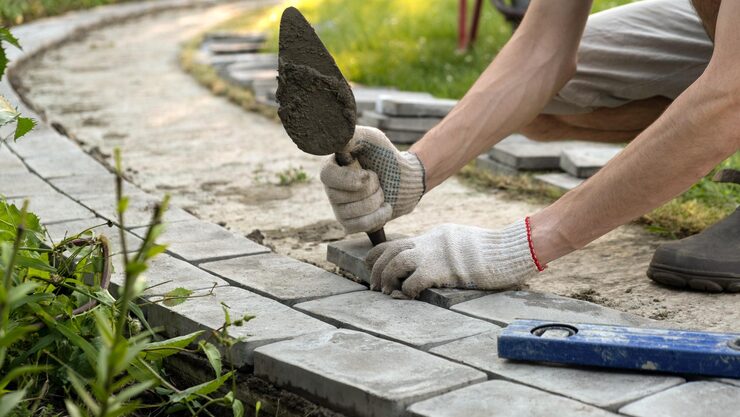
A walkway that stays flat for years starts with excavation deep enough to get below the topsoil and organic material that shifts with moisture. On top of that goes a compacted gravel base, built up in layers and compacted as it goes, not dumped in all at once and tamped once at the end. The base does the real work: it drains water away from the surface and gives the walkway something stable to sit on when the ground below it freezes and heaves every winter.
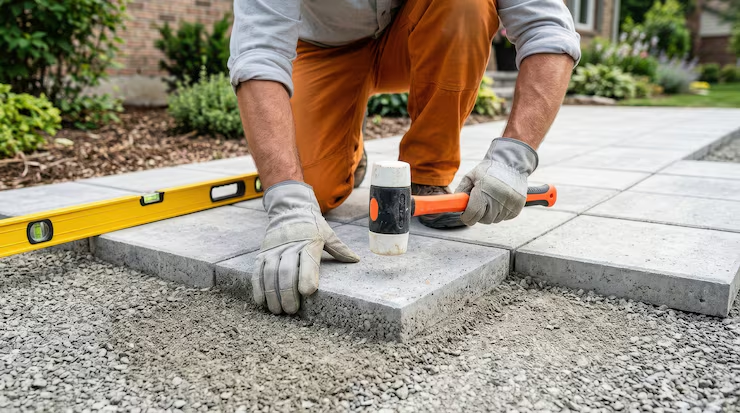
Bedding sand or stone dust goes over the base to create a level setting bed for pavers or stone. Edge restraint, buried along both sides, is what keeps that bedding layer from spreading sideways under foot traffic and plow-thrown snow. Skip any one of these steps and the surface may look fine the first season. By the second or third freeze-thaw cycle, joints open, pavers rock, and poured concrete develops the stair-step cracks that run along a weak control joint.
Framingham’s mixed soils make this more than a formality. Some lots sit on well-drained glacial sand; others, especially closer to the Sudbury River and low-lying parcels, hold water longer after a storm. The base has to be built for the ground it’s actually sitting on, not a generic spec.
Layout matters just as much as what’s buried. A walkway that cuts the shortest line from driveway to door isn’t always the right call if it crosses a low spot, runs tight against a foundation planting bed, or ignores where people actually walk once snow is on the ground. Good layout accounts for:


What Our Clients Say
Choosing a material honestly
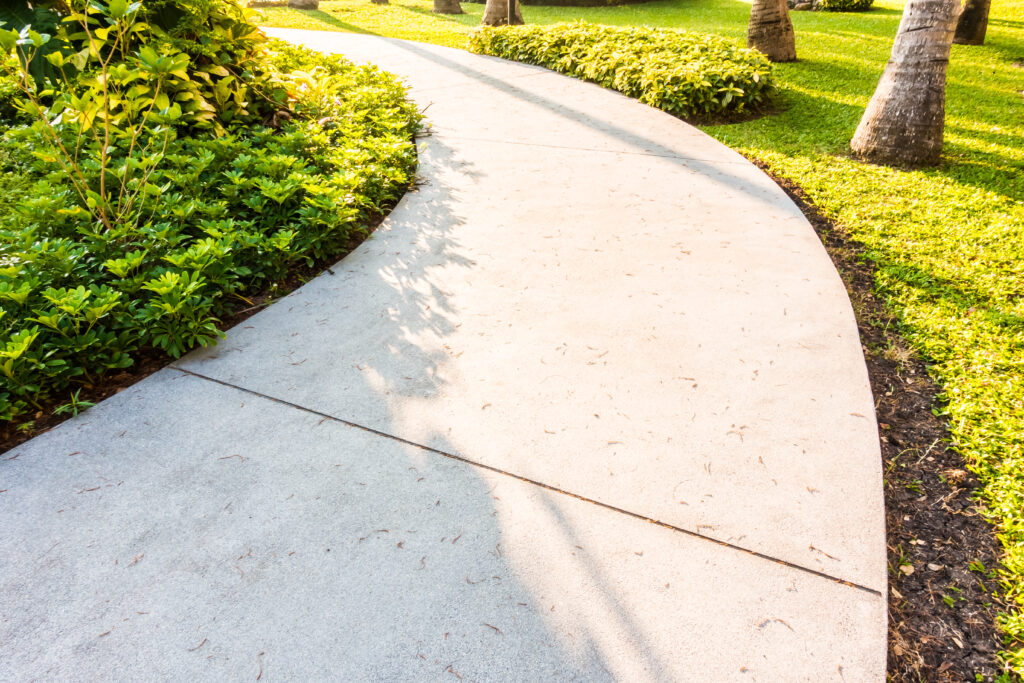
Concrete is cheapest but cracks visibly. Pavers cost more, flex with freeze-thaw, and repair easily paver by paver. Natural stone suits Framingham’s colonials and capes near the center, Saxonville, and Nobscot—priciest, but it ages into the property.
Where water goes next
Every hard surface changes where rain goes. A walkway that pitches toward the foundation instead of away from it will eventually send water into a basement or crawl space, no matter how good the material looks.
Tying into the driveway
Your walkway almost always meets the driveway somewhere, and that junction deserves a clean transition or deliberate edge, not an abrupt stop.
Matching the entry
The last few feet of walkway, where it meets the steps or porch, get noticed most. Matching pitch, width, and landing to the existing entry keeps the whole Framingham approach looking built on purpose, not added later.
Working around older houses
Framingham has plenty of colonials and capes with established foundation plantings and mature trees close to the front of the lot. Walkway work here means routing around roots and existing beds rather than clearing a straight line through them.
Narrow city lots
On the dense two-family streets north of downtown, a front walk often spans just a few feet from sidewalk to porch.
Choosing a material
The materials are not equal. Each suits some properties and not others.
Suburban straight shots
In the mid-town subdivisions, most walks run a short, direct line from driveway or sidewalk to the front door. The job here is less about routing and more about a clean, level base that won’t move under regular foot traffic.
Larger south-side lots
South toward Saxonville and the Sudbury line, longer front walks cross real grade and sometimes connect multiple areas of the yard. These benefit from a design that considers drainage across the whole path, not just at the ends.
Edge restraint and winter
Plows and shovels catch unprotected walkway edges every winter. Buried edge restraint keeps pavers and stone from creeping outward over seasons of snow clearing, which is often the real cause of a walkway that looks wider and sloppier every year.
Stone dust versus poured base
A stone dust setting bed over compacted gravel gives pavers and natural stone a stable, slightly flexible surface. Poured concrete needs its own engineered base underneath, since the slab itself has no give once it cures.
Planning before planting
If new landscaping is coming, the walkway should go in first or at least get designed alongside it. Changing a path’s width or route after beds and shrubs are in means redoing work that didn’t need redoing.


A note on repair versus replacement
Not every uneven walkway needs to come out entirely. A section that’s heaved from a single large root or a spot where the base failed locally can sometimes be cut back and rebuilt without touching the rest of the path. This depends on the material: pavers lend themselves to partial repair because individual units lift and reset cleanly, while poured concrete usually means replacing the whole panel between joints since there’s no way to patch a slab invisibly. Natural stone falls somewhere between the two, depending on how it was originally set.
Before recommending a full replacement, it’s worth having someone look at what’s actually failed underneath. A walkway with good bones and one bad section is a different job, and a different cost, than one where the base was never built correctly from the start. On older Framingham properties where a walk has been patched more than once already, that history usually tells you which problem you’re dealing with.
What drives the price
A new walk has to meet several existing things cleanly.
- The entry : The walk must arrive at the door at a sensible height. The threshold sets the finished level, so the work starts at the door and runs outward.
- The drive : Where a walk meets a drive, the levels and the drainage have to agree. A mismatch becomes a trip edge or a puddle.
- Walls and planting : Existing stone walls, foundation beds and mature trees constrain the route. Roots under a path are worked around, not cut through without thought.
- An older house : Scale, colour and pattern should follow the architecture. A narrow, dark stone walk suits an old house differently than a broad paver field does.

Getting started
A walkway project starts with a look at the actual site: the soil, the grade, what’s already built, and what the house calls for. From there the base work, material choice, and drainage plan come together as one job rather than a list of separate decisions made on the fly.
Driveway Specialists has worked across Framingham and the surrounding MetroWest towns for more than 35 years as a family-run contractor, building walkways that are planned to handle the ground they sit on rather than just the look of the day they’re installed. Whether it’s a tight entry walk on a two-family lot or a longer path across a larger property south of town, the approach starts the same way: get the base right, get the water moving the right direction, and build a surface that ties into the house instead of looking dropped onto it.
If you’re planning a new walkway or dealing with one that’s heaved, cracked, or never looked right, call Driveway Specialists at (413) 337-3772 to talk through what your property actually needs.
Before you call
It helps to know:
- Where the walk starts and where it needs to end
- Whether the route crosses a slope or a shared area
- Which material you lean towards, and whether the house is older
- Where water currently runs on the property
Questions people ask
Can a walk be built on a steep Framingham lot?
Yes. The route usually changes. It may zigzag, step up in stages or include landings. The base and drainage matter more on a slope, not less.
Do I need the walk pitched away from the house?
Yes. A walk that falls toward the foundation sends water to the wrong place. The pitch is gentle and almost invisible.
Pavers or poured concrete?
Pavers can be lifted and reset if the ground moves. Concrete cannot be repaired cleanly once it cracks. Concrete is simpler for a long straight run, and pavers allow more variety and easier repair.
Can you match a walk to an older house?
Usually. Material, colour, scale and pattern all matter, and we can talk through what suits the architecture before anything is ordered.
Why does the base matter more than the surface?
Frost lifts what sits above it. A deep, well-compacted, free-draining base gives frost nothing to work with, and that is why a well-built walk stays flat.
What does a walkway cost?
It depends on length, material, slope and access. We quote after seeing the site.
Next step
Call Driveway Specialists on (413) 337-3772. We are a family-run company in business since 1988, and we will walk the route with you and talk through material, grade and drainage before anything is priced.