
Walkway Installation in Holliston, MA
A lot of Holliston properties sit back from the road on rolling ground, with the driveway climbing toward the house and the front door reached by whatever path happened to form over the years — a strip of grass worn bare, a few old stepping stones, or a slab that was never really planned. A new walkway is usually less about fixing a problem and more about making the approach to the house match the house: a clear line from the driveway or the street to the front door that looks like it was designed rather than accumulated.
On wooded lots, that line has to deal with shade, root systems, and a grade that rarely runs flat for more than a few feet. On the rolling terrain common around town, a walkway often has to step down or up to meet an entry, which changes how it needs to be built, not just how it looks. A path that crosses a slope needs steps, a landing, or a gentle switchback worked into the layout — details that have to be settled before any material gets ordered, not adjusted after the fact.
What’s Actually Under a Good Walkway
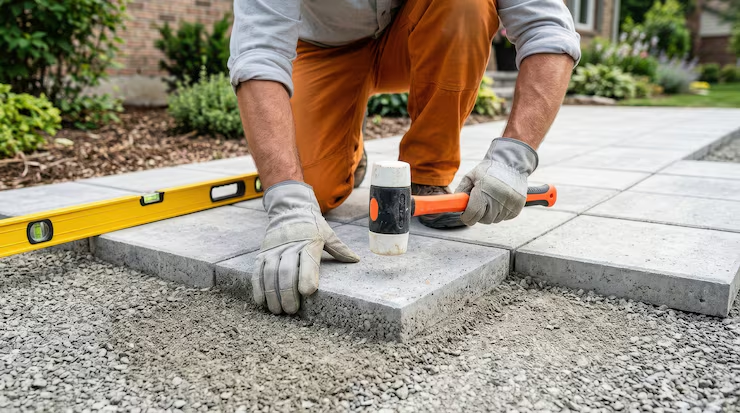
The visible surface is the smallest part of the job. What holds a walkway flat through a Massachusetts winter is the work done before any stone or paver goes down: excavating below frost-sensitive topsoil, laying a compacted gravel base, setting bedding material to the right depth, and installing edge restraint that keeps the whole assembly from creeping sideways as the ground freezes and thaws. Skip any one of those steps and the walkway will still look fine the first year. By the third or fourth winter, frost heave finds the weak point — a low spot that holds ice, an edge with no restraint, a base that wasn’t compacted enough to resist movement — and that’s where the surface starts to wave, settle, or crack.
Frost in this part of Massachusetts doesn’t move the ground evenly. It moves wherever moisture collects and freezes, which is why drainage and base work matter more than the surface material in determining how long a walkway stays flat. A walkway that runs alongside a foundation or under a roofline without gutters needs extra attention to where runoff goes, since that’s exactly the kind of spot where water collects, freezes, and starts lifting pavers out of line.
Roots are the other factor particular to wooded lots like many in Holliston. A walkway built too close to a mature oak or maple will eventually get pushed by root growth underneath, no matter how good the base is. Part of planning the route is deciding where to hold the path back from a tree line versus where it’s fine to run close, and building the edge restraint to allow for some future movement without the whole walkway failing at once.


What Our Clients Say
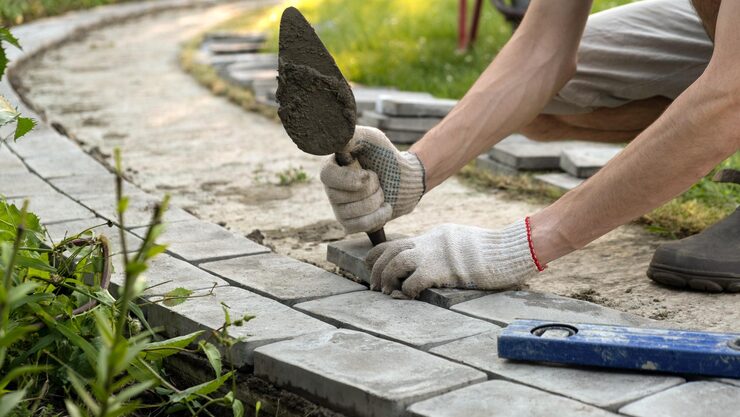
Materials And What They Actually Trade Off
Natural stone, concrete pavers, and poured concrete all handle a Massachusetts freeze-thaw cycle differently, and none is the right answer for every Holliston house.
Natural stone ages beautifully and suits Holliston's older, wooded properties, but individual pieces can shift with New England frost heave and need periodic resetting.
Concrete pavers are the most repairable option for Holliston walkways: a single heaved or cracked unit lifts out and resets without disturbing the rest of the path, which matters on root-heavy, tree-lined lots common throughout town.
Poured concrete gives a clean, formal line that suits Holliston's newer builds, but a crack in a monolithic slab isn't a spot repair — it usually means replacing the full panel, which costs more than planning joints correctly from the start.
Gravel or stone-dust paths cost less and drain well under tree canopy, but they need occasional topping up and aren’t ideal on a steep grade.
Drainage Decides More Than The Surface Does
Once a hard surface goes down, water that used to soak into lawn has to go elsewhere.
Choosing a material
The materials are not equal. Each suits some properties and not others.
Pitching a walkway away from the foundation isn't a finishing touch — it's part of the layout from the start, especially on Holliston's sloped lots, where runoff already drains toward the house and poor grading invites standing water and cracked pavers.
On Holliston’s rolling, often ledgy lots, a walkway sometimes needs a shallow swale alongside it to carry water off to the side, rather than letting the path itself become a channel during heavy New England downpours and spring thaw.
Tying Into What's Already There
A walkway rarely stands alone. It has to connect sensibly to the driveway edge, step up to a front entry, and sit comfortably next to existing walls, planting beds, or a stoop that was built years before.
Matching an older Holliston house means picking a material, scale, and joint pattern that reads as original to the property—brick, bluestone, or irregular fieldstone—not an obvious add-on sitting awkwardly against a different-era driveway, porch, or stone foundation.
Where a walkway meets the driveway, the transition needs a clean, stable edge so the two surfaces don’t shift independently of each other over time.


Where This Work Fits Holliston Properties
Holliston's wooded lots, rolling terrain, and driveways that climb from the road all point toward the same set of decisions: a walkway route that works with the grade instead of fighting it, a base built to handle frost on uneven ground, and edge restraint sized for root pressure near mature trees. Houses near the rail-trail corridor and the quieter residential streets off it tend to have longer, more informal approaches from driveway to door, which is exactly the kind of layout where getting the base and drainage right the first time saves a rebuild later. Properties closer to downtown and the town common often deal with tighter lots and established plantings, where a walkway has to be routed around existing landscaping rather than through open ground, and where matching an older home's look matters as much as function. A short, flat entry walk near the street is a simpler job; a path that winds up a slope through tree roots to reach a raised entry is a different scope of work, with excavation, steps, and drainage all factoring into the plan.
What drives the price
A new walk has to meet several existing things cleanly.
- The entry : The walk must arrive at the door at a sensible height. The threshold sets the finished level, so the work starts at the door and runs outward.
- The drive : Where a walk meets a drive, the levels and the drainage have to agree. A mismatch becomes a trip edge or a puddle.
- Walls and planting : Existing stone walls, foundation beds and mature trees constrain the route. Roots under a path are worked around, not cut through without thought.
- An older house : Scale, colour and pattern should follow the architecture. A narrow, dark stone walk suits an old house differently than a broad paver field does.

Planning The Route Before Picking Materials
It helps to walk the property and settle on where the path actually needs to go — shortest line to the door isn’t always the right line once you account for slope, tree roots, and how the path will be used in winter when footing matters most. Getting this sequence right the first time means fewer surprises once excavation starts and the base goes in.
From there, material choice follows the site rather than leading it. A steep or shaded section might call for a different surface than a flat, sunny stretch of the same walkway, and mixing materials thoughtfully — stone steps where the grade rises, pavers on the flat run — is often a better answer than forcing one material to do a job it’s not suited for.
Driveway Specialists has worked on properties across Middlesex County for over 35 years, including the wooded, sloped lots typical of Holliston, and can walk a property with you to talk through what the ground actually calls for before any work is quoted.
Before you call
It helps to know:
- Where the walk starts and where it needs to end
- Whether the route crosses a slope or a shared area
- Which material you lean towards, and whether the house is older
- Where water currently runs on the property
Questions people ask
How long does a new walkway take to install?
It depends on the length, the grade, and how much excavation and base work the site needs. A short, flat walk goes faster than a long path that climbs a slope or winds around mature trees.
Can you build a walkway around tree roots without harming the tree?
Often yes, by routing the path to avoid major roots and adjusting the base depth near the tree line. It's something we look at during the site visit, since every tree and lot is different.
Which material holds up best to Massachusetts winters?
Each material handles freeze-thaw differently rather than one being simply best. Concrete pavers are the easiest to repair if frost shifts a section; natural stone ages well but may need occasional resetting; poured concrete gives a clean look but repairs as full panels, not spot fixes.
Do you also handle the driveway connection when installing a walkway?
Yes. Tying the walkway edge cleanly into the existing driveway is part of the layout work, so the two surfaces meet properly and don't shift apart over time.
Will a new walkway change how water drains near my house?
It can, since a hard surface sheds water that used to soak into soil or lawn. Pitching the walkway away from the foundation and, where needed, adding a shallow drainage path alongside it is built into the layout from the start.
Next step
Call Driveway Specialists on (413) 337-3772. We are a family-run company in business since 1988, and we will walk the route with you and talk through material, grade and drainage before anything is priced.