
Walkway Installation in Lexington, MA
Most of the walkway work we see in Lexington isn’t a repair job. It’s a homeowner with a mid-century colonial or cape, a front lawn that’s looked the same since the house was built, and a walk from the driveway or street to the front door that’s either cracked asphalt, tired concrete, or just a worn path in the grass. The goal is usually the same: something that looks right against an older house, handles the front entry properly, and doesn’t heave apart after a few Massachusetts winters.
A walkway is a smaller job than a driveway, but it’s not a simpler one. There’s less room for error in the layout, more of it is visible up close, and it has to work with whatever is already on the property, not instead of it.
What’s actually under a walkway that lasts
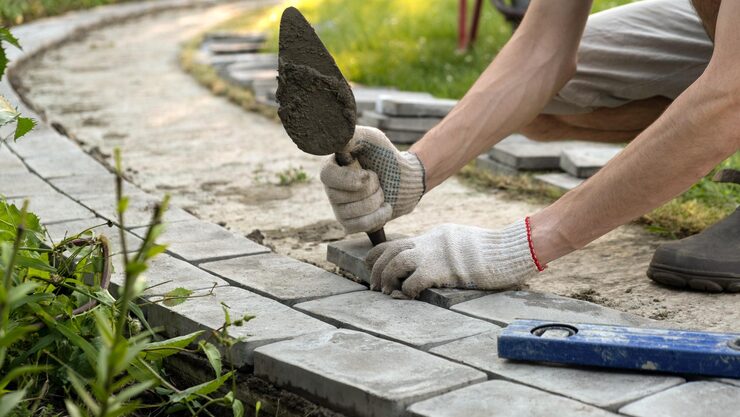
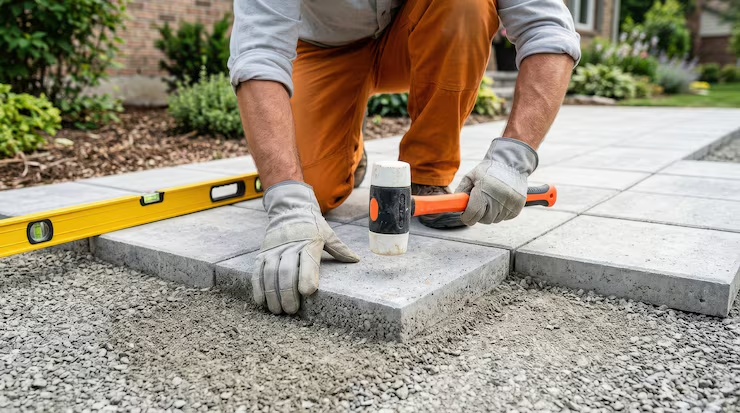
Everything that matters is below grade. We excavate to a depth that gets past the topsoil and organic material, which doesn’t compact and won’t support anything long-term. Underneath, a compacted gravel base does two things: it spreads load so the surface doesn’t settle unevenly, and it gives water somewhere to go instead of sitting under the stone or pavers and freezing.
That freezing is the part that wrecks walkways built without a proper base. Water in the soil expands as it freezes and pushes upward unevenly, because moisture content and soil density are never perfectly uniform across a path. One section heaves, the next doesn’t, and the walkway that looked flat in October looks like a wave by March. A compacted base drains before that water has a chance to sit and freeze in place, and edge restraint keeps the whole assembly from spreading sideways as the ground moves. Bedding sand underneath the surface material gives a consistent, adjustable layer so individual stones or pavers can be reset if one does shift, without rebuilding the whole path.
None of this shows once the job is done. It’s also the entire reason one walkway is still flat in ten years and another one isn’t.
Matching what’s already there
Lexington has a lot of older housing stock, and a walkway that looks grafted onto a 1950s cape instead of built for it is an obvious miss. Material, joint pattern and edge detail all need to read as belonging to the house, not just sitting in front of it. We look at the front door, the existing foundation plantings, and any stone or brick already on the property before recommending a material, because matching those is often more important than the material itself.


What Our Clients Say
Materials: the real trade-offs
Natural stone, concrete pavers, brick and poured concrete all handle a Lexington winter differently, and they age differently too.
Natural stone ages beautifully and suits Lexington’s older homes, but it costs more upfront, and irregular pieces take longer to set correctly, especially around curves, steps, or tight garden paths where precise cuts and fitting really matter.
Concrete pavers are more consistent to install and individual units can be lifted and reset if Lexington's winter frost heave moves one, making long-term repair simpler than with poured surfaces.
Brick suits Lexington’s colonial and Georgian-style homes especially well, lending classic curb appeal. However, it’s more prone to spalling from our region’s freeze-thaw cycling than stone or dense pavers, so proper base preparation and drainage matter for lasting walkway durability.
Poured concrete is the cheapest walkway option upfront, but Lexington's freeze-thaw winters make it crack as one rigid slab rather than flexing at joints like pavers.
Drainage comes before design
Any hard surface changes where water goes.
Choosing a material
The materials are not equal. Each suits some properties and not others.
Grade has to carry water away from the house, not just off the walkway.
Tying into what's already built
A walkway rarely stands alone. It meets the driveway apron, steps up to the entry, and often runs past existing walls, beds, or utility covers.
Where a new walk meets an existing driveway edge or a stone retaining wall, the transition has to be planned, not improvised, or you end up with a visible seam that collects water and debris.
Trees and roots
Mature oaks and maples are common across Lexington's older lots, and roots don't stop at a property line or a planned path.
A root under a flexible paver or stone walkway in Lexington can be worked around or the affected section lifted and reset later.


Where this fits in Lexington
Lexington’s housing stock of mid-century colonials, capes and a handful of older homes near the center means walkway work is often about proportion and period as much as function. A front walk that’s too wide or finished in the wrong material looks wrong against a modest colonial facade even if it performs fine structurally. Front walk width, material, and how it meets the entry steps all get judged against the house itself, and on established lots with mature trees overhead, root movement and shade-driven dampness both factor into material choice more than they would on a newer, open lot.
Historic-district proximity near the center means some properties carry more weight on getting the look right, even without a formal design review requirement attached to the work itself. We treat that as a design input, not a complication: the walkway should look like it was always part of the house.
What drives the price
A new walk has to meet several existing things cleanly.
- The entry : The walk must arrive at the door at a sensible height. The threshold sets the finished level, so the work starts at the door and runs outward.
- The drive : Where a walk meets a drive, the levels and the drainage have to agree. A mismatch becomes a trip edge or a puddle.
- Walls and planting : Existing stone walls, foundation beds and mature trees constrain the route. Roots under a path are worked around, not cut through without thought.
- An older house : Scale, colour and pattern should follow the architecture. A narrow, dark stone walk suits an old house differently than a broad paver field does.

Next step
If you’re planning a new front walk, replacing a cracked concrete path, or want a walkway that actually matches an older Lexington home instead of fighting it, we start by walking the property with you. That means looking at the lot’s grading, the existing driveway and entry, the mature trees overhead, and how water moves across the yard after a storm before we ever recommend a material. A walkway near a stone foundation or a colonial-style entry calls for different edging and finish than one running past a newer build, and root systems from old oaks and maples common around Lexington can shift a path if the base isn’t prepared correctly.
- Options to discuss: brick, natural stone, pavers, or poured concrete
- Considerations: slope, drainage, tree roots, and matching existing hardscape
- Outcome: a plan suited to your home’s age and layout, not a generic template
Call Driveway Specialists at (413) 337-3772 to talk through what your property actually needs before any work begins.
Before you call
It helps to know:
- Where the walk starts and where it needs to end
- Whether the route crosses a slope or a shared area
- Which material you lean towards, and whether the house is older
- Where water currently runs on the property
Questions people ask
How long does a walkway installation take?
It depends on length, material and site access, but a typical front walk is a short job compared to driveway work. We'll give you a realistic timeframe once we've seen the layout and chosen a material.
Can you match an existing patio or stone wall?
Often, yes. We look at what's already on the property, including wall stone, existing pavers or brick, and the house itself, before recommending a material so the new walkway reads as part of the property rather than an add-on.
Will tree roots damage a new walkway?
Mature trees are common on older Lexington lots, and roots do move over time. Flexible materials like pavers or natural stone set in a compacted base can be reset locally if a root causes movement, which is harder to manage with poured concrete.
Do you handle the drainage, or just the walkway surface?
Grading and drainage are part of the same job. A walkway has to pitch water away from the house and work with the drainage patterns already established on the lot, so we plan that before any excavation starts.
What's the most durable material for Massachusetts winters?
There's no single answer, since it depends on your budget, the look you want, and how much long-term maintenance you're willing to do. We'll walk through the trade-offs between stone, pavers, brick and concrete for your specific property.
Next step
Call Driveway Specialists on (413) 337-3772. We are a family-run company in business since 1988, and we will walk the route with you and talk through material, grade and drainage before anything is priced.