
Walkway Installation in Lincoln, MA
A lot in Lincoln is rarely a small, square frontage with a straight shot from curb to front door. More often it’s acres of conservation-abutting woodland, a long gravel or asphalt drive winding in from the road, and a house that sits well back from view. The walkway problem here isn’t usually “we need a path” – it’s “we need a path that looks like it’s always been part of this property, doesn’t fight the trees, and won’t heave apart every winter.”
That last part is the one most people underestimate. A walkway is a small, simple-looking thing on the surface, but what makes it last – or fail – happens below grade, before a single paver or slab goes down.
What’s actually under a good walkway
Massachusetts ground freezes and thaws repeatedly through the winter, and that cycle moves whatever is under the surface. Water in the soil expands as it freezes, pushes upward, then drops back when it thaws. Do this forty or fifty times a season and anything resting on unprepared soil will eventually tilt, heave, or crack.
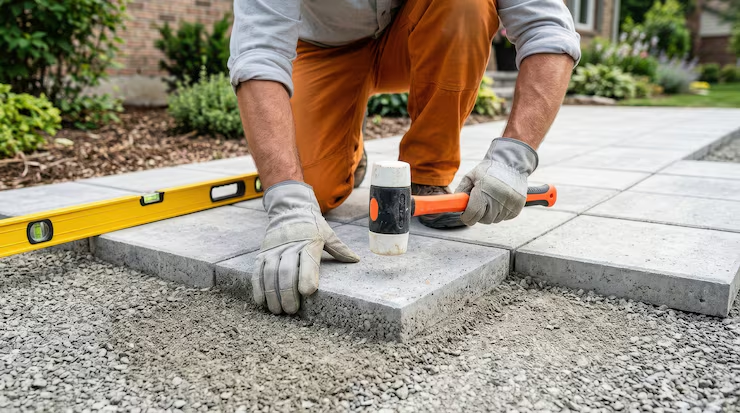
The fix isn’t a thicker top layer – it’s proper excavation below the frost-affected zone, a compacted base of crushed stone that drains instead of holding water, and a bedding layer that lets the surface material sit stable and level. Edge restraint matters just as much: without it, the sides of a paver or stone path creep outward year by year until the whole thing loosens. This is the difference between a walkway that still reads flat after a decade and one that looks like a wave frozen mid-motion.
On a lot like the ones common in Lincoln – long run from drive to door, tree roots nearby, and soil that’s often a mix of glacial till and ledge rather than clean sand – that base work takes more judgment than on a flat suburban lot. Roots from mature oaks and maples don’t stop at the property’s planting beds; they run under lawns and into where a path wants to go. Cutting through root zones without killing the tree, or routing around them without making the path look like it’s dodging something, is a design decision as much as a construction one.
Grade matters too. Water has to go somewhere once a hard surface sits on the ground, and on a property with real topography – not just a flat pad – that usually means pitching the walkway and the ground beside it away from the house and toward a spot where water can soak in or run off without pooling against a foundation or an entry step.
None of this is about adding something dramatic to the property. It’s about putting in a path that sits quietly in the landscape, does its job in every season, and doesn’t need to be relaid in five years because the base underneath it was never built to handle a New England winter.


What Our Clients Say
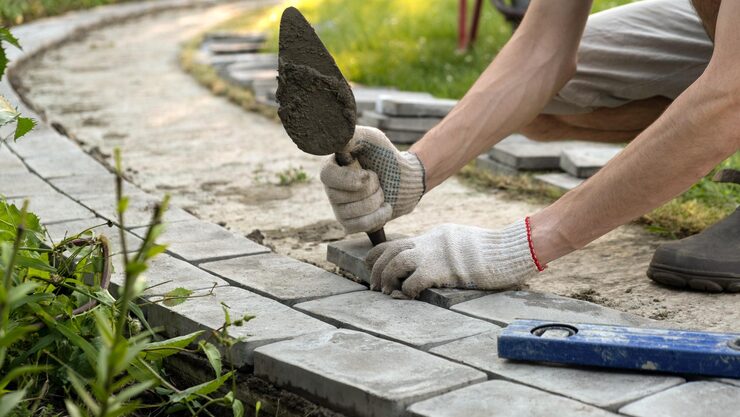
A straight bluestone path reads very differently from a curved fieldstone one.
Pavers can be lifted and reset individually if a root or Lincoln's frost heave disturbs one section.
Natural stone ages by weathering and lichen growth, which suits an older Lincoln farmhouse or stone-wall property. Concrete pavers stay more uniform and budget-friendly but can look manufactured against that backdrop.
Bluestone and granite cost more up front than poured concrete, but they handle Lincoln's freeze-thaw cycling without surface spalling, which concrete is prone to over time.
Gravel or stone-dust paths cost the least and suit a casual Lincoln garden or woodland route, but they need periodic top-ups, proper edging restraints, and don’t hold a crisp line the way a mortared paver walkway does over time.
A walkway that meets the driveway needs a transition that handles different loads – foot traffic on one side, vehicle weight on the other – without a visible seam, trip hazard, or step, even through Lincoln’s freeze-thaw winters.
Choosing a material
The materials are not equal. Each suits some properties and not others.
Where a Lincoln path meets an entry step or porch, the top course has to land level and tight.
Matching a walkway to an existing Lincoln stone wall or older foundation means choosing a stone color, texture, and jointing style that reads as original rather than added on.
On a long drive-to-door walk, lighting and material choice both affect how the path reads after dark, not just in daylight.
Shaded Lincoln paths under heavy tree canopy stay damp longer after rain, encouraging moss and algae buildup. We select surface materials and textured finishes that resist slip hazards, improve drainage, and keep walkways safer underfoot through autumn and winter months.
A path crossing an exposed root needs either a reroute or a bridging technique that protects the root while keeping the surface level – not both ignored.


Lincoln’s lots tend to be large, wooded, and governed by an unspoken expectation that construction stays understated – nothing glossy, nothing that reads as suburban hardscaping dropped onto a rural setting. A long private drive through trees, a house set well back, and nearby conservation land all point toward the same answer: a walkway built from natural materials that follows the land’s existing contours rather than fighting them, avoiding the clean geometric lines that suit a tighter, more formal neighborhood.
Access for construction equipment also matters differently here than on a tight urban lot. A long gravel drive through woods can usually get a small excavator and material delivery to the work site without much disturbance, but it means more distance to cover, more roots to work around, and more decisions about where the path should actually run before any digging starts. Getting that routing right the first time – respecting mature trees, following natural grade changes, tying into stone walls or existing plantings – saves having to redo work later.
What drives the price
A new walk has to meet several existing things cleanly.
- The entry : The walk must arrive at the door at a sensible height. The threshold sets the finished level, so the work starts at the door and runs outward.
- The drive : Where a walk meets a drive, the levels and the drainage have to agree. A mismatch becomes a trip edge or a puddle.
- Walls and planting : Existing stone walls, foundation beds and mature trees constrain the route. Roots under a path are worked around, not cut through without thought.
- An older house : Scale, colour and pattern should follow the architecture. A narrow, dark stone walk suits an old house differently than a broad paver field does.

Getting started
A walkway on a Lincoln property starts with looking at the ground itself – where the trees and roots actually are, where water moves after rain, how the existing drive and entry sit relative to each other, and what material will hold up against the frost cycle without fighting the character of the house and landscape already there.
That’s a site visit, not a phone estimate. Every one of these lots is different enough – different tree cover, different soil, different grade – that a plan made without walking the property is a guess. Once the route and material are settled, the base work underneath is where the real investment goes, even though it’s the part nobody sees once the job is finished.
Before you call
It helps to know:
- Where the walk starts and where it needs to end
- Whether the route crosses a slope or a shared area
- Which material you lean towards, and whether the house is older
- Where water currently runs on the property
Questions people ask
What's the best material for a walkway on a wooded Lincoln lot?
Natural stone such as bluestone or fieldstone tends to suit wooded, older-house properties best because it weathers naturally and handles freeze-thaw without surface damage. Concrete pavers are a lower-cost alternative but read more uniform against a rustic setting. The right choice depends on the house style and how the path ties into existing stonework.
Will tree roots damage a new walkway?
They can, if the path is routed directly over an active root without accounting for growth. The better approach is either rerouting around major roots or using a base method that bridges them without crushing them, so the tree stays healthy and the surface stays level.
How does frost affect a walkway differently than a driveway?
The mechanism is the same – freeze-thaw cycling moves anything sitting on unprepared soil – but a walkway has less margin for error because any unevenness is immediately noticeable underfoot. Proper base excavation and compaction below the frost zone is what keeps it flat season after season.
Can a walkway be built without disturbing the surrounding landscape?
On a large wooded lot, yes, if the route is planned around existing trees, grade changes and stone features rather than cut straight through them. This takes more site assessment up front but avoids losing mature trees or reshaping land that already works well.
Does the walkway need to match the driveway material?
Not necessarily, but the transition between the two needs to be planned so it handles different loads cleanly and doesn't create a visible seam or trip point where foot traffic meets vehicle traffic.
Next step
Call Driveway Specialists on (413) 337-3772. We are a family-run company in business since 1988, and we will walk the route with you and talk through material, grade and drainage before anything is priced.