
Walkway Installation in Maynard, MA
Most Maynard lots were laid out long before anyone thought about a front walk as a design feature. The houses sit close to the street, the drives are short and narrow, and the path from the sidewalk to the front door is often a strip of cracked concrete or a few settled stepping stones that have been there since before the mill closed. Replacing that path is one of the few upgrades on a small lot that changes how the whole property reads, without touching the house or the driveway itself.
A walkway on a lot this size has to do several jobs in a short distance. It has to get someone from the sidewalk or the driveway to the door without feeling like an afterthought, it has to survive a New England winter without heaving or cracking, and it has to look like it belongs next to a house that may be seventy or a hundred years old. That last part rules out some approaches straight away. A walk that looks right outside a new build in a subdivision can look wrong outside a tight-set Maynard colonial or cape, and on a small lot there is nowhere to hide a mismatch. Material choice matters more here than on a sprawling property, because every foot of the walk is visible from the street and from the front steps at the same time.
Width is worth thinking about even on a short run. A single-file 30-inch path feels cramped the moment two people try to use it together, whether that’s a homeowner and a delivery driver or two guests arriving at once. Where the lot allows it, a 42 to 48 inch width lets people pass comfortably without stepping into the mulch bed on either side, and it reads as more intentional even over a distance of fifteen or twenty feet.
What actually fails first
Almost none of the failure in a walkway happens at the surface. Pavers don’t crack because the paver is weak, and concrete doesn’t heave because the concrete is bad. It happens underneath. Massachusetts ground freezes and thaws repeatedly over a winter, and any water trapped under or beside a walk expands and contracts with it. On a narrow Maynard lot where the walk sits close to the foundation, downspouts, and a neighbor’s fence line, there’s often less room for water to spread out and more reason for it to pool right where you don’t want it.
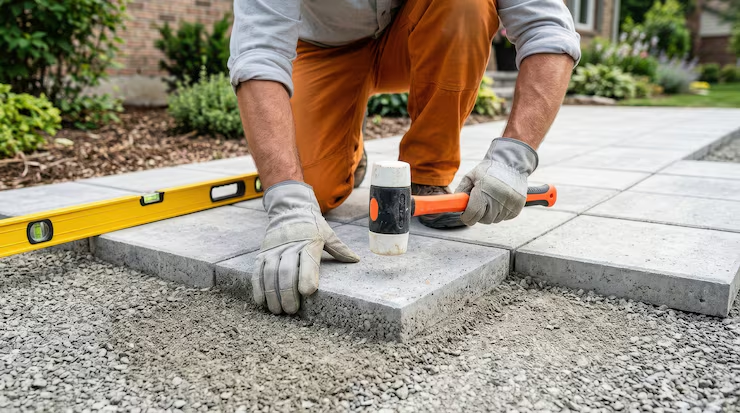
Proper excavation depth, a compacted gravel base that actually drains, and bedding sand set to the right depth under the surface material are what keep a walk flat through its first few winters and its fifteenth. Skip the base work to save a day and the surface telegraphs every freeze-thaw cycle back at you, whether that surface is concrete, pavers, or natural stone.


What Our Clients Say
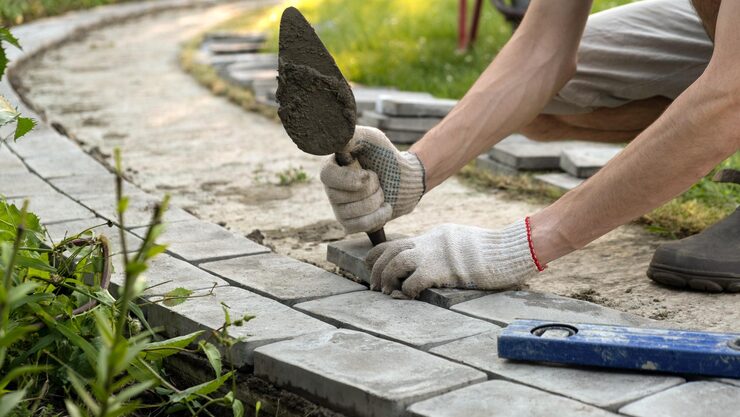
On a tight Maynard lot, a walk usually has to share space with a short drive, a stoop, and sometimes a retaining wall. Getting the grades to meet cleanly matters more than on a bigger property.
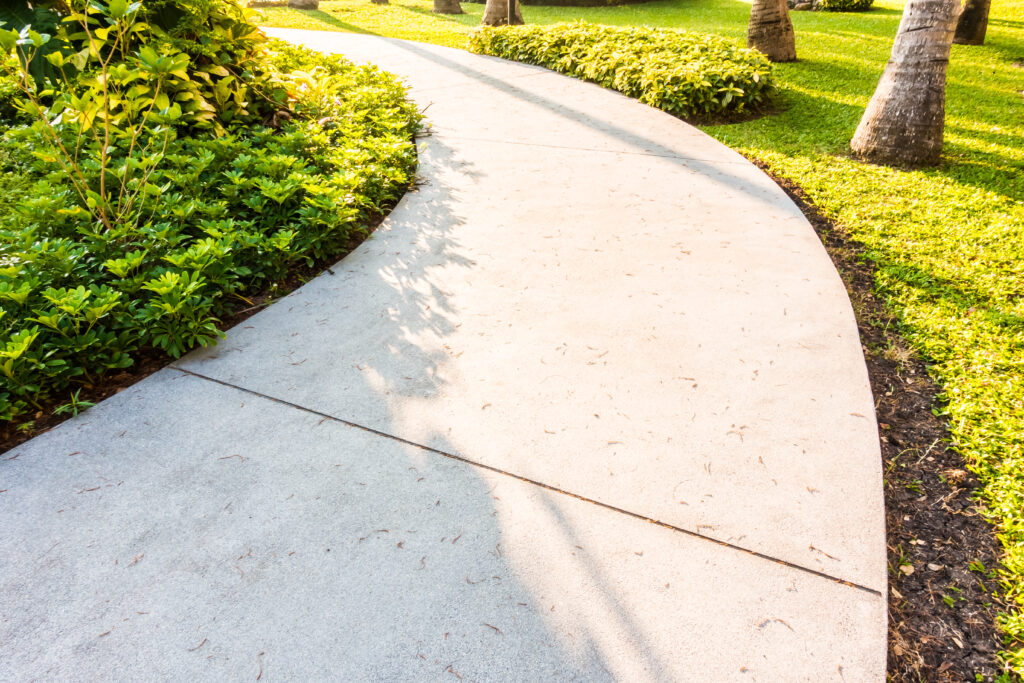
Concrete holds a crisp, formal line and costs less to install than most alternatives, a practical choice for Maynard’s older neighborhoods. It ages into a single slab that cracks in whole panels, and a crack rarely repairs invisibly.
Pavers settle or heave unit by unit, not as one slab. In Maynard’s freeze-thaw winters, a section that shifts can be lifted, re-based on fresh gravel, and reset level without disturbing the rest of the walkway.
Natural stone, like bluestone or fieldstone, suits an older Maynard house better than most manufactured products, though it comes at a higher material cost and demands a more exacting, properly compacted base underneath to prevent shifting or settling over time.
Brick splits the difference for Maynard’s older homes: a traditional look that suits historic facades near town center, decent freeze-thaw performance through New England winters, and individual units that can be swapped later if one spalls or cracks.
None of these materials are interchangeable once you weigh cost, how they age, and how easily a bad section gets fixed later.
Choosing a material
The materials are not equal. Each suits some properties and not others.
Water has to go somewhere once a hard surface replaces lawn or dirt. On a small lot, that often means directing runoff away from the foundation and toward the street or a drainage swale, not just away from the walk.
A walk pitched flat, or worse, pitched back toward the house, sends snowmelt and rain straight at the foundation. On older Maynard homes with fieldstone or parged foundations, that moisture has somewhere to go that isn’t good.
Grading a short fifteen or twenty foot walkway is trickier than pitching a long driveway in Maynard. With so little distance to work with, every inch of fall has to be placed deliberately to keep water moving off the path.
A new walkway has to tie cleanly into what’s already there: a driveway apron, a concrete stoop, a stone wall. Matching heights and material lines at those joints is exactly where Maynard installs commonly go wrong.
On an older house, matching the period matters almost as much as matching the grade. A clean modern paver pattern next to a hundred-year-old foundation can look like it was dropped there from a different property.


Where this fits in Maynard
Maynard’s housing stock, much of it built for mill workers and later residents in close rows near the center of town, tends to put the front door within a short, narrow stretch of the sidewalk. That compressed footprint is exactly where a well-built walk earns its keep: there’s no room for drainage mistakes to go unnoticed, no room for a mismatched material to blend into a bigger landscape, and no slack in the grade to absorb a bad pitch. The same tight layout that makes driveway paving in Maynard a planning exercise makes walkway work a precision one. A path that’s excavated, based, and pitched correctly will outlast one that was laid quickly over existing dirt, and on a lot this size, the difference between the two is visible from the sidewalk every single day, not hidden at the back of a long drive the way it might be in a more spread-out town like Stow or Sudbury.
What drives the price
A new walk has to meet several existing things cleanly.
- The entry : The walk must arrive at the door at a sensible height. The threshold sets the finished level, so the work starts at the door and runs outward.
- The drive : Where a walk meets a drive, the levels and the drainage have to agree. A mismatch becomes a trip edge or a puddle.
- Walls and planting : Existing stone walls, foundation beds and mature trees constrain the route. Roots under a path are worked around, not cut through without thought.
- An older house : Scale, colour and pattern should follow the architecture. A narrow, dark stone walk suits an old house differently than a broad paver field does.

If your front walk is cracked, uneven, or just doesn’t match the house anymore, the next step is a visit to look at the actual grade, the soil at your specific address, and how the walk needs to tie into your driveway and entry. That’s a conversation that’s hard to have accurately without seeing the lot, since a plan that works on a flat, open yard can be wrong for a shaded, close-set one, and Maynard’s older neighborhoods near the center and along the Assabet often have mature trees, root systems, and drainage quirks that change how a walkway needs to be built. Driveway Specialists has been doing this kind of hardscape and paving work across Middlesex County since 1988, as a family-run crew that still measures before it quotes.
- Grading and base prep suited to Maynard’s soil and slope conditions
- Material options that complement existing driveways, stoops, and house styles
- Attention to tree roots, drainage, and frost heave common in the area
Before you call
It helps to know:
- Where the walk starts and where it needs to end
- Whether the route crosses a slope or a shared area
- Which material you lean towards, and whether the house is older
- Where water currently runs on the property
Questions people ask
Why does a concrete walkway crack within a few years in Maynard?
It's almost always the base, not the concrete. If the gravel base underneath isn't deep enough or compacted properly, freeze-thaw cycles move the ground under the slab and the concrete has nowhere to go but crack. Older Maynard walks poured directly over dirt or thin base tend to fail faster than ones with proper excavation underneath.
Can a new walkway be built to match an older Maynard home?
Yes, and it usually should. Natural stone or brick tends to sit better next to an older house than a bright, uniform paver pattern. Matching the material, joint lines, and even the edge detail to the age of the house makes the walk look original rather than added on.
Does a walkway need its own drainage plan on a small lot?
It needs the grade handled correctly even on a small lot, which is a form of drainage planning. Pitching the walk away from the foundation and toward an area that can absorb or carry off water matters more on a tight lot, where there's less open ground to soak up runoff.
How does a walkway tie into an existing driveway or stoop?
The base and the surface material both have to meet at a consistent height and a clean line where the walk meets the drive apron or the stoop. Getting that transition wrong is one of the most common visible mistakes in walkway installs, especially on short runs where there's little room to hide a mismatch.
Next step
Call Driveway Specialists on (413) 337-3772. We are a family-run company in business since 1988, and we will walk the route with you and talk through material, grade and drainage before anything is priced.