
Walkway Installation in Medfield, MA
Medfield’s older neighbourhoods tend to have something newer subdivisions don’t: room. Generous frontage, mature plantings, a front door set back from the street with space in between for something better than a slab of cracked concrete or a worn dirt track. If you’re looking at that stretch of lawn between your driveway and your front steps, the question isn’t really whether to put a walkway in. It’s what to build it from, and whether it will still look right in fifteen years.
A walkway is a different project from a driveway, even though the ground underneath behaves the same way. Nobody drives a car over it, so the loads are lighter, but the frost is just as real, the drainage questions are just as important, and the materials you choose will be looked at up close, every day, by you and everyone who walks to your door. That’s a different design problem than a driveway, and it deserves a different answer.
Width matters more than people expect. A walkway narrower than about three feet feels cramped the moment two people try to use it together, or one person tries to use it with an armful of groceries. Many of the older homes around Medfield were built with narrow original paths that no longer suit how the property is actually used; widening during a rebuild is often the single change that makes the biggest difference in how the whole approach to the house feels.
What’s actually under a walkway that lasts
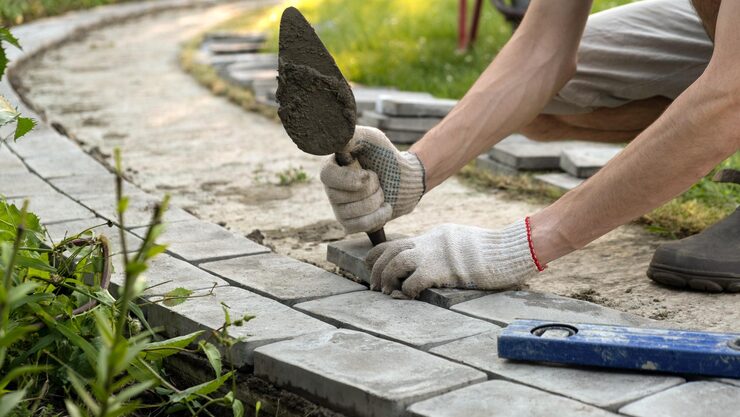
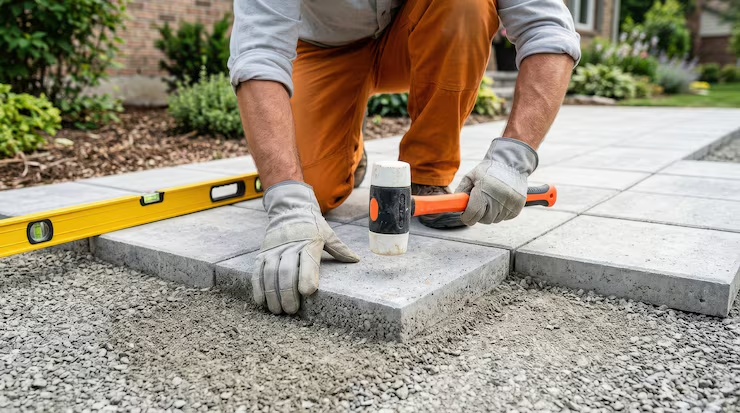
The visible surface, whether it’s brick, bluestone or a paver, is the last few inches of the job. Underneath it there’s excavation to a stable depth, a compacted base layer that lets water drain through rather than pool, a bedding layer that sets the final grade, and an edge restraint that keeps the whole assembly from creeping sideways over time. Skip or shortcut any one of those layers and the walkway will still look fine the first winter. It’s the second, third and fourth freeze-thaw cycle that find the weak point.
Massachusetts frost doesn’t push evenly. Wherever moisture sits in the base, the ground heaves unevenly as it freezes, and that uneven lift is what turns a flat walkway into a wavy one, paver by paver, year by year. Well-draining base material, properly compacted before anything sits on top of it, is the entire difference between a walkway that stays flat and one that needs lifting and relaying inside a decade. On the well-kept lots common around Medfield, where lawns are maintained and irrigation systems run close to the walkway edge, getting that drainage right below ground matters as much as the material you pick above it.
Material choice should follow the house, not a catalog trend. A few things worth weighing before you commit:


What Our Clients Say
Materials and the trade-offs that matter
Bluestone gives a clean, formal look and ages well, but it costs more and a cracked slab means replacing the whole piece. Pavers are easier to repair individually and handle frost movement with more give at the joints.
Brick suits Medfield's older colonial-style homes particularly well, lending classic curb appeal to tree-lined streets near town center.
Poured concrete walkways are the cheapest option up front, but they crack as one continuous slab and offer no easy way to repair a single damaged section without redoing the run.
Grade and water
A walkway is a hard surface on ground that used to absorb rain. Pitching it correctly, away from the foundation and toward a spot where water can actually go, isn’t optional once that surface is in place.
On Medfield’s flat lots, a walkway built without attention to grade becomes a path for water to pool near the entry rather than run off, inviting ice patches and soggy soil where the lawn never had an issue before.
Choosing a material
The materials are not equal. Each suits some properties and not others.
Matching material, scale and edge lines to an older house takes more planning than starting from scratch on a new build, but it’s what makes the finished path look original rather than added on.
Edge restraint and frost
Loose edges are where walkways fail first. A proper restraint, set below grade and anchored into the compacted base, keeps individual units from spreading apart as Medfield’s clay-heavy soil heaves and settles with each freeze-thaw cycle through winter.
Without a properly compacted base, even a well-laid paver walkway in Medfield will slowly widen its joints and lose its line over a few freeze-thaw seasons, regardless of how attractive the surface material looked on installation day.
Shade, roots and surface condition
Mature trees are common on older Medfield lots, and a walkway routed near large roots needs a base built to tolerate future movement rather than one that assumes the ground stays still.
Shaded paths also stay damp longer after rain, so material choice and joint design matter more there than on a walkway that gets full sun most of the day.


Where this fits on Medfield properties
Straight, level drives and generous setbacks are typical on Medfield properties, which usually means a walkway can run a clean, direct line from driveway or street to the front door without major grade changes to work around. That open layout also gives more flexibility in where a path goes, not just how it looks at the curb.
That’s a simpler install than a sloped or narrow lot elsewhere in the area, but it doesn’t mean skipping the base work. A flat, well-drained site still needs a properly built foundation underneath, with compacted base material and attention to how water moves across the yard; it just means the finished result is more forgiving to get right. There’s also more room to size the walkway generously, add a landing at the door, or run a secondary path to a side yard, garden, or patio without feeling cramped or forcing awkward angles.
What drives the price
A new walk has to meet several existing things cleanly.
- The entry : The walk must arrive at the door at a sensible height. The threshold sets the finished level, so the work starts at the door and runs outward.
- The drive : Where a walk meets a drive, the levels and the drainage have to agree. A mismatch becomes a trip edge or a puddle.
- Walls and planting : Existing stone walls, foundation beds and mature trees constrain the route. Roots under a path are worked around, not cut through without thought.
- An older house : Scale, colour and pattern should follow the architecture. A narrow, dark stone walk suits an old house differently than a broad paver field does.

Next step
If you’re planning a new walkway in Medfield, we’ll come look at your grade, your soil, and what you’re trying to connect it to before recommending a material. Clay-heavy soil, tree roots, and freeze-thaw cycles all show up differently depending on where your property sits relative to the Charles River, and a path that holds up on a flat, well-drained lot can heave and settle within a season or two on sloped or poorly draining ground. We walk the site, check drainage patterns, and look at how the walkway ties into your porch, driveway, or garden beds before we ever talk material or layout.
- Base prep suited to your soil, not a one-size-fits-all approach
- Material options matched to how the path will actually be used
- Grading and drainage planning to prevent pooling or ice buildup
We’ve been doing this kind of hardscape work across Norfolk County since 1988, as a family-run crew, not a subcontracted install team. Call (413) 337-3772 to arrange a visit and get a straight answer about what will actually hold up on your property, not just what looks good in a photo.
Before you call
It helps to know:
- Where the walk starts and where it needs to end
- Whether the route crosses a slope or a shared area
- Which material you lean towards, and whether the house is older
- Where water currently runs on the property
Questions people ask
How long does a walkway installation take in Medfield?
It depends on length, material, and how much base preparation the site needs. A straightforward paver or brick path on a level lot moves faster than one that requires significant grading or tie-ins to steps and walls. We'll give you a realistic timeframe once we've seen the site.
Can a cracked concrete walkway be replaced with pavers without starting from scratch?
Usually yes. The old concrete gets removed and the base underneath is rebuilt properly, since reusing a failed base just repeats the same problem. It's a full excavation either way, but it opens the door to a material that's easier to maintain and repair going forward.
What material holds up best to New England winters?
Pavers generally handle freeze-thaw movement the best because individual units can shift slightly without cracking, and a damaged one can be swapped without disturbing the rest. Bluestone and brick both perform well too, but repairs are less forgiving when a single piece fails.
Does a walkway need the same base as a driveway?
The same principles apply, excavation, a compacted base, proper drainage, and edge restraint, but a walkway carries foot traffic rather than vehicle weight, so the base doesn't need to be built to the same depth or specification as a driveway.
Will tree roots near my front walk cause problems later?
Mature roots can heave a walkway over time if the base isn't built with some tolerance for that movement. On lots with large established trees, we look at root location before finalizing the path's route and base design.
Next step
Call Driveway Specialists on (413) 337-3772. We are a family-run company in business since 1988, and we will walk the route with you and talk through material, grade and drainage before anything is priced.