
Walkway Installation in Milford, MA
A lot of Milford properties have the same problem: the front walk was poured decades ago, it has heaved at the joints, and it no longer matches what you want the entry to look like. Closer to the town center, lots are narrow and the walk often runs tight along a shared drive or a neighbor’s fence line. Out toward the newer subdivisions, the lots are bigger and the walk has more room to curve, branch toward a side door, or connect a patio to the driveway. Either way, a walkway is a visible, permanent part of the property, and it is worth building correctly the first time rather than patching the old one again.
What happens below the surface
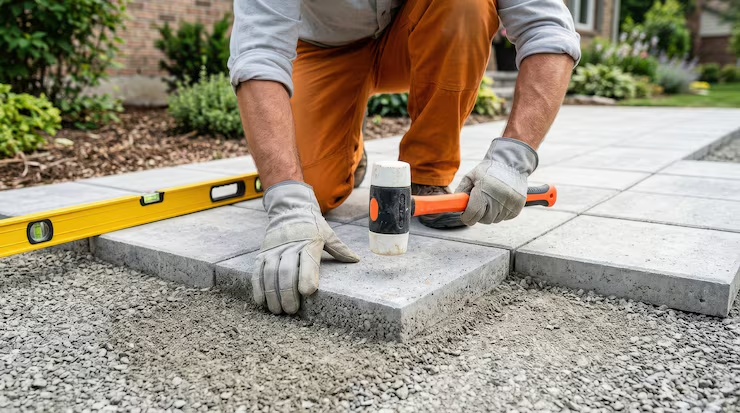
The part anyone sees is the top course – the pavers, the stone, or the concrete finish. What decides whether that surface stays flat is the work underneath it, and that work is identical in principle whether the walk is brick, bluestone, or poured concrete. The ground gets excavated to a consistent depth, a compacted gravel base goes in, and the surface material sits on bedding over that base with edge restraint holding the sides. Skip or shortcut any one of those steps and the walk will move.
In Massachusetts specifically, the reason this matters more than almost anywhere else is frost. Water in the soil under the walk freezes and expands every winter, and if the base is not built to handle that movement evenly, sections of the walk lift unevenly and settle back down in different places each spring. That is why an old concrete walk ends up with lips and gaps at the joints after enough winters, even though nobody did anything wrong above ground. A properly compacted base drains instead of holding water, so there is far less to freeze and lift in the first place.
Materials carry real trade-offs and none of them is the right answer for every house. Concrete is the lowest-maintenance option and holds a clean, simple line, but a crack in a concrete walk is hard to disguise and usually means replacing a whole section. Pavers cost more up front but a damaged section lifts out and resets without touching the rest of the walk, which matters on a property with heavy foot traffic or where a tree root might eventually interfere. Natural stone, including fieldstone and bluestone common on older New England properties, ages well and suits a traditional house, but it needs a mason who can set irregular pieces tightly and it’s a slower, costlier install.
Grade matters as much as material. A walkway has to shed water away from the foundation and away from the walk surface itself, not pool at the doorstep or along the edges where it will refreeze. On flatter Milford lots that means building the pitch in deliberately, since the ground won’t do it on its own.


What Our Clients Say
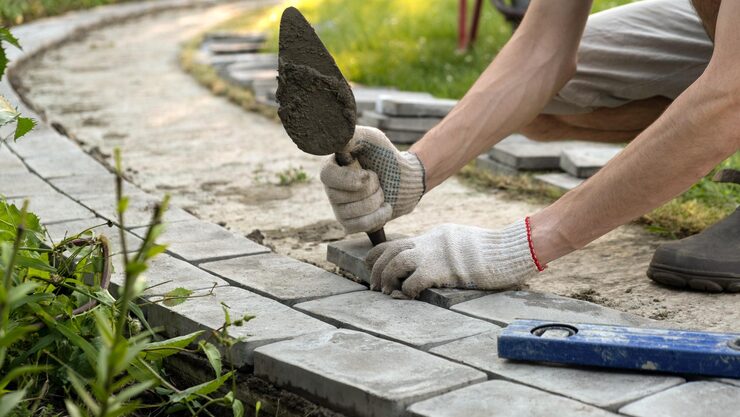
Where a new Milford walkway meets the driveway or front step, that transition needs planning, not improvising. A mismatched height or unsealed joint is where water gets in and where frost does the most damage over time.
Matching an older Milford house usually means choosing a material and a simple layout over a busy pattern. Fieldstone and certain paver tones sit naturally next to original brick or clapboard.
Newer construction toward the edges of Milford has more flexibility. Clean concrete lines, large-format pavers, or stamped finishes suit a contemporary build without fighting the architecture, while still connecting comfortably to driveways, porches, and existing landscaping already in place.
Narrow side yards and shared driveways near the Milford town center limit how wide a walk can be and how equipment gets to the site.
Mature trees along older Milford streets mean root systems close to the surface.
Edge restraint keeps paver and stone walkways from spreading sideways over time, especially where a plow or snowblower runs close to the edge every Milford winter.
Choosing a material
The materials are not equal. Each suits some properties and not others.
A walkway connecting to an existing retaining wall or planting bed needs its grade coordinated with those features, not treated as a separate project laid down afterward.
Poured concrete remains the most economical choice for Milford homeowners wanting a straightforward, functional front walkway where budget matters more than custom appearance.
Pavers suit Milford households expecting to adjust the layout later – adding a branch to a shed, garden bed, or side gate – since sections lift and reset cleanly without cracking, letting you extend or reroute the walkway as your property's needs change over time.
Bluestone and fieldstone cost more upfront, but on Milford’s older properties they hold long-term value, complementing stone foundations and mature landscaping where the walkway is part of overall curb presentation, not merely a functional path from driveway to door.
A walkway that ties the driveway, front entry, and yard together in one cohesive material reads as a finished Milford property rather than a patchwork of separate repairs.


Where this fits in Milford
Milford’s mix of dense older streets near downtown and newer subdivision lots on the outskirts means there’s no single walkway spec that fits the whole town. On the older, tighter lots, the usual job is replacing a cracked original concrete walk with something that handles frost better and fits a smaller footprint – often pavers or stone, since equipment access is limited and a smaller crew working by hand suits the site better than heavy machinery. On newer lots at the edges of town, there’s more room to plan a walk that connects the driveway, the entry, and sometimes a side patio as one project, with a longer run and a wider, more flexible design.
In both cases the frost and drainage work underneath is non-negotiable – it’s what separates a walkway that still looks right after years of New England winters from one that needs patching every few seasons. The surface material is the visible decision; the base and grading are the ones that determine whether that decision still looks good later.
What drives the price
A new walk has to meet several existing things cleanly.
- The entry : The walk must arrive at the door at a sensible height. The threshold sets the finished level, so the work starts at the door and runs outward.
- The drive : Where a walk meets a drive, the levels and the drainage have to agree. A mismatch becomes a trip edge or a puddle.
- Walls and planting : Existing stone walls, foundation beds and mature trees constrain the route. Roots under a path are worked around, not cut through without thought.
- An older house : Scale, colour and pattern should follow the architecture. A narrow, dark stone walk suits an old house differently than a broad paver field does.

Getting started
A walkway project starts with a look at the actual lot – the grade, what it needs to connect to, how equipment or materials get to the site, and what’s already there in terms of driveway, entry, and planting. That’s not something to guess at over the phone. Driveway Specialists has worked across Milford and the surrounding Worcester County towns since 1988, as a family-run crew that handles both the hardscape work and the driveway work it often connects to, so the walkway and drive can be planned together when that’s what the property calls for, or kept entirely separate when that’s the better fit.
A proper site visit covers a few things worth asking about up front:
- Existing grade and drainage, so water sheds away from the house and the walk itself
- Material choice – paver, poured concrete, or natural stone – matched to the home’s style and Milford’s freeze-thaw winters
- Width and routing that actually work for how the household and visitors move through the yard
Before you call
It helps to know:
- Where the walk starts and where it needs to end
- Whether the route crosses a slope or a shared area
- Which material you lean towards, and whether the house is older
- Where water currently runs on the property
Questions people ask
How far down does a walkway base need to go in Milford?
It depends on the soil under the specific property, but the principle holds everywhere in this part of Worcester County: the base has to sit below the depth where seasonal frost movement happens, and it has to be compacted in layers, not dumped and leveled once. A shallow, under-compacted base is the single biggest reason a walk heaves and separates after a few winters.
Can a new walkway be built around an older Milford house without looking out of place?
Yes, and it usually comes down to material choice and edge detail rather than an exact style match. Fieldstone, certain paver colors, and a simple straight-edge layout tend to sit comfortably next to older homes near the town center, while cleaner concrete suits newer builds at the edges of town.
Does a walkway need to connect to the driveway, or can it stand alone?
It can do either. Tying the walkway into the driveway with a shared material or a matched edge reads as one planned project. Keeping them visually separate works too, especially where the two surfaces are different materials or ages – the main requirement is that grade and drainage at the joint are handled properly either way.
What is the next step to get a walkway quote in Milford?
Call (413) 337-3772 to arrange a site visit. Lot access, existing grade, and what the walkway needs to connect to all affect the plan, so a look at the property is more useful than a quote over the phone.
Next step
Call Driveway Specialists on (413) 337-3772. We are a family-run company in business since 1988, and we will walk the route with you and talk through material, grade and drainage before anything is priced.