
Walkway Installation in Millis, MA
A lot of Millis properties share the same layout: a long driveway coming in off a country road, a house set well back behind trees, and no real path connecting the two. If you park and walk across lawn or gravel to reach your own front door, or the route from the drive to the entry turns muddy every spring, a proper walkway solves a problem the driveway alone never will. This is work that improves how the property is used day to day, not a repair job.
The lots here tend to be larger and older than the subdivision work closer to Boston, which changes the design question. There is usually more distance to cover, more existing tree cover to work around, and an older house whose foundation line, stone walls, or granite steps need to be respected rather than overridden by something that looks dropped in from a catalog.
What holds a walkway flat, and what doesn’t
Everything that matters on a walkway happens before the surface goes down. Massachusetts frost pushes and pulls on anything built on unprepared ground, and a path laid straight onto topsoil or loam will heave unevenly within a season or two because the ground under it is still full of organic material that holds water and expands when it freezes. The fix is excavation down past the topsoil, a compacted gravel base that lets water drain through rather than pool and freeze, a properly screeded bedding layer, and edge restraint that keeps the whole assembly from creeping sideways as the ground moves. Skip any one of those steps and the walkway will tell you within a couple of winters, usually by going wavy at the joints or dropping at one edge.
On wooded Millis lots this matters more than most places, because tree roots are already disturbing the ground nearby and shaded sections stay damp long after open areas have dried out. A base that doesn’t drain just stays saturated under the surface, which is exactly the condition that makes frost heave worse.
Material choice is the other half of the decision, and the honest answer is that no option wins on every count. Concrete pavers hold up to freeze-thaw well because individual units flex slightly rather than cracking as one slab, and a damaged section can be lifted and replaced without redoing the whole path. Natural stone, including bluestone or fieldstone, suits an older Millis farmhouse or colonial in a way that manufactured pavers sometimes don’t, but it costs more and irregular stone needs careful setting to stay even. Poured concrete gives a clean, low-maintenance surface but cracks as a single piece when the ground shifts, and a crack in concrete is there for good rather than a swap-out repair.


What Our Clients Say
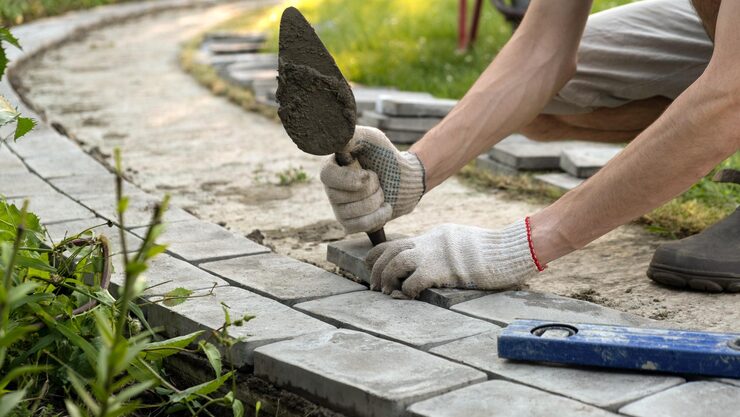
Grade is decided before material. Around Millis homes, water has to move away from the house and off the walkway itself, or it sits, freezes through winter, and works at the joints from above as well as below.
On a shaded, tree-lined Millis lot, a slightly wider base, extra compaction, and attention to drainage under the walk matter more than on an open sunny site, since damp, root-laced soil settles unevenly and stays wetter longer after storms.
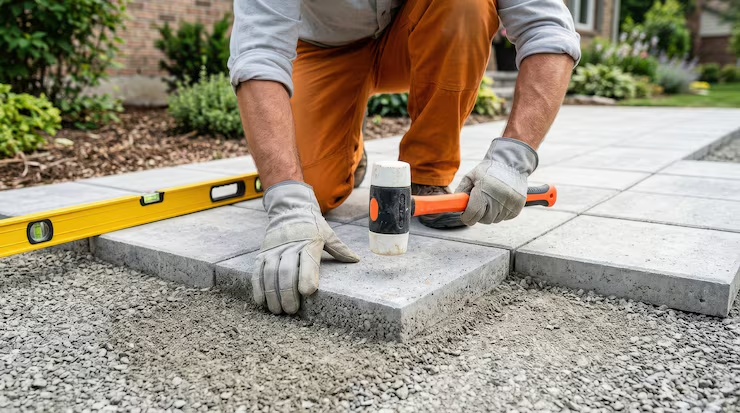
Edge restraint keeps pavers from spreading apart as Millis winters push and pull the ground beneath your walkway. Without properly anchored edging, joints widen, base material shifts, and the surface stops sitting flat, flush, and level underfoot.
Bluestone and fieldstone pair naturally with the older farmhouses and colonials common in Millis, though they take longer to set correctly than uniform pavers.
A long walkway connecting a set-back Millis house to its driveway often needs a landing or a gentle direction change rather than one straight run across open lawn, keeping grading, drainage, and sightlines in mind for everyday foot traffic and winter safety.
Where a walkway meets the driveway, the transition should read as one planned surface, not two unrelated materials butted together.
Choosing a material
The materials are not equal. Each suits some properties and not others.
On older Millis properties, existing stone walls, granite steps, mature trees, or long-established plantings are worth designing a new walkway around rather than removing.
In Millis, where frost heave and tree roots are common culprits, a damaged paver can be lifted and swapped without disturbing the rest of the walkway.
Compaction under the base is what prevents settling later. A base that looks fine on day one but wasn't compacted properly will show dips within a year or two.
Shaded sections near mature trees stay damp longer after rain, so the base there needs to drain as well as the open stretches do.
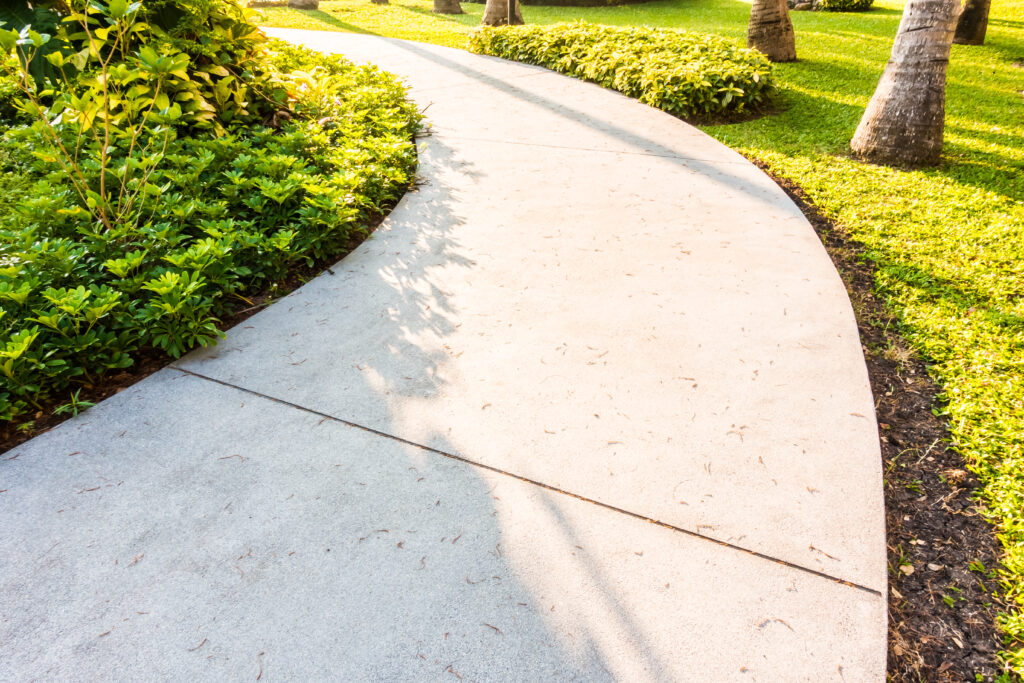
In Millis, a path that curves gently through existing trees and plantings generally reads better on a wooded lot than one forced into a straight line between two points.


Drainage and grade on a larger lot
Pitch is the detail that gets skipped most often, and it’s the one that causes the most trouble later. Once a hard surface replaces lawn or soil, rainwater that used to soak in now has to go somewhere else, and the walkway has to be graded to send it there deliberately. Pitching away from the house foundation is not optional on any property, but on a Millis lot with a long run from driveway to entry, there’s also more length over which water can collect if the grade is wrong even slightly. A walkway that dips in the middle becomes a shallow pond every time it rains, and then an ice sheet every time it freezes.
Where a path crosses a natural low point in the yard, a drain or a change in base depth may be needed to carry water through rather than let it sit under the surface. This is design work done before anything is excavated, not something fixed afterward.
What drives the price
A new walk has to meet several existing things cleanly.
- The entry : The walk must arrive at the door at a sensible height. The threshold sets the finished level, so the work starts at the door and runs outward.
- The drive : Where a walk meets a drive, the levels and the drainage have to agree. A mismatch becomes a trip edge or a puddle.
- Walls and planting : Existing stone walls, foundation beds and mature trees constrain the route. Roots under a path are worked around, not cut through without thought.
- An older house : Scale, colour and pattern should follow the architecture. A narrow, dark stone walk suits an old house differently than a broad paver field does.

Tying into what's already there
Few walkways stand alone. Most connect a driveway to a front entry, pass near existing steps or a porch, or run alongside a stone wall or planting bed that’s been there for decades. The job is to match grade, width, and material so the new work looks like it belongs rather than looks added on. On an older Millis house, that often means choosing a stone or paver tone that sits well against original fieldstone foundations or granite details, rather than a bright, uniform product that reads as obviously new.
Where the walkway meets the driveway surface, that transition point needs the same attention as any other edge: a clean line, proper restraint, and a material pairing that makes sense rather than two unrelated surfaces butted together. The same goes for where it meets the front step or porch slab.
Before you call
It helps to know:
- Where the walk starts and where it needs to end
- Whether the route crosses a slope or a shared area
- Which material you lean towards, and whether the house is older
- Where water currently runs on the property
Questions people ask
Why does a walkway heave in winter when the driveway next to it doesn't?
A walkway usually has less traffic and a thinner build than a driveway, so any shortcuts in base depth or compaction show up faster. Frost pushes hardest where the base hasn't been properly drained and compacted, which is exactly the spot most walkways get built without it.
Is natural stone worth the extra cost on a rural Millis property?
It depends on the house. On an older farmhouse or colonial, stone often matches the property's age and setting in a way manufactured pavers don't, which is part of what you're paying for. On a newer build, pavers can look just as appropriate for less.
Can a walkway be built around mature trees without damaging the roots?
Yes, but it changes the design. The path may need to curve around root zones rather than cut straight through them, and excavation depth may need to be adjusted near large roots instead of cutting them out.
Does the walkway need to match the driveway material?
No, but the transition between the two needs to be planned rather than left as an abrupt edge. Many Millis properties mix a paver or stone walkway with an asphalt or gravel drive and the pairing works fine when the edge detail is done properly.
Next step
Call Driveway Specialists on (413) 337-3772. We are a family-run company in business since 1988, and we will walk the route with you and talk through material, grade and drainage before anything is priced.