
Walkway Installation in Milton, MA
A lot of Milton properties sit on a slope, whether that’s a gentle rise off a Blue Hills-adjacent street or a steeper grade on one of the older lots toward Milton Village. Getting from the driveway to the front door, or from the back patio down to the yard, often means dealing with a change in elevation and water that wants to run somewhere you don’t want it to go. A new walkway is as much a drainage decision as a design one, and on these lots it pays to think about both at the same time.
This is different work from paving a driveway. A walkway carries foot traffic, not vehicle loads, so the base doesn’t need to be built to the same depth or compaction standard as a drive. But it still has to survive a Massachusetts winter sitting on the ground, and that’s where most walkway problems actually start – not on the surface, but underneath it.
What’s happening below the surface
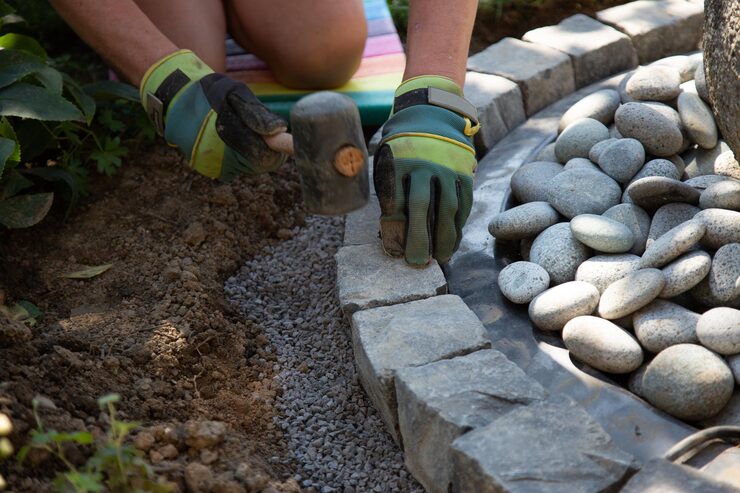
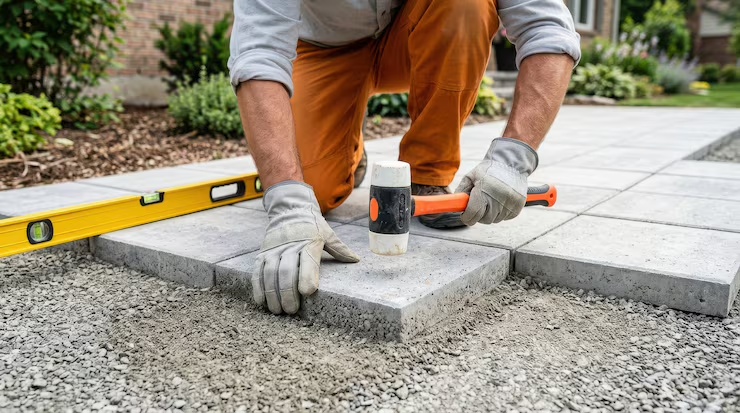
A walkway that stays flat for years and one that heaves and separates within a couple of winters usually differ in exactly one place: what’s under the pavers or the concrete. Proper excavation removes the organic topsoil that holds moisture and shifts with the seasons. A compacted gravel base replaces it with material that drains and stays put. Bedding sand sits on top of that to let individual units settle evenly, and edge restraint – metal, plastic, or a concrete haunch depending on the material – keeps the whole assembly from creeping outward as the ground freezes and thaws underneath it.
Frost is the part almost nobody explains properly. Water in the soil beneath a walkway expands when it freezes. If that soil is holding water because it hasn’t drained, the expansion pushes the surface up unevenly – a little more under one paver than the next, a little more at the edge than in the middle. That’s what turns a flat path into a wavy one over a few winters. A base that drains freely doesn’t hold enough water to cause that movement, which is the entire argument for getting the excavation and base right the first time, before a single paver goes down.
On a sloping Milton lot, the base also has to manage water moving across the site, not just water sitting under the walkway itself. That changes how the sub-base is built and where a path needs a drain inlet rather than just a slope.


What Our Clients Say
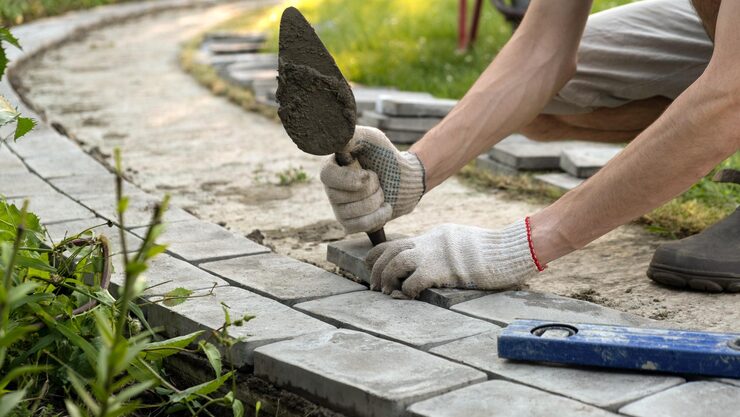
On a graded Milton lot, a walkway without a plan for runoff just becomes a channel. Water needs somewhere to go that isn't the foundation, the front steps, or the neighbor's yard.
Bluestone reads as the classic New England front walk, and it suits Milton’s older homes especially well. It’s durable and ages beautifully, though it costs more upfront, and a cracked slab usually means full replacement rather than a simple patch.
Concrete pavers cost less than natural stone and come in enough shapes, textures, and colors to suit most house styles, including the older homes common around Milton.
Poured concrete is the cheapest walkway option upfront for Milton homes, but it’s harder to repair invisibly and prone to visible cracking if the base isn’t properly compacted and graded before the pour, especially through freeze-thaw winters.
Brick suits Milton's colonial and older New England homes particularly well, echoing historic streetscapes near town center.
Every material handles Milton's freeze-thaw cycles differently. Concrete, pavers, flagstone, and gravel each age at their own pace.
Choosing a material
The materials are not equal. Each suits some properties and not others.
Pitch matters more than most Milton homeowners expect. A well-installed walkway should shed water away from the house and off to the side, never pooling against a foundation, threshold, or step—especially through our region’s heavy spring thaw and rainfall.
On steeper Milton lots, a walkway sometimes needs a shallow drain channel cut in and tied into the broader grading plan, rather than left to chance.
A new walkway should read as part of the property, not an addition bolted on.
Where a walkway meets the driveway, the transition needs a clean edge and a matched or deliberately contrasted material – not a gap where gravel and weeds take over.
Older Milton homes often have existing stone walls, granite steps, or mature plantings close to the front walk.

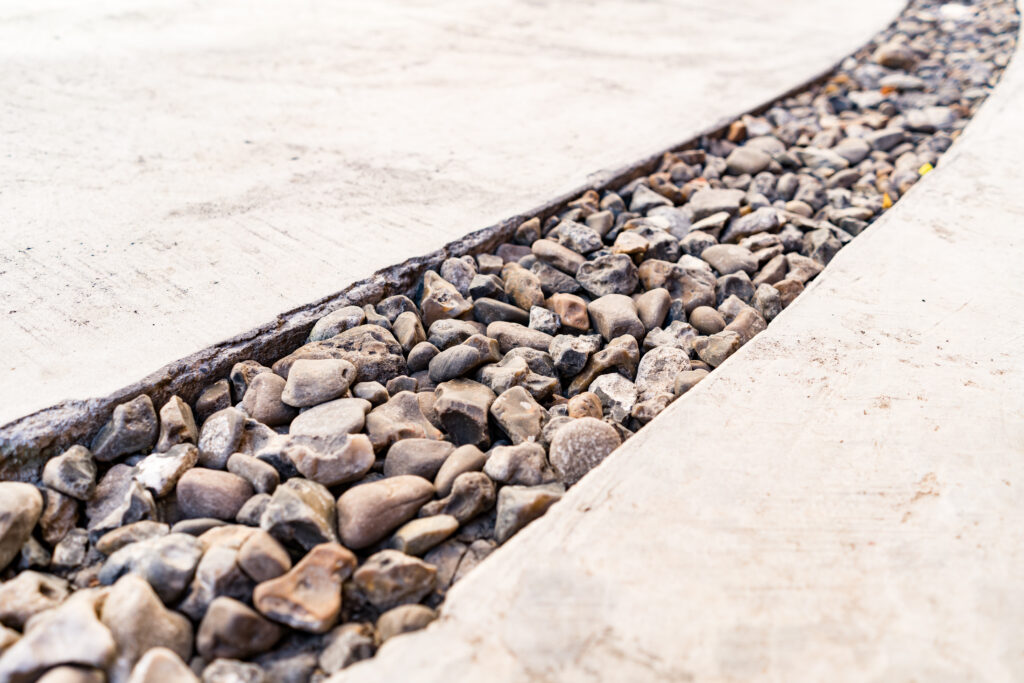
Milton’s sloping, tree-lined lots near the Blue Hills and Milton Village mean walkway work is rarely a flat, straightforward run from driveway to door. Grade changes are common, mature trees bring roots and shade close to the path, and older housing stock often means matching stone, brick, or an existing granite step to get the result right. The walkway has to answer to both the slope of the lot and the age of the house, not just connect two points.
That’s a different challenge from a flat ranch lot in a newer subdivision, where the main decision is material and layout. In Milton, drainage planning usually comes first, because a walkway that ignores the grade will eventually show it – either as standing water at the base of the steps or a base undermined by water it was never built to handle. Sizing the excavation and base correctly for a sloped site is what separates a walkway that holds its line for years from one that needs attention within a couple of seasons.
What drives the price
A new walk has to meet several existing things cleanly.
- The entry : The walk must arrive at the door at a sensible height. The threshold sets the finished level, so the work starts at the door and runs outward.
- The drive : Where a walk meets a drive, the levels and the drainage have to agree. A mismatch becomes a trip edge or a puddle.
- Walls and planting : Existing stone walls, foundation beds and mature trees constrain the route. Roots under a path are worked around, not cut through without thought.
- An older house : Scale, colour and pattern should follow the architecture. A narrow, dark stone walk suits an old house differently than a broad paver field does.
Getting started
If you’re planning a new walkway in Milton, the first useful step is walking the site with someone who’ll look at the slope, the existing drainage, and what the path needs to tie into – not just hand over a materials catalog. Family-run since 1988, Driveway Specialists has worked hardscape and paving across Norfolk, Middlesex, and eastern Worcester counties for 35-plus years, and that includes a fair number of sloped, older lots not unlike what you’ll find near the Blue Hills or Milton Village.
A walkway is a visible, daily-use part of the property, and it’s also a long-term structural decision about where water goes once it leaves your roof and your yard. Getting the base, the pitch, and the material right the first time avoids a redo in a few years. If you’re ready to talk through what your lot needs, call (413) 337-3772 to set up a time to walk the site and get a straight answer on what will actually hold up.
Before you call
It helps to know:
- Where the walk starts and where it needs to end
- Whether the route crosses a slope or a shared area
- Which material you lean towards, and whether the house is older
- Where water currently runs on the property
Questions people ask
Does a walkway need the same base as a driveway?
No. A walkway carries foot traffic rather than vehicle weight, so the excavation depth and compaction don't need to match driveway standards. It still needs a properly drained base, just not as deep or heavily compacted as what sits under a drive.
What happens if a walkway is built without good drainage on a sloped lot?
Water runs toward the path instead of around it, saturates the base, and freezes in winter. That expansion pushes pavers or concrete unevenly, which is how a flat walkway turns wavy within a few winters.
Can a walkway be matched to an older house's existing stonework?
Yes, within reason. Brick and natural stone can be chosen to complement existing walls, steps, or foundations common on older Milton homes, though an exact match to aged material isn't always possible with new stone.
Is poured concrete a good choice for a front walkway?
It's the lowest upfront cost, but it cracks more visibly if the base beneath it isn't built correctly, and repairs are harder to make invisible compared with a paver system where individual units can be lifted and reset.
How does a walkway tie into the driveway without looking disconnected?
The transition point needs a clean, intentional edge rather than a gap filled with gravel or weeds. Matching or deliberately contrasting materials at that junction is a layout decision made before installation, not an afterthought.
Next step
Call Driveway Specialists on (413) 337-3772. We are a family-run company in business since 1988, and we will walk the route with you and talk through material, grade and drainage before anything is priced.