
Walkway Installation in Needham, MA
A lot of Needham’s walkway work happens for the same reason: a teardown goes up, a drive gets rebuilt, and the front walk that connected the old house to the street no longer makes sense with the new one. Other times the house is original to the neighborhood and the path is the thing still letting the property down — heaved, narrow, or patched in a material that never matched the front door it leads to. Either way, a front walk is the part of the property most people actually touch. It gets more attention per square foot than the driveway ever will, since every visitor, delivery, and family member crosses it on foot, often more than once a day.
This is hardscape work, not paving. The goal isn’t just a flat surface that holds up to a car’s weight. It’s a path that reads as part of the house, holds its line through a Massachusetts winter, and still looks right next to a 1920s colonial near Needham Centre or a new build out toward Charles River Street with a very different footprint. Material choice matters here in a way it doesn’t on a driveway: bluestone, brick, and concrete pavers all carry a different character, and the right pick usually takes its cue from the house’s existing trim, foundation stone, or roofline rather than from whatever’s trending.
What’s happening below the surface
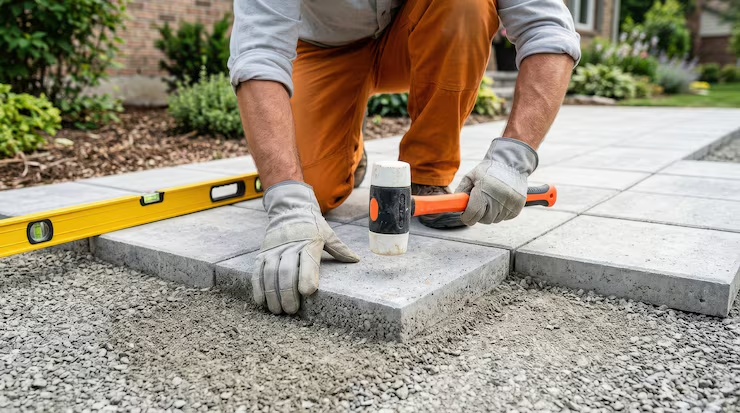
Everything that makes a walkway fail starts underground. Excavation depth, the base material, how well it’s compacted, the bedding layer under the pavers or slab, and the edge restraint holding the whole assembly in place — that’s the work nobody sees and the reason one walkway stays flat for decades while another goes wavy within a few winters. Frost doesn’t ask permission. Water gets into the base, freezes, expands, and pushes. A base that was compacted properly and drains instead of holding water shrugs this off. A base that was rushed telegraphs every freeze-thaw cycle straight up through the surface, and you see it first at the edges and the joints, long before the middle of the walk shows any trouble.
Edge restraint matters more on a walkway than people expect, because a path doesn’t have a curb protecting it the way a street does. Loose edges are how individual pavers start walking out of line within a couple of seasons, and once one paver shifts, the ones next to it follow. A few things worth asking about before work starts:
- How the new walk will meet existing steps, porch slabs, or a driveway apron without an awkward height jump
- Whether the base needs to change partway across the property if grade or drainage shifts
- How water moving off the roof or driveway will be routed away from the new path instead of across it


What Our Clients Say
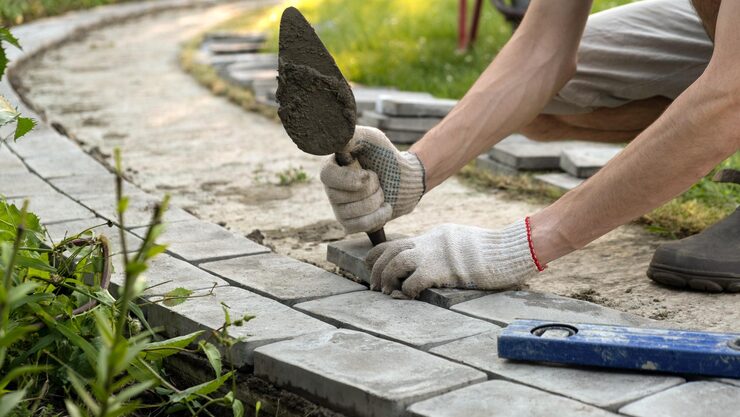
Material choice decides how the walkway ages. Bluestone suits older Needham homes but requires replacing the whole slab if cracked.
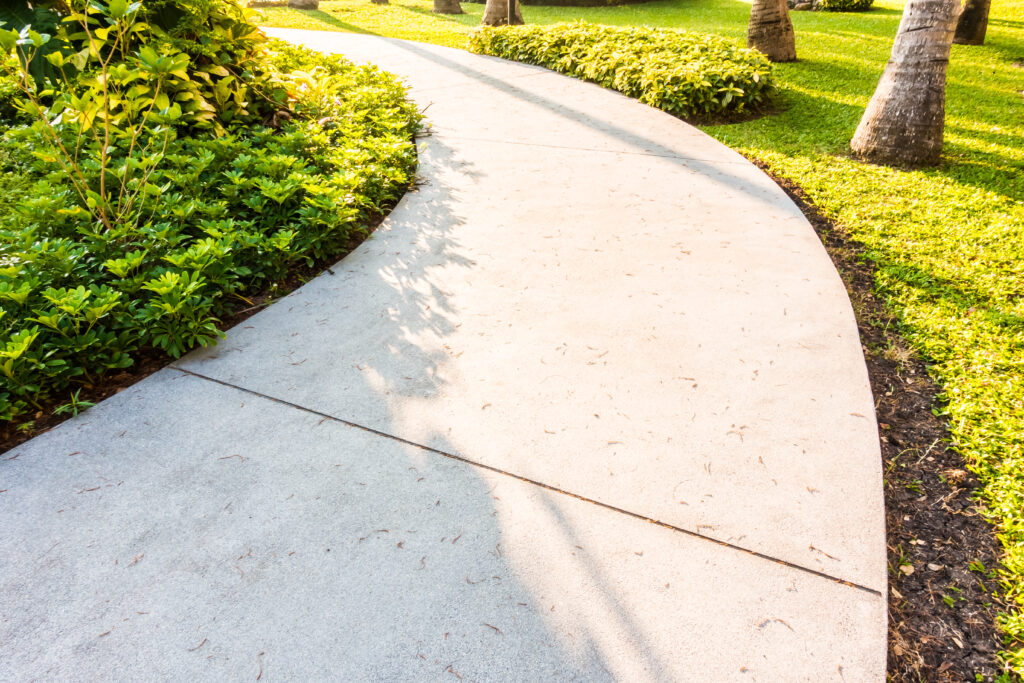
Poured concrete is the cheapest option up front and the least forgiving over time. Once frost cracks a slab, that crack is permanent and visible for the life of the walk, with no way to repair just the damaged section.
Natural stepping stone or irregular fieldstone set in stone dust gives an informal, older New England look. It handles ground movement well but needs a base that’s shaped and compacted stone by stone, not poured.
Brick is the classic match for colonial and Georgian-style houses common around Needham. It ages well visually but is denser and more expensive than concrete paver options of similar size.
Grade is the part people skip. A walkway is a hard surface laid across ground that used to absorb water. Get the pitch wrong and that water runs toward the foundation instead of away from it.
Even a short path needs a deliberate slope, usually subtle enough that it isn’t visible to the eye but still enough to move water off the surface and away from the house during a heavy rain.
Choosing a material
The materials are not equal. Each suits some properties and not others.
Where the walkway meets the driveway matters as much as either surface alone. A mismatched material or a step up of the wrong height makes the whole front of the house look unplanned, even if both surfaces are sound.
Tying a new walkway into Needham’s existing entries, stoops, or step sets means matching heights, slopes, and reveals exactly, since even small discrepancies are obvious to anyone walking up to the front door every day, rain or shine.
Existing retaining walls, planting beds, and mature trees all constrain where a new walk can run. Root systems from established oaks and maples, common on older Needham lots, can heave a path laid too close.
Matching an older house is as much about proportion as material. A walkway too wide or too narrow for the facade looks wrong even in the right stone, so we work from the house’s own lines first.
On a new Needham construction lot, the walkway is often the last piece built, after grading and the driveway are finished.


Why this fits Needham properties specifically
Needham’s mix of established neighborhoods and active teardown-rebuild projects means we see both ends of this job regularly. On a rebuild, the walkway gets designed alongside a new driveway and entry from scratch, which is actually the easier version of this work — grading, materials, and sightlines can all be planned together instead of around decisions made decades ago.
The harder, more common job is the established house where the front walk has outlived its usefulness. Settled bluestone, a concrete path installed before anyone thought about drainage, or a walk that was fine when a tree was a sapling and now runs straight through its root flare. These lots tend to have mature plantings and some grade change between the street and the front door, which means the new walkway has to work with what’s already established rather than starting clean.
Either way, the work is the same underneath: get the excavation and base right, pick a material that matches the house and handles frost, and pitch it so water goes somewhere other than the foundation.
What drives the price
A new walk has to meet several existing things cleanly.
- The entry : The walk must arrive at the door at a sensible height. The threshold sets the finished level, so the work starts at the door and runs outward.
- The drive : Where a walk meets a drive, the levels and the drainage have to agree. A mismatch becomes a trip edge or a puddle.
- Walls and planting : Existing stone walls, foundation beds and mature trees constrain the route. Roots under a path are worked around, not cut through without thought.
- An older house : Scale, colour and pattern should follow the architecture. A narrow, dark stone walk suits an old house differently than a broad paver field does.

Getting started
If the front walk is heaving, cracked, or just doesn’t match a newly rebuilt house and driveway, that’s a straightforward site visit. We look at the existing grade, how the current walkway was built, what materials are already in place, and most importantly, what’s feeding water toward the problem area — Needham’s mix of older foundations, mature tree roots, and heavy clay soil in spots all play into why walkways settle or crack in the first place. We’ll also talk through how the walkway ties into your driveway, steps, and entryway, since those transitions are often where water pools or where mismatched materials stand out the most.
From there, we’ll walk you through realistic options for materials and layout based on your home’s style and how the space actually gets used — whether that’s a simple poured concrete path, a paver walkway, or something that matches an existing driveway install. Call (413) 337-3772 to talk through what’s currently on your lot, what’s likely causing the issue, and what a properly built replacement walkway would involve from start to finish.
Before you call
It helps to know:
- Where the walk starts and where it needs to end
- Whether the route crosses a slope or a shared area
- Which material you lean towards, and whether the house is older
- Where water currently runs on the property
Questions people ask
How is a walkway installation different from driveway paving?
A walkway carries foot traffic, not vehicle weight, so the base doesn't need to be built to the same load spec as a driveway. But it still needs proper excavation, compaction, and edge restraint, because frost heave affects a thin pedestrian path just as much as a drive, and sometimes more visibly since any unevenness is underfoot.
Can a new walkway tie into an existing driveway or entry?
Yes, and matching the tie-in point is usually the trickiest part of the design. We match materials, heights, and transitions so the walkway, driveway, and entry steps read as one connected approach rather than three separate projects stitched together.
Will tree roots near the house affect a new walkway?
They can. Mature trees common on older Needham lots send roots well beyond the canopy, and a path laid too close can heave within a few seasons as roots grow. We route around root zones where possible and adjust the base where we can't avoid them entirely.
What material holds up best through a Massachusetts winter?
No material is immune to freeze-thaw, but how each one fails differs. Pavers flex at the joints and let you replace a single damaged unit. Poured concrete and stone slabs crack as one piece, and once that crack is there, it doesn't go away.
Does the walkway need to pitch away from the house?
Yes. Any hard surface laid near a foundation needs to move water away from it rather than toward it. The pitch is usually subtle enough not to be noticeable when walking, but it's a deliberate part of the design, not an afterthought.
Next step
Call Driveway Specialists on (413) 337-3772. We are a family-run company in business since 1988, and we will walk the route with you and talk through material, grade and drainage before anything is priced.