
Walkway Installation in Norwood, MA
Most houses in Norwood sit on compact post-war lots with narrow drives squeezed between close-set neighbors and a short, flat run from the sidewalk or driveway to the front door. That tight frontage is actually an advantage for walkway work. There’s no long slope to manage, no drainage swale to route around, and the whole path is usually visible from the street in one glance – which means it has to look right from day one, not just hold up underground.
A front walk is also one of the few hardscape jobs where appearance and longevity are equally weighted. You’re not fixing a cracked slab that was failing anyway. You’re choosing a surface, a pattern, and an edge that will sit next to your house for years, get walked on every day, and either age well or start looking tired within a few seasons. That decision happens mostly below ground, not above it.
What holds a walkway flat
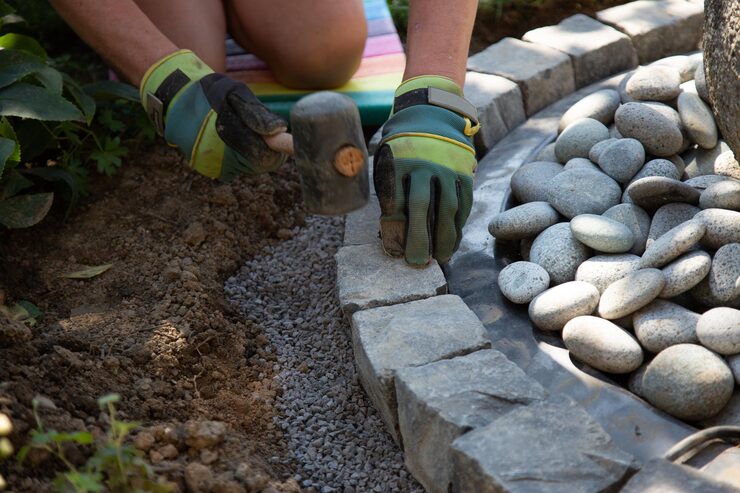
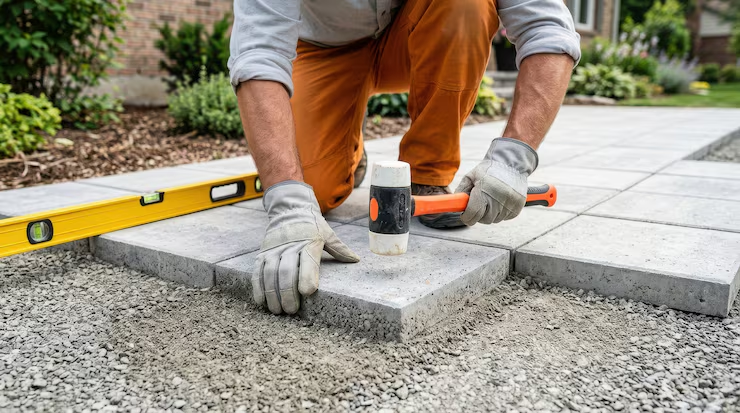
Everything visible on a walkway – the pavers, the stone, the joints – sits on a base that nobody sees again once the job is done. That base is what determines whether the walk stays flat through a Massachusetts winter or starts heaving and settling unevenly within a few years. The process is excavation to a stable subgrade, a compacted base layer, a bedding layer, and edge restraint that keeps the whole assembly from creeping sideways over time.
Frost is the reason this matters more here than in most of the country. Water in the soil beneath a walkway freezes and expands, lifting whatever is above it. Where the base is uniform and well-compacted, that movement is even and the surface stays flat. Where it’s inconsistent – loose in one spot, compacted in another, or mixing soil types – the walkway lifts unevenly, and that’s when you get the wavy, tripping-hazard surfaces that show up in older Norwood neighborhoods after a few freeze-thaw cycles. Good base work isn’t glamorous, but it’s the entire reason one walkway stays flat for decades and another needs relaying after five winters.
Material choice matters too, and it’s worth deciding early rather than picking from whatever’s in stock. Clean-edged concrete pavers read as tidy and formal, which suits the symmetrical front elevations common on Norwood’s Colonial and Cape-style homes. Irregular natural stone – bluestone or fieldstone – reads more relaxed and tends to suit older, less formal frontages. Either way, the joint pattern and the border course do more to define the look than the paving material itself, so it’s worth spending time on that detail before anything gets set.


What Our Clients Say
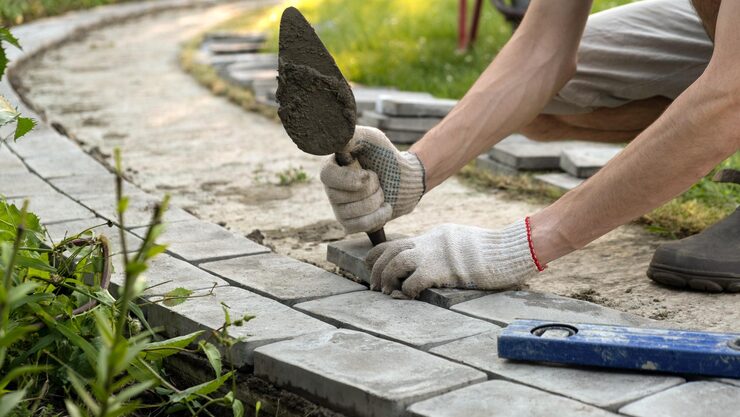
Walkway width and layout on a compact Norwood lot usually come down to the gap between the house and the property line – every inch gets planned, not guessed, with materials and curves chosen to suit narrow side yards and existing landscaping.
Concrete pavers
Pavers handle Norwood’s freeze-thaw cycles well because individual units flex slightly instead of cracking as one slab. If a paver shifts, stains, or cracks, it can be lifted and swapped out without repouring or redoing the entire walkway.
Natural stone
Bluestone and similar natural stone age beautifully and suit the character of older Norwood homes, but irregular units cost more to install, take longer to lay correctly, and are harder to patch neatly if a single piece ever cracks or fails.
Poured concrete
A single poured slab is the least expensive option up front for a Norwood walkway, but it cracks as one continuous piece under winter frost movement, and any repair patch always stays visibly mismatched against the surrounding concrete.
Brick
Brick suits the colonial and cape-style homes common throughout Norwood, lending a classic, warm look to walkways.
Choosing by how it ages
The right material depends on whether you want low upkeep, the best long-term look, or the lowest price today – these three goals rarely point to the same choice.
Choosing a material
The materials are not equal. Each suits some properties and not others.
Grade and water
A walk has to pitch water away from the foundation, not toward it. On a flat Norwood lot, even a slight miscalculation here sends runoff straight at the house instead of into the yard.
Why flat lots still need pitch
Flat Norwood frontage looks problem-free, but a perfectly level walkway pools water at thresholds and gateways. We build in a deliberate, slight pitch and cross-fall, directing runoff away from the house rather than leaving drainage to chance or settling soil.
Tying into the driveway
Where the walk meets the drive, materials, joint lines and heights have to line up cleanly.
Tying into the entry
The step at the front door sets the finish height for the whole Norwood walkway.
Matching an older house
Many Norwood homes date to the postwar boom, with simple brick or concrete stoops.

Working around existing planting
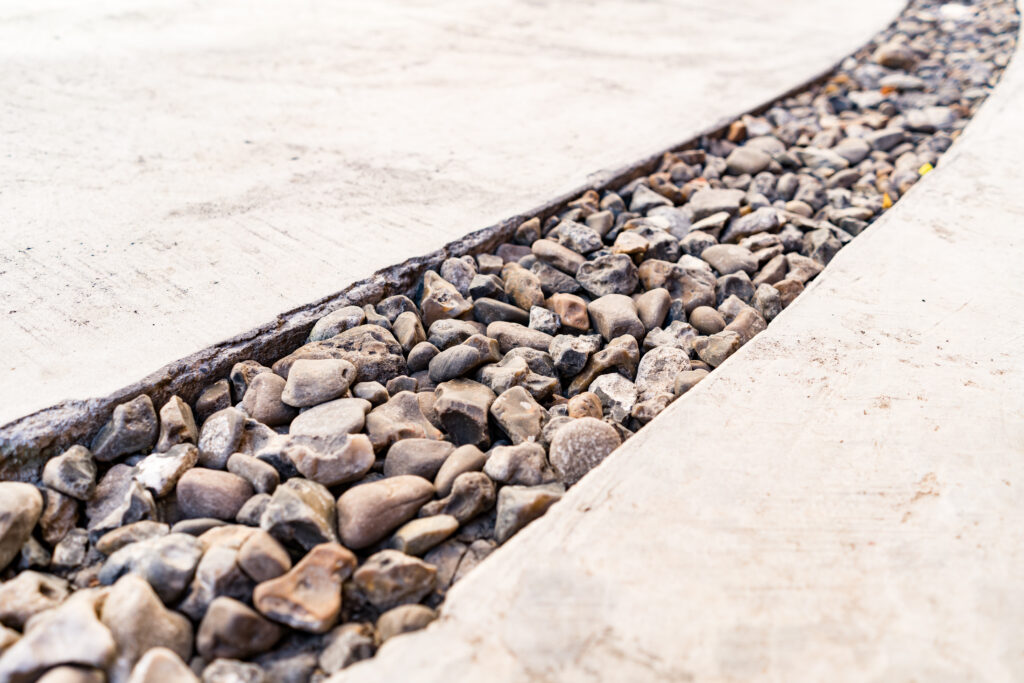
Mature foundation shrubs, boxwood hedging, and narrow side-yard beds are common features on Norwood’s older lots, where properties were landscaped decades ago and root systems have had plenty of time to spread close to the house. Any walkway installation here has to account for that reality from the planning stage, not as an afterthought once the digging starts.
We map out planting beds and visible root zones before excavation begins, adjusting the path’s line or edge where needed to avoid severing roots that keep mature shrubs and small trees healthy. Hand digging replaces machine excavation near trunks and root balls, and we keep spoil and foot traffic off adjacent beds to protect soil structure and drainage. Where a path edge runs close to existing planting, we’ll discuss options like a slightly altered curve, a root barrier, or a narrower excavation profile rather than simply removing established greenery.
- Careful hand excavation around root systems
- Path adjustments to protect mature shrubs and trees
- Minimal disturbance to surrounding beds and soil
The goal is a walkway that looks intentional against your existing garden, not one that leaves your established planting worse off.
What drives the price
A new walk has to meet several existing things cleanly.
- The entry : The walk must arrive at the door at a sensible height. The threshold sets the finished level, so the work starts at the door and runs outward.
- The drive : Where a walk meets a drive, the levels and the drainage have to agree. A mismatch becomes a trip edge or a puddle.
- Walls and planting : Existing stone walls, foundation beds and mature trees constrain the route. Roots under a path are worked around, not cut through without thought.
- An older house : Scale, colour and pattern should follow the architecture. A narrow, dark stone walk suits an old house differently than a broad paver field does.
Why Norwood's lots suit this work
The site conditions across Norwood’s residential streets make front walk installation more straightforward than it is in towns with steep or irregular lots. Frontage is typically flat, the distance from curb or driveway to door is short, and the soil under most of these postwar developments drains reasonably well compared to the heavier clay found in some older, low-lying parts of eastern Massachusetts. That combination means the base work behaves predictably – compaction holds, and frost movement, while still a factor every winter, tends to be more even across a short, flat run than it would be on a long sloped path.
The narrow side yards and close house spacing that define a lot of Norwood’s streets also simplify access. Material deliveries and equipment don’t need to maneuver around long curved drives or steep grades, which keeps the job contained to a smaller footprint and shortens the disruption to the property. For a homeowner replacing a cracked concrete path or adding a walk where there’s only grass now, that’s a meaningfully easier job than the same work on a hillier lot elsewhere in Norfolk County.
Before you call
It helps to know:
- Where the walk starts and where it needs to end
- Whether the route crosses a slope or a shared area
- Which material you lean towards, and whether the house is older
- Where water currently runs on the property
Questions people ask
How long does a walkway installation take in Norwood?
It depends on the length of the walk, the material chosen, and what's involved in removing an existing surface first. A short front walk on a flat lot is generally more contained than a long or sloped path.
Can you install a walkway without disturbing existing landscaping?
In most cases yes. Excavation for a walk is narrow and shallow compared to a driveway, so we work carefully around established shrubs and garden beds rather than removing them.
Which material is best for a Norwood front walk?
It depends on your priorities. Pavers offer the easiest repairs, natural stone ages the best, poured concrete costs the least upfront, and brick suits older colonial and cape-style homes. We'll walk through the trade-offs for your specific house.
Will the new walkway match my driveway?
It can be designed to complement it, but the walkway and driveway don't need to be the same material. What matters more is that the transition between them is level, clean, and planned rather than an afterthought.
Why does my current walkway have uneven, lifted sections?
That's almost always a base problem rather than a surface problem. Inconsistent compaction or mixed soil beneath the walk causes uneven frost heave each winter, which gradually distorts the surface above it.
Next step
Call Driveway Specialists on (413) 337-3772. We are a family-run company in business since 1988, and we will walk the route with you and talk through material, grade and drainage before anything is priced.