
Walkway Installation in Shrewsbury, MA
Shrewsbury splits into two different kinds of property, and both end up needing the same thing solved differently. Around Lake Quinsigamond and the older village streets, lots are narrow and front walks are short, often squeezed between a driveway and a foundation planting bed that’s been there for decades. Out toward the east side, newer subdivisions have wider frontage, longer setbacks from the road, and a front entry that can look bare without a proper path connecting it to the driveway. In both cases, a walkway is a design decision as much as a construction one. It’s not a repair job; it’s an addition that either reads as part of the house or looks bolted on.
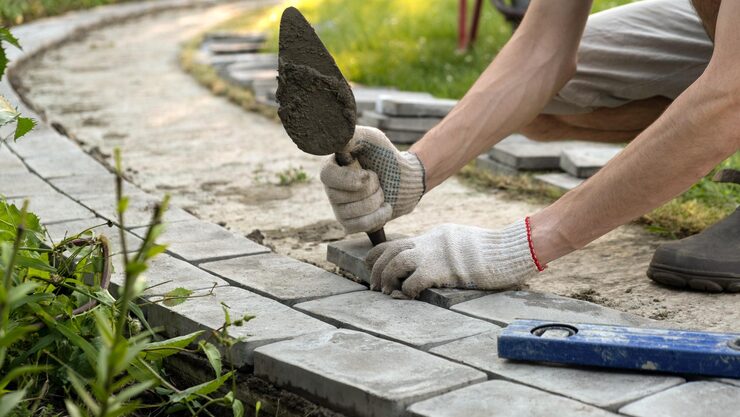
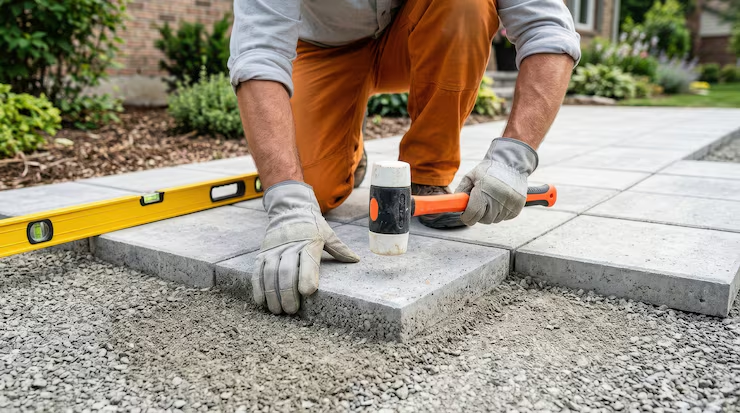
The work below the surface decides which outcome you get. A walkway that stays flat through a Massachusetts winter has the same bones as one that heaves and separates: excavation to a consistent depth, a compacted base layer that doesn’t hold water, a bedding layer under the surface material, and edge restraint that keeps the whole assembly from creeping sideways as the ground freezes and thaws. Skip any one of those steps and the walkway will eventually show it, usually at a joint or an edge, usually within a couple of winters. On older Shrewsbury lots with established trees, root intrusion is an added wrinkle; a base built to spec resists heaving better, but no walkway near a mature maple or oak is entirely immune, and that’s worth discussing honestly before the layout is finalized rather than after.
Matching the house, not just the budget
Material choice on a walkway gets judged by the front door, which is a more exposed spot than a driveway ever is. Pavers in a clay or concrete blend read differently against a colonial on an older Shrewsbury street than a poured concrete path does against a contemporary build on the east side. Natural stone costs more and reads as more permanent, but it’s not the right fit for every house. The honest answer is that the walkway should look like it was planned with the house, not added after, which means matching brick tones, trim colors, and even the driveway material already in place before anything else gets decided.
Grade matters just as much as material. Water that used to soak into a planting bed now has somewhere else to go once that bed is covered in pavers or concrete, and that water has to be pitched away from the foundation, not toward it. On a sloped lot near the lake, that’s a real design constraint, since runoff has to be managed without turning the walkway into a ramp. On a flatter subdivision lot, it’s a smaller problem but still not optional, and it still has to be planned for rather than assumed away.


What Our Clients Say
What sits under a walkway
Excavation, compacted sub-base, bedding layer and edge restraint.
Pavers: the common choice
Clay and concrete pavers handle freeze-thaw by flexing at the joints instead of cracking.
Poured concrete: simpler, less forgiving
Concrete reads clean and modern but cracks as one piece once it moves. Control joints help, but a weak base under concrete shows up as a crack, not a gap.
Natural stone: the permanent option
Bluestone or granite ages the best and costs the most, developing a weathered character that suits Shrewsbury's older streetscapes beautifully.
Grading away from the house
Once ground is covered, water runs off instead of soaking in.
Tying into the driveway
The point where a new walkway meets the existing drive gets the most attention.
Choosing a material
The materials are not equal. Each suits some properties and not others.
Working around mature trees
Shrewsbury's older streets have mature root systems that will heave a walkway laid too shallow.
Edge restraint and plow season
An unedged walkway near a driveway takes plow and shovel damage at the border first. Proper restraint keeps that edge from being the point of failure.
Matching an older house
A walkway added to a decades-old Shrewsbury colonial has to read as original, not applied. Material, scale, edging and joint pattern all carry that impression, or they don't.
New subdivision frontage
East Shrewsbury's newer homes often have no real path from drive to door.
Walls, steps and planting beds
A walkway rarely stands alone.


Where this fits in Shrewsbury
Close to the lake, short lots mean a walkway has to do a lot of work in a small footprint; a bad grading decision shows up fast. On the east side, where lots run longer and flatter, the path from driveway to door is often the missing piece that makes a newer house look finished rather than half-built. Worcester County winters are hard on anything laid without a proper base, and that’s as true for a forty-foot front walk as it is for a driveway. The difference with a walkway is how visible the result is every time someone comes to the door.
A short, flat path near an older house calls for a narrower scope than a winding walk connecting a long driveway to a wraparound porch. Both start with the same excavation and base work; they differ in material, width and how many transitions they need to handle along the way. Getting that scope right up front is most of what keeps the project on budget and on schedule once digging starts.
What drives the price
A new walk has to meet several existing things cleanly.
- The entry : The walk must arrive at the door at a sensible height. The threshold sets the finished level, so the work starts at the door and runs outward.
- The drive : Where a walk meets a drive, the levels and the drainage have to agree. A mismatch becomes a trip edge or a puddle.
- Walls and planting : Existing stone walls, foundation beds and mature trees constrain the route. Roots under a path are worked around, not cut through without thought.
- An older house : Scale, colour and pattern should follow the architecture. A narrow, dark stone walk suits an old house differently than a broad paver field does.

Next step
A walkway is one of the more visible things on a property, and it’s also one of the easier projects to get wrong by rushing the base. Shrewsbury’s mix of clay-heavy soil and freeze-thaw winters means a walkway that isn’t built on a properly compacted gravel sub-base will heave, crack, or settle unevenly within a few seasons, no matter how good the surface material looks on day one. The right next step depends on what you’re trying to achieve: a new front walk that ties into your entry, a connector path running alongside an existing driveway, or a full entry rework that includes lighting, edging, and grading for better drainage away from the foundation.
Before any decision gets made about brick, pavers, natural stone, or poured concrete, it’s worth having someone look at the site itself, the slope, the soil, and how water moves across your yard after a hard rain. If you’re planning any of these projects in Shrewsbury, call Driveway Specialists at (413) 337-3772 to walk the property together and figure out which materials and layout actually make sense for your house.
Before you call
It helps to know:
- Where the walk starts and where it needs to end
- Whether the route crosses a slope or a shared area
- Which material you lean towards, and whether the house is older
- Where water currently runs on the property
Questions people ask
What is the best walkway material for a Shrewsbury property?
It depends on the house and the lot. Near Lake Quinsigamond where lots are tight and older, clay or concrete pavers tend to suit the smaller front walks and match older house fronts well. On the larger eastern subdivisions, bigger-format pavers or a poured concrete path with a broom or exposed finish often fits the scale of the frontage better. Neither is automatically right; it comes down to how the walk sits against the house and drive.
Will frost crack a new walkway?
A rigid slab with a weak base will crack. A segmental paver walk, set on compacted base with sand bedding and proper edge restraint, is built to move with the frost cycle rather than fight it, which is why it stays flatter over time than a thin, poorly based concrete path.
Can a walkway be added without disturbing the existing driveway or lawn?
Usually yes. Excavation for a walkway is narrow and shallow compared with a driveway, and the edges can be cut cleanly against existing concrete, asphalt or lawn. Where the new walk meets the drive, the joint and transition get the most attention so it doesn't become a trip point or a water channel.
How does drainage around a new walkway affect the house foundation?
A hard surface sheds water instead of absorbing it, so the walkway has to be pitched to move that water away from the foundation and toward a lawn area or existing drainage, not toward the house. This is decided at grading, before any base material goes down.
Next step
Call Driveway Specialists on (413) 337-3772. We are a family-run company in business since 1988, and we will walk the route with you and talk through material, grade and drainage before anything is priced.