
Walkway Installation in Sudbury, MA
A lot of Sudbury properties sit well back from the road, down a long drive that winds through trees before you ever reach the front door. On a lot like that, the walkway is often the last piece that ties the whole approach together: the path from where you park to the entry, or the link between a side door and a patio. It gets less traffic than a driveway but more scrutiny, because it’s the part of the property people actually walk across and look down at. Getting it right matters more than people expect going in.
Done well, a walkway on a wooded, winding Sudbury lot reads as if it has always been there, following the natural grade rather than fighting it, curving around an established oak instead of forcing the tree to go. Done poorly, it heaves, pools water, and looks patched within a few winters. The difference is almost entirely in work nobody sees once it’s finished.
What’s under the surface
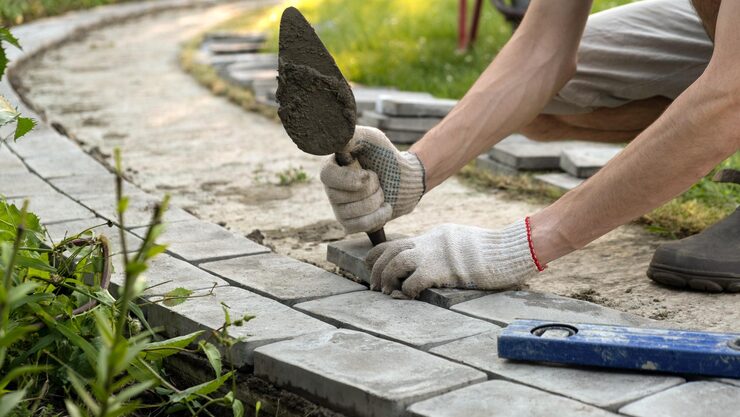
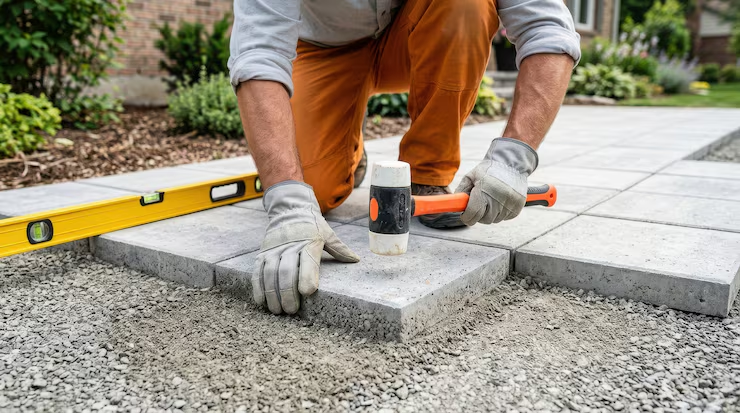
Every walkway that stays flat through a Massachusetts winter starts with excavation deep enough to remove the organic topsoil and root material, replaced with a compacted gravel base. That base does two jobs: it carries load, and it drains water away from the walking surface before that water can freeze and expand. Frost doesn’t move a walkway evenly. It lifts the sections with the least support and the most trapped moisture, which is why an inconsistent base shows up a season or two later as a wave, not a crack. Depth and compaction need to be consistent along the entire run, not just at the ends where it’s easiest to check.
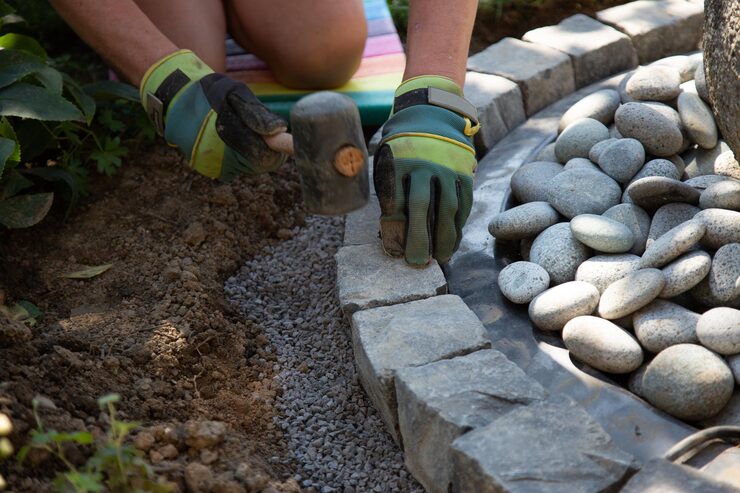
Edge restraint matters just as much as the base. Without it, pavers and bedding material migrate sideways over time, especially where a path curves through planting beds or around tree roots, which is the normal layout on a Sudbury lot rather than the exception. A straight run through open lawn can get away with less; a path that bends through roots and beds can’t.
Material choice affects both of those concerns. Common options for Sudbury walkways include:
- Natural stepping stone or fieldstone, set to echo the irregular, wooded character many lots already have
- Concrete pavers, for a cleaner, more uniform line where the house itself is more formal
- Poured concrete or exposed aggregate, where a continuous surface suits the grade or the budget better than individual units
On properties bordering conservation land, the work tends to be more deliberate about disturbance. Keeping excavation tight to the footprint of the path, rather than opening up a wide work area, matters more here than on a typical suburban lot, and it often means hand work in sections a machine can’t reach without damaging roots or grade nearby. Surface water also needs somewhere to go that isn’t straight toward a foundation or a neighboring wetland buffer, which is a real consideration on many Sudbury parcels and worth raising before excavation starts, not after.


What Our Clients Say
Mature oaks and maples define most Sudbury frontages. Roots run shallow and wide, and a walkway built too close to a trunk will heave within a few years as the roots keep growing underneath it.
Materials: the real trade-offs
Concrete pavers handle Sudbury's freeze-thaw cycles well since individual units flex slightly instead of cracking as a whole slab, and a damaged section lifts out for easy replacement.
Natural stone, bluestone especially, suits older Sudbury homes and wooded, tree-lined settings so well. It’s slower to install and pricier than poured options, but it weathers gracefully, developing character and charm over time rather than cracking or fading.
Poured concrete is the cheapest option initially. It cracks as a single slab under frost movement, and once it cracks, the repair always shows. It suits flat, simple runs better than curved paths through roots.
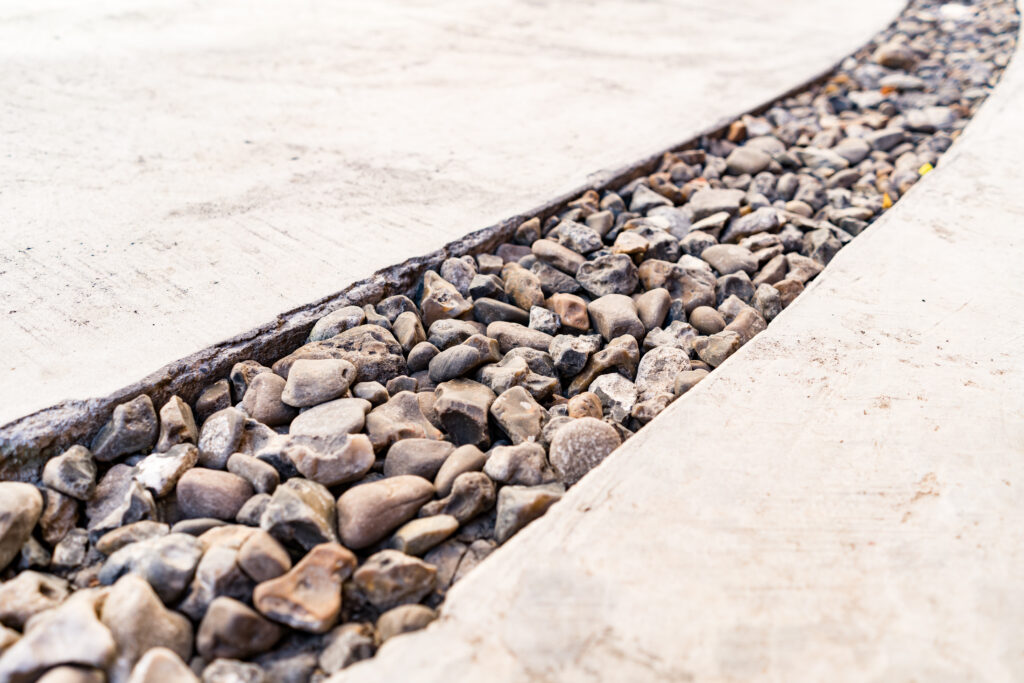
Gravel or stepping-stone paths suit the long, informal stretches common on Sudbury's wooded lots, where a fully hardscaped path would look out of place against the natural rock and tree-lined setting.
Drainage and grade
Hard surfaces don't absorb water the way soil does, so grading matters.
Choosing a material
The materials are not equal. Each suits some properties and not others.
On a sloped Sudbury lot, grading the path correctly often matters more than the material chosen, since a flat walk on a falling grade will carry runoff straight toward the house.
In Sudbury, long driveways winding through trees often lose grade gradually, so water collects in low points along the path instead of running off at either end.
Tying it into what's already there
A walkway rarely stands alone.
Matching material and jointing style to an older Sudbury home takes more planning than a new-build property, where there's no existing palette of stone or brick to work around.
Where a Sudbury walkway crosses from driveway paving onto a softer path material, the transition point needs its own edge restraint, properly bedded, so freeze-thaw cycles and seasonal ground movement don’t pull the two surfaces apart over time.

Where this fits in Sudbury
Sudbury’s lots tend to be large, wooded, and set well back from the street, which puts the walkway in a different role than it plays in a tighter suburban town. It’s not competing for space with the driveway or squeezed against a property line. It’s a path through a landscape that already has mature trees, established planting, and in many cases conservation land along one edge. That setting rewards materials and layouts that work with the trees rather than against them: routing around root zones instead of through them, keeping excavation narrow near protected boundaries, and choosing a surface that can handle shade and damp leaf cover without becoming slick.
A long winding drive with a path branching off to a side entry or garden also means more transition points to plan for than a simple front walk on a small lot. Each one is a place where grade, drainage, and material have to agree with each other, and where a short cut during installation shows up as a problem within a few winters.
What drives the price
A new walk has to meet several existing things cleanly.
- The entry : The walk must arrive at the door at a sensible height. The threshold sets the finished level, so the work starts at the door and runs outward.
- The drive : Where a walk meets a drive, the levels and the drainage have to agree. A mismatch becomes a trip edge or a puddle.
- Walls and planting : Existing stone walls, foundation beds and mature trees constrain the route. Roots under a path are worked around, not cut through without thought.
- An older house : Scale, colour and pattern should follow the architecture. A narrow, dark stone walk suits an old house differently than a broad paver field does.
Next step
If you’re planning a walkway for a Sudbury property, the lot itself: the trees, the slope, the existing drive, decides most of the right answers before material selection even comes into it. Mature tree roots along the Sudbury River corridor and the gentle but persistent grade changes common to this area mean a walkway has to be planned around the land, not laid on top of it. That means careful excavation to avoid root damage, proper base preparation so the path doesn’t heave or settle through New England’s freeze-thaw cycles, and thoughtful routing that ties the walkway naturally into your existing driveway and entry points rather than cutting across the lot awkwardly.
Driveway Specialists has worked wooded, long-drive properties across Middlesex County since 1988, including nearby Wayland and Concord lots with the same root and grade challenges. We’ve seen what holds up here and what doesn’t, from material choice to drainage details. Call (413) 337-3772 to talk through what your property actually needs, and we’ll walk the site with you before recommending anything.
Before you call
It helps to know:
- Where the walk starts and where it needs to end
- Whether the route crosses a slope or a shared area
- Which material you lean towards, and whether the house is older
- Where water currently runs on the property
Questions people ask
Can a walkway be built around existing tree roots instead of removing them?
In many cases yes. Routing the path slightly or using a surface laid on a shallower, flexible base can avoid cutting major roots, which also avoids destabilizing the tree. It takes more planning at the layout stage than a straight path would.
Will a walkway near conservation land need special handling?
Properties bordering conservation land generally call for tighter, more controlled excavation so the work doesn't disturb ground outside the path footprint. It's a site-by-site question depending on how close the boundary sits to the planned path.
Does a gravel path need the same base work as a paver walkway?
It needs less depth but still needs a compacted sub-base and edge restraint, otherwise gravel migrates into lawn and planting beds within a season or two, especially on a sloped or winding route.
How does a walkway tie into a driveway that's already paved?
The transition point needs its own edge restraint where the two materials meet, so freeze-thaw movement in one surface doesn't pull apart the joint with the other over time.
Next step
Call Driveway Specialists on (413) 337-3772. We are a family-run company in business since 1988, and we will walk the route with you and talk through material, grade and drainage before anything is priced.