
Walkway Installation in Watertown, MA
Watertown lots don’t leave much room to work with. Two-families share a drive, the setback from the street is small, and the front walk often has to do several jobs at once: get people from the sidewalk to the door, connect to a shared driveway apron, and still look like it belongs to the house. A new walkway here is rarely a blank slate. It’s a piece that has to fit between a porch that’s been there for decades, a driveway another contractor already set, and a strip of yard that might be four feet wide. That’s a design problem before it’s a materials problem, and it’s worth thinking through before anyone breaks ground, including where snow gets shoveled or piled and whether a walkway that’s too narrow turns into a bottleneck every winter.
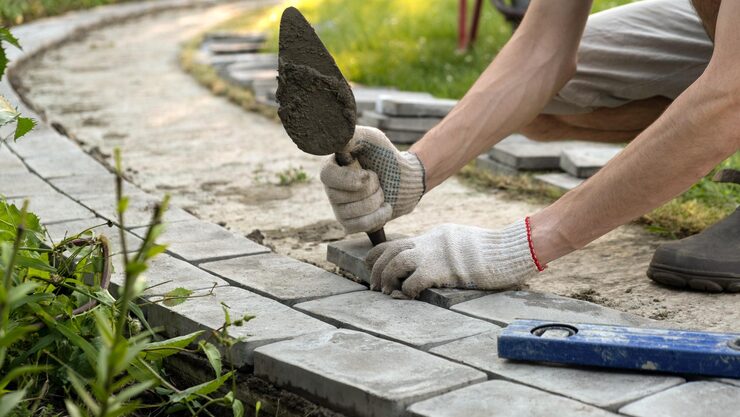
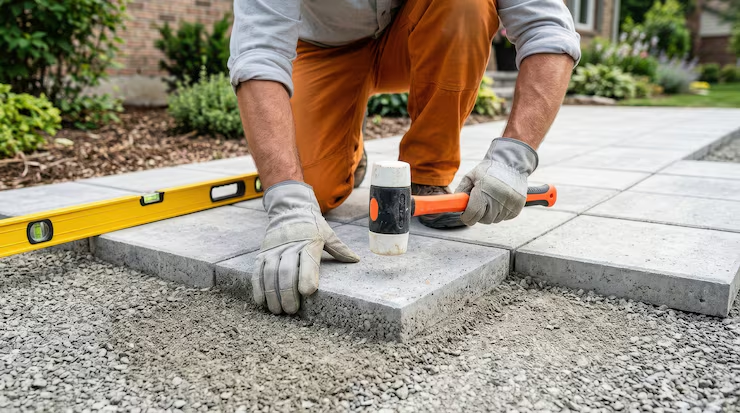
What happens below the surface decides whether that walkway stays flat or starts to heave within a few winters. Massachusetts frost doesn’t stay in one place. It moves moisture through the soil and pushes up anything that isn’t sitting on a base that can handle it. The sequence is always the same: excavate down past the topsoil and organic material, lay a compacted gravel base that lets water drain through instead of sitting and freezing, bed the surface material correctly, and set edge restraint that holds the line instead of letting it creep. Skip or shortcut any one of those steps and the walkway will tell you within a couple of seasons, usually at the joints or the edges first.
On a tight Watertown lot, the walkway edge is often right up against a planting bed, a foundation, or a shared drive. Frost heave shows up fastest where the base is thinnest or the drainage is worst, which on a narrow lot is usually right at that edge. Proper edge restraint, tied into a base that actually drains, is what keeps a paver or brick walkway from gradually working itself loose along the line where it meets everything else. Grading matters too: water shed off a roof or a neighboring driveway has to go somewhere, and on a small lot that often means routing it along or under the walkway rather than letting it pool against the house.
Material choice matters just as much as what’s underneath it:
- Concrete pavers hold a crisp edge, come in a range of finishes, and if one cracks or sinks, that single unit can be lifted and reset without touching the rest of the walk.
- Brick has the look that suits an older Watertown house, especially near a brick foundation or chimney, but it’s less forgiving of settlement and costs more to repair piece by piece.
- Poured concrete is the least expensive option and goes down fast, but it moves as one slab: a crack or a heave shows across the whole surface, and there’s no fixing one section without redoing a run.
- Natural stone looks the best as it ages and resists wear, but it costs the most and takes longer to set correctly.


What Our Clients Say
Drainage decides more than the base. The walkway itself has to pitch water away from the house, not toward it, or you’re sending runoff straight at a foundation that’s already close to the property line.
On a shared two-family drive, common in Watertown, the walkway often runs parallel to the apron for several feet.
Tying a new walkway into an existing Watertown concrete or asphalt driveway means matching height, slope, and material expansion at the joint.
Mature shade trees near older Watertown homes keep walkways damp longer after rain.
Where a Watertown walkway meets a porch or stoop, step height, landing size, and slope all have to work together. Getting that transition wrong makes an otherwise well-built walkway feel unfinished and can even create a tripping hazard underfoot.
Narrow side yards, common in Watertown’s denser blocks, often call for a walkway that’s more utilitarian in width but still worth detailing well, since it’s seen every day.
Choosing a material
The materials are not equal. Each suits some properties and not others.
Existing retaining walls or raised beds along a Watertown front walk need to be accounted for in the excavation plan, or the new work ends up undermining what’s already holding soil in place, causing costly settling and cracks later.
A walkway that matches the age and material of the house, rather than whatever was cheapest, tends to hold its value better when the property eventually sells.
Access for equipment is tighter on a dense Watertown lot than almost anywhere else nearby. Material often has to be moved by hand or wheelbarrow the last stretch, which affects scheduling.
Where two driveways sit close together on adjoining Watertown lots, a walkway sometimes has to route around a shared boundary line rather than straight from curb to door, so we plan the path, grading, and materials around that constraint from the outset.
Older Watertown streets often have uneven sidewalk-to-lawn grades.


Matching the house and what's already there
Most walkway work we do in Watertown isn’t a standalone project — it’s tying new work into something already there: a concrete driveway apron, a brick or stone porch, a retaining wall holding back a sloped yard, or foundation plantings that have sat in place for years. Getting those transitions right matters more than any single material choice. A paver walk meeting a concrete drive needs a clean, level joint. A path running past an old stone wall should pick up a tone or texture from that wall rather than fight it. On lots where everything sits close together, these small matches are what make finished work look planned rather than patched in.
Houses in Watertown’s older neighborhoods tend to be brick, clapboard, or a mix with stone foundation courses, built well before concrete walkways were standard. A material that nods to that period, laid with care for how it meets the porch and the drive, reads as intentional rather than incidental — the difference between a walkway that looks tacked on and one that looks like it was always meant to be there.
What drives the price
A new walk has to meet several existing things cleanly.
- The entry : The walk must arrive at the door at a sensible height. The threshold sets the finished level, so the work starts at the door and runs outward.
- The drive : Where a walk meets a drive, the levels and the drainage have to agree. A mismatch becomes a trip edge or a puddle.
- Walls and planting : Existing stone walls, foundation beds and mature trees constrain the route. Roots under a path are worked around, not cut through without thought.
- An older house : Scale, colour and pattern should follow the architecture. A narrow, dark stone walk suits an old house differently than a broad paver field does.

Where this fits in Watertown, and what's next
This kind of work suits the Watertown lots we see most often: small frontages, shared two-family drives, minimal space between the sidewalk and the front door, and houses old enough that the original walk is cracked, sunken, or simply the wrong material for how the property is used now. It’s not a driveway repair and it’s not a paving job. It’s a front-of-house improvement that has to work with tight geometry, existing structures, and a street-facing apron that’s often shared with a neighbor.
If you’re planning a new walkway, or replacing one that’s heaving or settling, the first step is a site visit to see how your lot’s grade, drainage, and existing hardscape actually sit together. We’ve been doing this kind of work across Middlesex County, including nearby Watertown and Newton as well as Watertown itself, since 1988, as a family-run business that still sends someone out to look before quoting anything. Call (413) 337-3772 to set up a time to walk the property and talk through materials that make sense for your house and your budget.
Before you call
It helps to know:
- Where the walk starts and where it needs to end
- Whether the route crosses a slope or a shared area
- Which material you lean towards, and whether the house is older
- Where water currently runs on the property
Questions people ask
How long does a typical Watertown walkway project take?
It depends on length, material, and how much excavation and base work the existing grade needs. Tight-lot access in Watertown, where material sometimes has to be carried in rather than driven to the site, can add time compared to a more open property.
Can a new walkway tie into my existing driveway apron?
Yes, and on a Watertown two-family lot with a shared drive, that joint is usually the most important detail in the whole project. Matching height and slope where the two meet keeps water moving the right way and avoids a lip or trip hazard.
Will tree roots from my neighbor's yard affect a new walkway?
They can. Mature trees near the property line are common in Watertown's older neighborhoods, and roots can heave a walkway built on too thin a base. A proper excavation depth and compacted base reduce that risk, though a very aggressive root system may still need attention over time.
Which material holds up best to New England winters?
Concrete pavers and natural stone, set on a correctly compacted and drained base, tend to handle freeze-thaw cycles with the least disruption, and individual units can be reset if one does move. Poured concrete slabs crack and heave as a single piece, which makes repairs harder.
Do I need a permit for a walkway in Watertown?
That depends on your specific property and where the walkway sits relative to the sidewalk and property line. It's worth checking with the town before work starts, since every lot's situation is a little different.
Next step
Call Driveway Specialists on (413) 337-3772. We are a family-run company in business since 1988, and we will walk the route with you and talk through material, grade and drainage before anything is priced.