
Walkway Installation in Westborough, MA
Westborough has a mix of housing stock that most towns on this stretch of Worcester County don’t: newer subdivision lots with wide, level drives and plain poured aprons, older homes closer to the center with more established plantings, and commercial frontage along the Route 9 corridor where a walkway has to do a job for a business, not just a homeowner. A front walk gets built for different reasons depending on which of those you are. On a newer lot it is usually about replacing a slab of concrete or bare dirt path with something that matches the house. On an older property it is about connecting a drive or parking area to an entry that was never properly tied in, often around mature trees, stone walls, or grade changes that weren’t a problem when the path was just a worn line in the grass. On commercial frontage it is about a surface that holds up to repeated foot traffic, meets basic accessibility expectations, and doesn’t become a liability when the first frost hits.
What all three have in common is what sits underneath the walkway, and that is where a good job and a bad job separate from each other.
What happens below the surface
A walkway is built in layers, and every layer is there to manage one thing: frost. Massachusetts ground freezes and thaws repeatedly through the winter, and when it does, the water in the soil expands and contracts. If a walkway is built straight onto unprepared soil, that movement happens directly underneath the surface material and the surface moves with it. That is why a cheap concrete path goes wavy or cracks along its length after two or three winters, while a properly built one stays flat for decades.
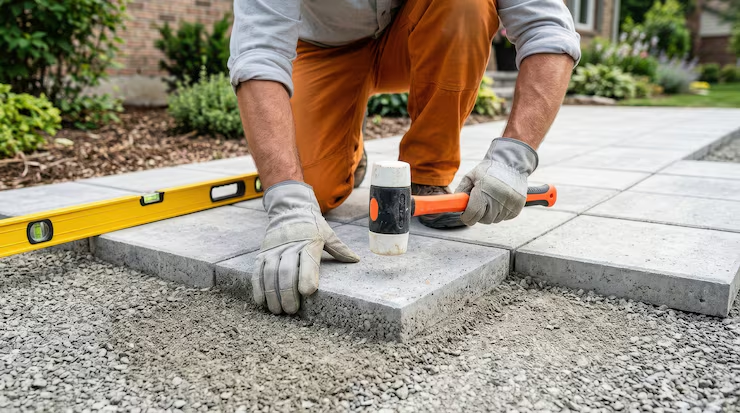
The fix is excavation deep enough to remove the organic topsoil and reach stable subgrade, then a compacted base of crushed stone that drains instead of holding water, then a bedding layer that lets the surface material sit level and tight. Edge restraint, whether it is a hidden plastic edging, a mortared border, or the weight of the material itself, keeps the sides from creeping outward as the base settles and shifts. Skip any one of these steps and the walkway will eventually show it, usually at the edges first.
Material choice matters too, and it tends to follow the same pattern as the housing stock. Newer homes often suit clean-edged pavers or stamped concrete that echo the straight lines of the house. Older properties closer to the center lean toward irregular bluestone, brick, or a cobble border that sits comfortably next to established plantings and stone walls. Commercial frontage usually calls for something lower-maintenance and slip-resistant, since the surface has to perform in all weather without constant upkeep.


What Our Clients Say
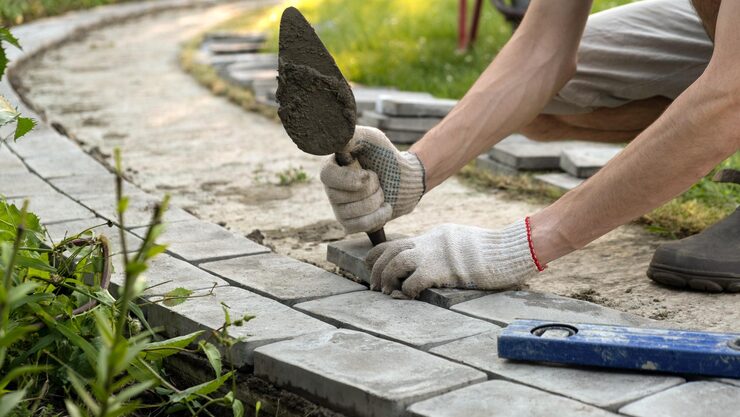
Paver walkways handle Westborough's freeze-thaw cycles well because individual units can shift slightly without cracking, and a damaged section can be lifted and reset without redoing the whole path.
Natural stone, like bluestone or fieldstone, suits older Westborough homes and ages beautifully, but irregular pieces take more labor to set correctly over a frost-safe base, with joints packed to resist New England’s freeze-thaw cycles and heaving over time.
Poured concrete gives Westborough walkways a clean, uniform look at a lower material cost, but it cracks as one continuous slab rather than failing at a single joint.
Stamped or colored concrete adds a decorative surface to a standard walkway pour, giving Westborough homeowners stone or brick-look paths without the full material cost, though the color layer can wear or chip faster than the concrete underneath it over time.
Gravel or stone-dust paths cost the least and drain well, suiting Westborough’s wooded, well-drained lots, but they shift underfoot over time and need periodic topping up, raking, and edge maintenance to keep borders crisp and walkways tidy.
Repairability matters as much as first cost.
Choosing a material
The materials are not equal. Each suits some properties and not others.
Grade is the first decision on any walkway.
On the newer subdivision lots common around Westborough, wide and level drives make grading simpler, but the walkway still needs its own pitch worked in, directing water away from entries, porch steps, and foundations rather than letting it pool against the house.
A walkway that ties into an existing drive apron needs a matched transition, so the two surfaces meet without a lip that catches a shovel or a plow blade.
Older Westborough homes near the center often have established stone walls, mature trees, or plantings close to the entry, and the new walkway has to work around roots, uneven grade, and drainage patterns already in place, without disturbing what makes the property feel settled.
Matching an older Westborough home usually means choosing a material, color, and joint pattern that reads as original to the property, not a modern add-on bolted to the front door.


Drainage, grade, and getting water away from the house
Put a hard, compacted surface on the ground and water that used to soak in locally now has to run off somewhere. Every walkway installation has to answer where that water goes. Pitching the path away from the house, basement entries, and low spots is part of the base design decided before any material goes down, not a finishing touch.
This matters most on older Westborough lots, where decades of landscaping, added walls, and regraded beds have sometimes routed water in ways nobody planned. A new walkway that ignores those existing patterns can worsen a damp spot or send runoff toward a neighbor’s yard instead of the street. Newer subdivision lots are usually graded more predictably since the site followed one plan, but the walkway still needs its own slight cross-pitch so it doesn’t turn into a channel during heavy rain.
Tying a walkway into a drive apron, entry steps, or an existing patio means matching more than one elevation at once, which is typically the trickiest part of the layout before excavation even starts.
What drives the price
A new walk has to meet several existing things cleanly.
- The entry : The walk must arrive at the door at a sensible height. The threshold sets the finished level, so the work starts at the door and runs outward.
- The drive : Where a walk meets a drive, the levels and the drainage have to agree. A mismatch becomes a trip edge or a puddle.
- Walls and planting : Existing stone walls, foundation beds and mature trees constrain the route. Roots under a path are worked around, not cut through without thought.
- An older house : Scale, colour and pattern should follow the architecture. A narrow, dark stone walk suits an old house differently than a broad paver field does.

Where this fits a Westborough property
Westborough’s mix of property types means there isn’t one standard walkway job here. A newer home on a wide, level lot might want a straightforward paver or concrete path from driveway to front door, built quickly since site conditions are simple. An older home closer to the center might call for natural stone set to match existing stonework, with extra care around mature trees and established beds. A business along the Route 9 corridor needs a surface built for steady foot traffic and a clean, professional entrance, which usually points toward concrete or pavers over anything more decorative.
In every case, the visible material matters less long-term than the base underneath it. A beautiful stone path over a shallow, uncompacted base will heave and settle within a few winters. A plain concrete walk over a properly built base will outlast it by decades. We build the base the same way regardless of what’s going on top, because that’s what decides whether the job still looks right five winters from now.
Before you call
It helps to know:
- Where the walk starts and where it needs to end
- Whether the route crosses a slope or a shared area
- Which material you lean towards, and whether the house is older
- Where water currently runs on the property
Questions people ask
How long does a walkway installation take in Westborough?
It depends on length, material, and what the excavation uncovers. A short paver or concrete path on a clear, level lot moves faster than a longer run through established landscaping or near tree roots. We give a timeline specific to the site once we've seen it.
Can a new walkway tie into our existing driveway apron?
Yes, and matching the transition is part of the design, not an afterthought. The two surfaces need to meet at the right elevation so there's no lip or gap that collects water or catches a snow shovel.
What happens if tree roots are near the planned path?
We assess root location and depth before excavating. Sometimes the path alignment shifts slightly to avoid major roots; sometimes the base design changes to work around them without harming the tree or undermining the walkway.
Is natural stone worth the extra cost over concrete or pavers?
It depends on the house and what you want long-term. Stone tends to suit older homes and ages well, but it costs more to install correctly and takes more labor to set over a frost-safe base. Concrete and pavers are more economical and each have their own trade-offs.
Do you handle walkways for commercial properties along Route 9?
Yes. Commercial frontage has different demands than a residential front walk, mainly around durability under repeated foot traffic and a clean, consistent look. We build the base to handle that use, not just a one-time installation.
Next step
Call Driveway Specialists on (413) 337-3772. We are a family-run company in business since 1988, and we will walk the route with you and talk through material, grade and drainage before anything is priced.