
Walkway Installation in Wrentham, MA
A lot of Wrentham homes sit well back from the road, down a long drive, often with woods or lake frontage around them. The walkway is what carries someone from the car, or from the drive, to the front door through all of that – and on these properties it usually has more ground to cover than a typical suburban front path. That changes the job. A forty-foot walk through open lawn is one project. A path that winds past mature trees, crosses a slope down to the water, or has to look right against an older farmhouse set back from the road is another.
We get called into Wrentham for both kinds. Sometimes it is a straight entry walk that needs replacing because the old concrete has heaved and cracked. More often it is a new path somewhere the house never had one – from a detached garage, from a side door, down to a dock or a fire pit, along the edge of a wooded lot. The work is the same underneath either way: it has to be built to move with frost without breaking, and it has to shed water instead of holding it.
What holds a walkway flat through a Massachusetts winter
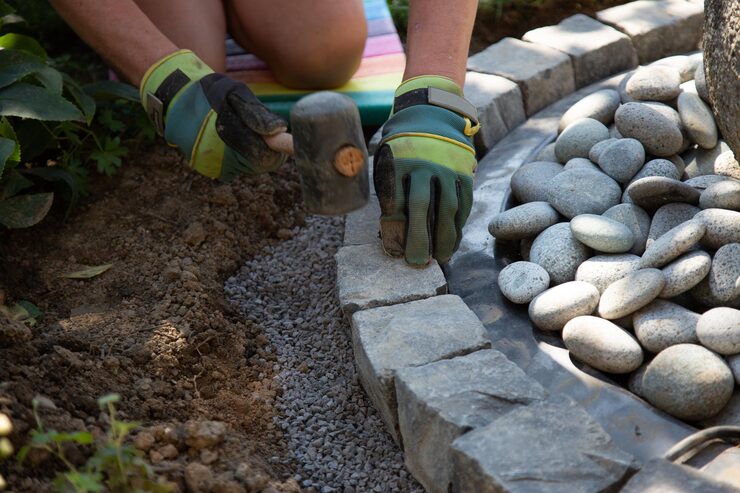
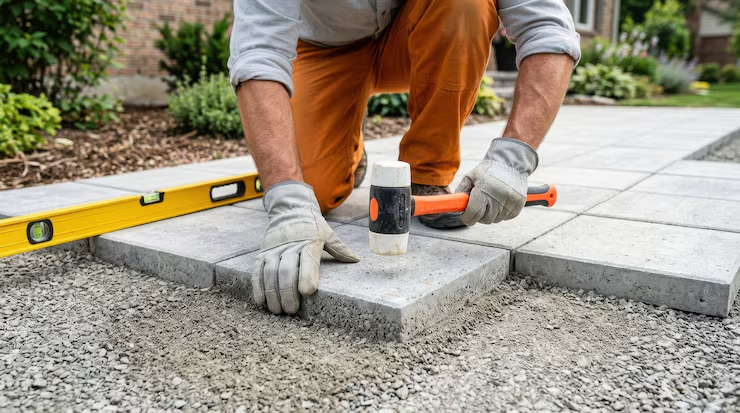
Everything that matters on a walkway is below what you see. We excavate below the frost-affected zone, lay a compacted gravel base, and set bedding material under the surface units with proper edge restraint holding the whole assembly together. Skip any one of those steps and the walkway still looks fine the day it’s finished. The failure shows up a year or two later, after the ground has frozen and thawed a few times and pushed whatever is underneath it wherever it wants to go.
Wrentham’s soil varies lot to lot – some of it drains well, some holds water longer near the lakes and wetter low areas. Either way, the base has to be built to let water pass through rather than sit under the surface and freeze. A base that holds water freezes solid in winter and heaves the stone or paver above it. That is the single most common reason an older walkway in this area has gone wavy, with lipped edges and gaps that catch a shoe.
Longer walkways also need to handle grade changes that a short front path never has to deal with. Where a path drops down toward Lake Pearl or any of the other wet, low-lying spots around town, we step the grade with low risers or a gentle running slope rather than forcing a straight line down a hill. Done wrong, that kind of slope turns into a sheet of ice at the first freeze and a wash of mud every spring thaw. Done right, it sheds water to the sides before it ever has a chance to pool on the walking surface.


What Our Clients Say
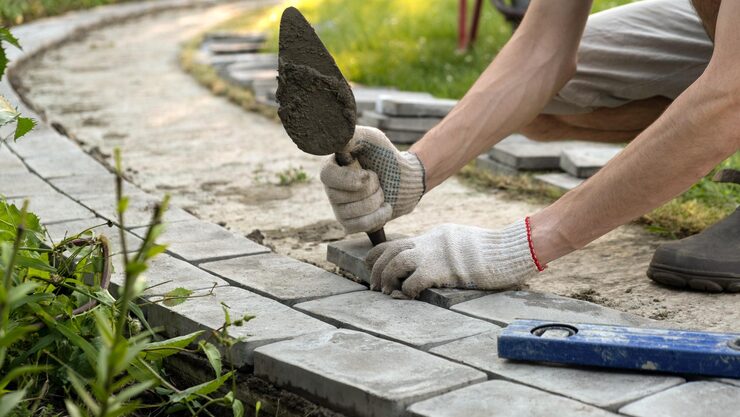
Material choices and what they trade off
Pavers hold a crisp look and let you reset individual units after frost heave. Natural stone suits older Wrentham homes but costs more to repair. Poured concrete is cheapest but patches show.
None of these is the right answer for every property. A fieldstone path suits a two-hundred-year-old farmhouse. A clean paver walk suits a newer build. The choice is about what the house and the ground are already telling you.
Grade and where the water goes
Once you add a hard surface, rainwater that used to soak in now has to run somewhere. On flat Wrentham lawns, that's minor.
A Wrentham walkway must pitch away from the house toward a spot where water disperses safely – not pooling at the door, washing out a bed, or running toward the foundation. We set that grade before any paver goes down.
Working around mature trees
Wooded Wrentham lots mean roots near the path line and shade that keeps the surface damp longer after rain. Both affect base work and material choice – a rigid slab fights root movement, while set pavers tolerate it better.
We route around significant roots where we can rather than cutting through them, since cutting a mature tree’s roots can destabilize it. The path curves instead of going straight. On a wooded lot that’s usually the better-looking outcome anyway.
Choosing a material
The materials are not equal. Each suits some properties and not others.
Tying into the driveway and entry
A walkway rarely stands alone – it connects the driveway to the front door or side entry.
At the house end, the walkway should land at the correct height against the threshold and any existing steps. Get that wrong and you end up with a trip hazard or a visible mismatch right at the front door.
Matching an older house
Many Wrentham homes have older stone walls, mature plantings, or distinct architectural character. A walkway that ignores this looks bolted on. One that echoes the same stone type or scale looks like it’s always belonged there.
We look at what is already on the property – wall stone, foundation material, existing hardscape – before recommending a walkway material. Consistency across the property reads better than any single feature on its own.
Paths beyond the front door
On larger Wrentham lots, we’re often asked for a secondary path – garage to kitchen door, house to dock, patio to fire pit. The same build principles apply: solid base, correct pitch, and a material suited to the setting.

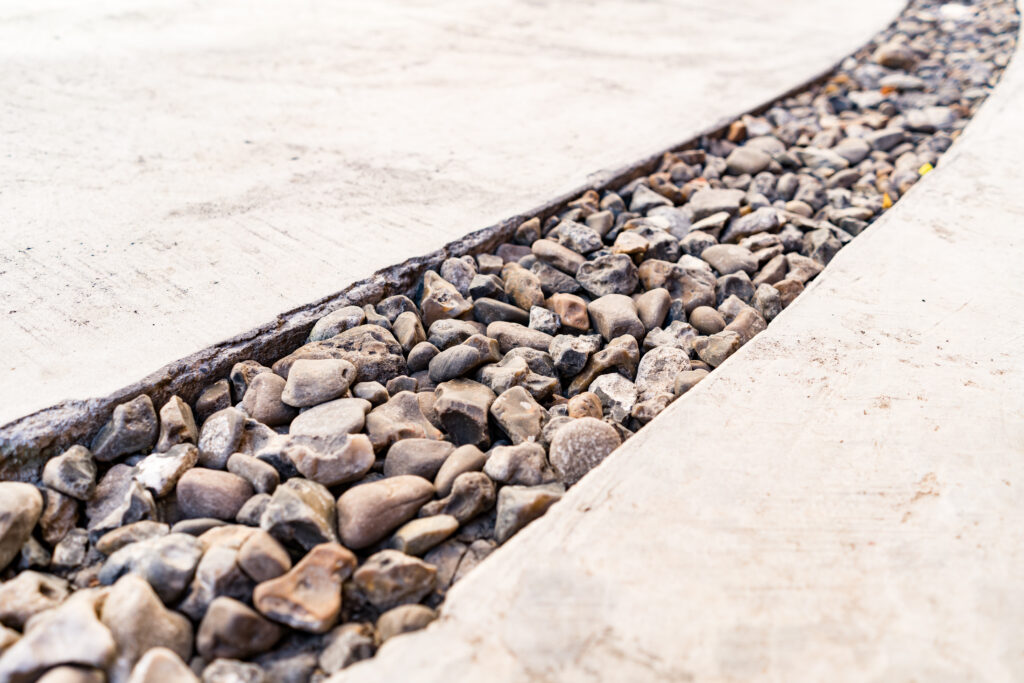
Secondary walkways—side yard paths to a shed, gate access routes, connectors between a driveway and a back patio—get less thought in a lot of Wrentham projects, and more problems as a result. They’re often laid thinner than the front walk, poured without a proper base, or skipped entirely in favor of a worn dirt track that turns to mud every spring. We build every path on a property the same way, whether it’s the main entrance walk or a narrow run along the side of the house: full excavation, compacted gravel base sized to the local frost depth, and a finished surface that matches or complements the rest of the hardscape.
That consistency matters more than people expect. A mismatched side path in poured concrete next to a stamped or paver front walk looks like an afterthought, and a thin, under-built section is usually the first thing to crack or heave once the ground freezes. We plan these secondary routes as part of the whole property layout, not a leftover task, so they hold up the same way and look like they belong.
What drives the price
A new walk has to meet several existing things cleanly.
- The entry : The walk must arrive at the door at a sensible height. The threshold sets the finished level, so the work starts at the door and runs outward.
- The drive : Where a walk meets a drive, the levels and the drainage have to agree. A mismatch becomes a trip edge or a puddle.
- Walls and planting : Existing stone walls, foundation beds and mature trees constrain the route. Roots under a path are worked around, not cut through without thought.
- An older house : Scale, colour and pattern should follow the architecture. A narrow, dark stone walk suits an old house differently than a broad paver field does.
Where a well-built walkway makes sense in Wrentham
Wrentham’s mix of long rural driveways, wooded and lakeside lots, and older homes set back from the road means the walkway is doing real work – connecting a car parked well away from the house, a dock down a slope, or a detached garage to the front entry. These are not short, flat, forty-foot suburban paths most of the time. They cross grade changes, pass under tree canopy, and run past established landscaping that was never designed with a hard surface in mind.
That is exactly the kind of project where the underlying build matters more than the surface material you pick. A path that looks right on day one but was laid on a shallow, compacted-by-hand base without real drainage planning will start showing problems within a couple of winters – heaving at the joints, standing water at the low point, edges that have shifted out of line. On a wooded or lakeside lot, with tree roots and seasonal water table changes working against the base year-round, that risk is higher than it would be on a flat open lawn in a denser neighborhood.
Before you call
It helps to know:
- Where the walk starts and where it needs to end
- Whether the route crosses a slope or a shared area
- Which material you lean towards, and whether the house is older
- Where water currently runs on the property
Questions people ask
Can a walk be built on a steep Wrentham lot?
Yes. The route usually changes. It may zigzag, step up in stages or include landings. The base and drainage matter more on a slope, not less.
Do I need the walk pitched away from the house?
Yes. A walk that falls toward the foundation sends water to the wrong place. The pitch is gentle and almost invisible.
Pavers or poured concrete?
Pavers can be lifted and reset if the ground moves. Concrete cannot be repaired cleanly once it cracks. Concrete is simpler for a long straight run, and pavers allow more variety and easier repair.
Can you match a walk to an older house?
Usually. Material, colour, scale and pattern all matter, and we can talk through what suits the architecture before anything is ordered.
Why does the base matter more than the surface?
Frost lifts what sits above it. A deep, well-compacted, free-draining base gives frost nothing to work with, and that is why a well-built walk stays flat.
What does a walkway cost?
It depends on length, material, slope and access. We quote after seeing the site.
Next step
Call Driveway Specialists on (413) 337-3772. We are a family-run company in business since 1988, and we will walk the route with you and talk through material, grade and drainage before anything is priced.