
Stone Foundation Waterproofing in Concord MA
Water coming through a basement wall in Concord usually isn’t a plumbing problem. It’s the foundation itself. Maybe it’s a damp patch that never fully dries by the stairs. Maybe it’s a wet corner every spring when the frost comes out of the ground. Maybe a section of fieldstone wall has started to bow or shed mortar. Whatever the symptom, the cause is almost always the same: the wall was built before anyone waterproofed foundations the way they do now, and water is moving straight through the stone.
Concord’s older housing stock, especially the homes in and around the historic district, sits on fieldstone and rubble foundations laid up with lime mortar or without any consistent mortar joint at all. There was no membrane on the outside when these walls went in, and there’s no perimeter drain system directing water away before it reaches the stone. Water sitting against the wall simply finds its way through the gaps between the stones, through porous mortar, or through hairline cracks that have opened up over a century of freeze and thaw. It doesn’t travel under the footing the way it would with a modern poured foundation leak. It comes through the wall itself, at whatever point the water table or surface runoff happens to be highest that season.
A lot of homeowners try an interior coating first, because it’s cheaper and faster. Those coatings can look like they’ve worked for a season or two, but they’re sealing the inside face of a wall that’s still wet on the outside. The water doesn’t stop moving, it just finds the next weak point, often a few feet along the same wall, or lower down near the footing. The only way to actually stop water entering a stone wall is to deal with it from the outside: excavate down to the footing, treat the wall itself, and give the water somewhere else to go before it ever reaches the stone.
That’s a different scope of work than most people expect when they first notice the damp patch. It means equipment in the yard, a trench along the affected wall, and several days of disruption rather than an afternoon in the basement. Along the way, the crew is usually checking a few other things too:
- Whether the footing itself is intact, or whether sections of mortar have washed out from underneath it over the years
- How close the grade and downspouts are pushing water toward that particular wall
- Whether a section of stone needs rebuilding or repointing before any coating or membrane goes on
- Where a new drain line can tie into existing drainage without cutting across the driveway or a mature tree’s root zone
It’s worth knowing all of this going in, because the honest answer to ‘can this be fixed from inside’ is almost always no, not permanently. Stone foundations don’t fail the way poured concrete does, with a single crack you can inject and move on from. They fail gradually, across the whole wall, which is why a patch job in one corner often just shifts the problem a few feet over within a year or two.


What Our Clients Say

What the excavation actually involves
The work starts at the surface, not the wall. A trench opens along the foundation on the affected side, dug deep enough to expose the footing itself, not just the upper courses of stone. Whatever is planted against that wall, and on an older Concord lot that’s often mature shrubs, a stone path, or a patio laid decades ago, has to come out or be carefully worked around. Once the wall is exposed, loose mortar and soil get cleaned off and the stone is treated, then a drainage layer, membrane, and perimeter drain go in before the trench is backfilled in stages, compacting as it goes.
Why access decides the approach
Concord has two very different lot types, and they change how this stone foundation waterproofing job gets done. In the historic district, houses often sit close to the street with narrow side yards, mature trees, low stone walls, and old walkways that limit where a machine can actually work. Hand-digging sections of the excavation is common there, which adds time but protects what’s already in place. On the long rural drives further out of the centre, access is usually easier for equipment, but the distance from the road to the affected wall can mean more trench, more backfill, and more material moved to get a crew and gear where they’re needed.

Reinstating the ground afterward
Once the stone foundation wall is treated and the new drain tile is in, the trench gets backfilled in stages — compacted in lifts rather than dumped back in loose — so the soil doesn’t settle unevenly over the following year. The grade is then rebuilt so water sheds away from the house rather than pooling back against the wall. On many Concord lots, the original grading is the reason water was reaching the foundation in the first place, so correcting that slope matters as much as the waterproofing work itself.
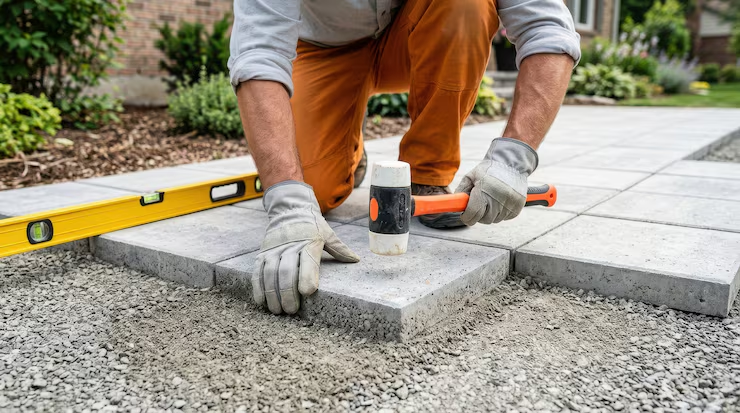
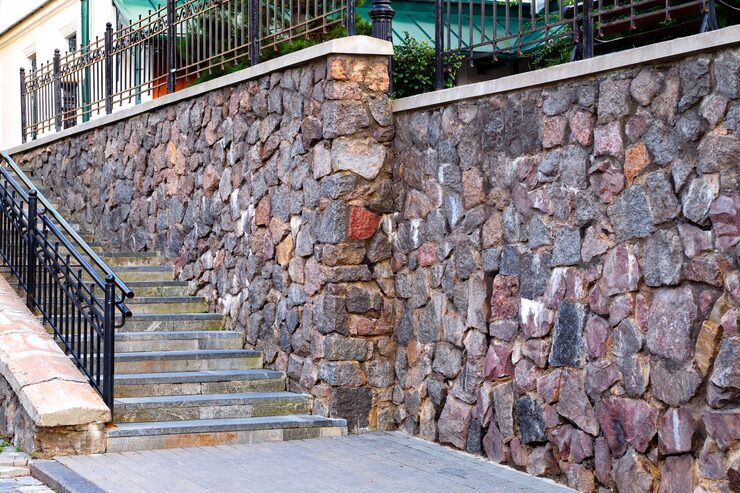
If a walk, patio, or section of driveway sits over the excavation path, it has to come up before digging starts and gets rebuilt afterward. That’s priced and scheduled as its own piece of work, not folded into the waterproofing contract. On the older, stone-foundation homes common around Concord’s historic district, we’re also careful to match whatever stone, brick, or paving was originally there, rather than leaving a visibly different patch where the trench ran. Plantings and beds disturbed by access get reset as well, wherever that’s practical.
The work in sequence
Access and excavation
We locate the affected wall, clear a route to it and dig down to the footing. On a sloped lot the excavation also has to be supported so the ground above does not move. Digging exposes the real condition of the wall, which can differ from what the inside suggested.
Planting and hardscape
Shrubs, beds, steps and walks along the foundation are in the way of the trench. Some can be lifted and replanted. Some will not survive the move, and stone or paved surfaces are taken up and set aside or replaced. We will walk the area with you before any digging so you know what is staying and what is not.
Wall treatment
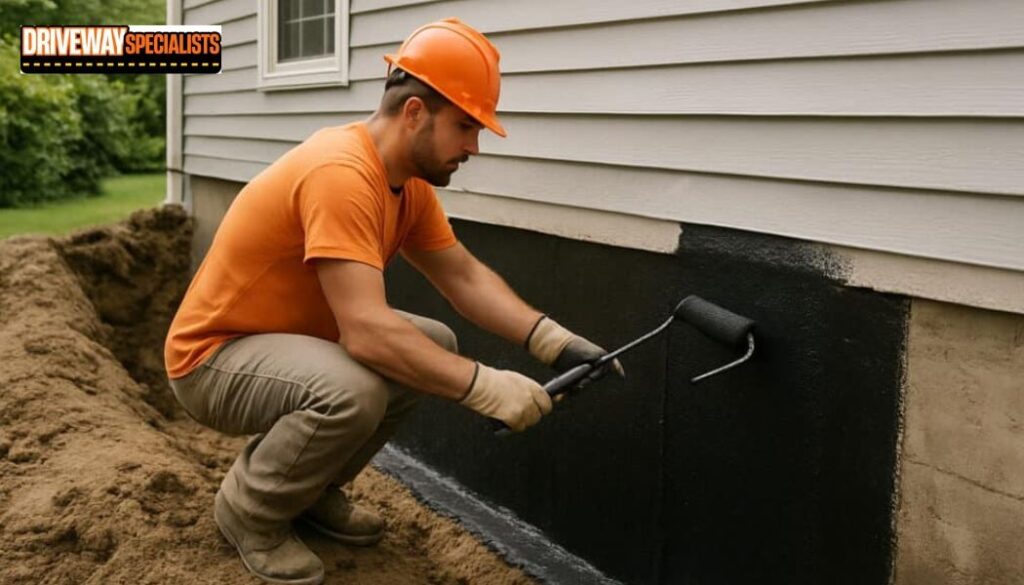
Once exposed, the wall is cleaned and assessed. Loose stone is reset and failed mortar is cut out and repointed. A membrane is applied to the outside face so water meets a barrier instead of an open joint. How much repair a wall needs depends on how much it has deteriorated, and that is rarely known until it is open.
Drainage and backfill
At the base of the wall, a drain carries water away from the footing to somewhere it can safely go. On a hillside lot, where that is can be the hardest question on the job. Backfill goes in with material that lets water pass down to the drain rather than pooling against the wall.
Reinstating the ground
The soil is graded back so that water runs away from the house. This is where the surface above the repair matters most.
Before you call anyone
A few things are worth checking first. Note when the water shows up relative to rain or snowmelt, which wall it’s on, and whether it’s a steady seep or shows up only after heavy weather. Photos of the damp pattern, any cracking, and the grade right outside that wall all help. That record, more than anything else, tells us what’s happening before we ever put a shovel in the ground.
If you’re seeing water, damp, or movement in a stone foundation, call (413) 337-3772 and describe what you’re seeing. We’ll tell you honestly what it looks like from there.
Pointers before anyone comes out
Most of this is observation, and it makes any visit more useful.
- Note when it happens. Is it after heavy rain, after snowmelt, or all the time? The pattern points to where the water is coming from.
- Photograph it. Take photos of the wall, the floor and the staining, with something for scale. Date them and repeat after the next rain.
- Mark the spot. Note which wall and which corner. Match it to the outside: which side of the house, and what is above it.
- Walk the outside. Look at where gutters discharge, which way the ground slopes at the foundation, and whether water pools after rain.
- Check the downspouts. Water dumped beside the wall adds to the load. Make sure they are not blocked or emptying near the foundation.
- Look at the stone and mortar. Powdery mortar, bulging or gaps are worth recording. Do not poke at a bowing section.
- Clear what you can. Move stored items away from affected walls so they can be seen and reached.
- Think about access. Where could a machine come in? Is anything shared with a neighbour?
Questions we get asked
Can water entry through a stone foundation be fixed from inside the basement?
Not permanently. Interior coatings seal the inside face of the wall, but the wall itself stays wet on the outside and water usually finds a new path through nearby. Stopping it means treating the outside of the wall and giving water somewhere else to go before it reaches the stone.
Will this damage the yard or landscaping around the foundation?
Anything planted or built directly against the affected wall has to come out or be worked around during excavation. On a historic district lot in Concord that might mean removing shrubs or a section of stone walk, which gets rebuilt once the drainage and backfill work is done.
How do you know which side of the house is causing the problem?
Usually by matching the pattern of damp or water entry on the inside to the grade, downspouts, and planting on the corresponding outside wall. A record of when and where water shows up, kept over a few rain events, makes this much faster to pin down.
Does this affect the driveway or walkway near the house?
Only if the excavation path runs under it. If a drive, walk, or patio sits directly over the trench line, that section has to be lifted before digging and rebuilt afterward as a separate piece of work.
Next step
If water is coming through an older stone foundation in Concord, we will come and look at the wall and the way in. We have worked on homes like yours for 35+ years, and the family has been doing it since 1988.