
Retaining Walls in MetroWest Massachusetts


What Our Clients Say

What a retaining wall does
A retaining wall holds soil where the land would otherwise slide, slump or wash out. It might hold back a bank beside a driveway. It might create a flat patch for a patio, or stop a hillside from creeping toward a foundation.
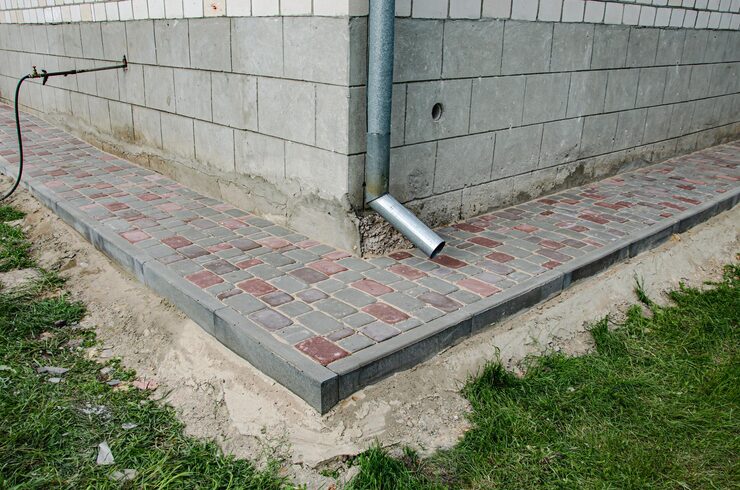
Soil is heavy, and wet soil is heavier. A wall that looks solid can still fail if water collects behind it, because the water adds weight and pushes sideways. Most failed walls in this region were not built too weakly. They were built without a way for water to leave.
This is hard-scape work, not paving. We build it as its own job, with its own base, its own drainage and its own questions about what is above and below it.
Who this suits
- A bank or slope is eroding, or has begun to lean or slide.
- You want level ground for a patio, a garden, a play area or a parking pad.
- A driveway cuts into a hillside and the cut face keeps crumbling.
- An existing wall is bulging, cracking or tilting, and you need to know whether it can be repaired or must be rebuilt.
Drainage comes first
Where engineering comes in
Some walls are a matter of good building. Others need an engineer’s design. The line depends on how tall the wall is, what sits above it (a driveway, a building, a slope that keeps rising), how close it is to a property line, and what your town asks for. We will say plainly at the site visit which side of that line your wall falls on. If it needs engineering, we will tell you before you spend money on anything else.
Why one quote does not fit every property
Two walls of the same length can be completely different jobs. What changes them:
- The ground. Sandy glacial soil drains and holds a base well. Wet clay and a high water table do not, and the wall has to be built to cope with that.
- The grade. A gentle slope and a steep bank load a wall very differently, as does a bank that rises past the top of the wall.
- Trees. Mature oaks and maples send roots into exactly the soil you are trying to hold. Roots move walls, and they complicate excavation.
- Access. A wall needs stone or block delivered, machinery brought in and soil moved out. A tight street or a narrow side yard changes how the job is done.
- Length and height. Both affect the foundation, the drainage run and the way the wall is built in sections.
This is why a quote needs a site visit. We cannot judge any of this from a photograph. It is also why the town pages below exist. Each one starts from the ground and conditions of that place.
Find your town
- Inside the Route 128 ring, closer to Boston: Newton, Watertown, Waltham, Needham, Wellesley.
- Along Route 9 and the Charles River: Natick, Framingham, Wellesley, Dover, Sherborn.
- West and north of Natick, on larger lots: Weston, Wayland, Sudbury, Lincoln, Concord.
- South through Norfolk County: Norwood, Walpole, Medfield, Westwood.
- Eastern Worcester County: Westborough, Northborough, Shrewsbury, Grafton.
Questions lot owners ask
Do I need a permit or an engineer for a retaining wall?
Why do retaining walls fail?
Can a leaning or bulging wall be repaired?
What is the wall made of, and does it matter?
Will tree roots affect the wall?
Why can't you quote from a photo?
Next step
Call us at (413) 337-3772. Tell us where the property is and what the slope is doing. We will arrange a visit to look at the ground and the water, and then give you a quote based on what is actually there.