
Walkway Installation in MetroWest Massachusetts


What Our Clients Say
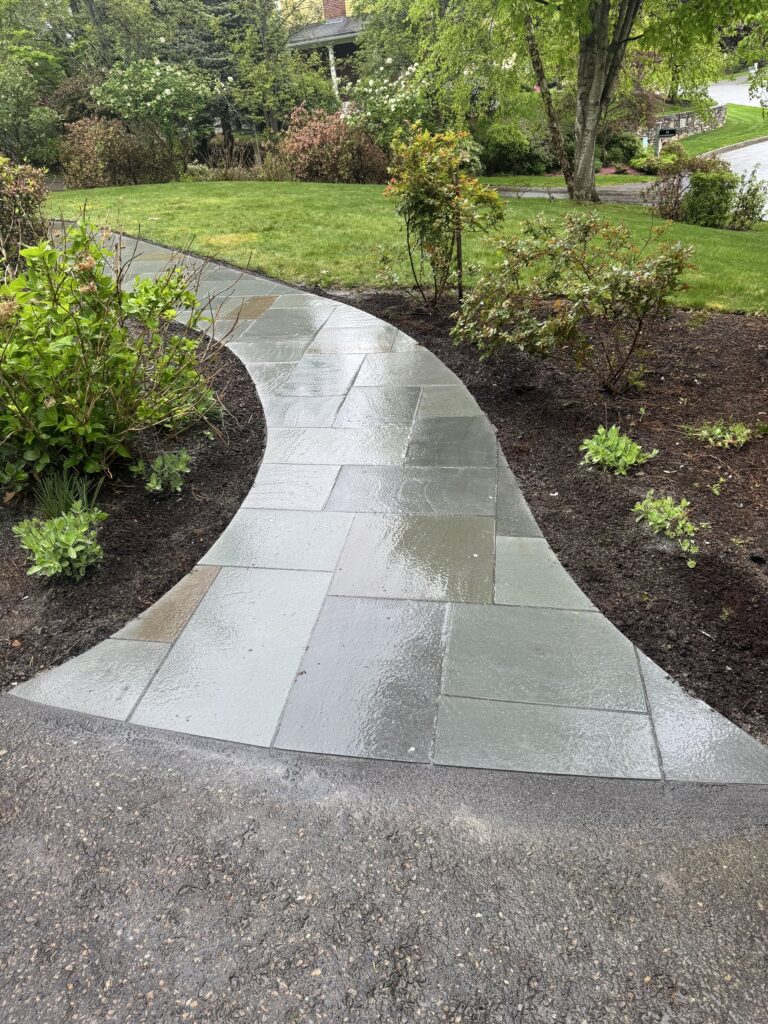
What a walkway job covers
A walkway is hardscape, not paving. It is a front walk, a side path to the back gate, a route from the drive to the door, or a run of steps and landings where the grade changes. It is built from pavers, natural stone or poured surfaces, depending on the house and how the path will be used.
It suits you if the walk you have is the problem. That means a slab that has lifted at a joint and become a trip hazard, a path that holds water against the foundation, or a surface that stays green and slippery under a maple. It also suits you if you are building new and want the path, the entry and the driveway to look like one design rather than three separate jobs.
It is probably not your page if the surface in question is a driveway. That is a paving job with different loads and a different base.
Why frost decides how long a walk lasts
New England winters do most of the damage. Water gets into joints and into the base beneath them. When it freezes, it expands and pushes up. When it thaws, the surface does not always settle back to where it was. Repeat that for years and you get the tilted pavers, open cracks and crumbling edges you may be looking at now.
A walk that lasts is a walk that drains. The base has to let water move through and away instead of holding it under the surface. That is why the same material can hold up well on one street and fail on the next.
Where the tie-ins get decided
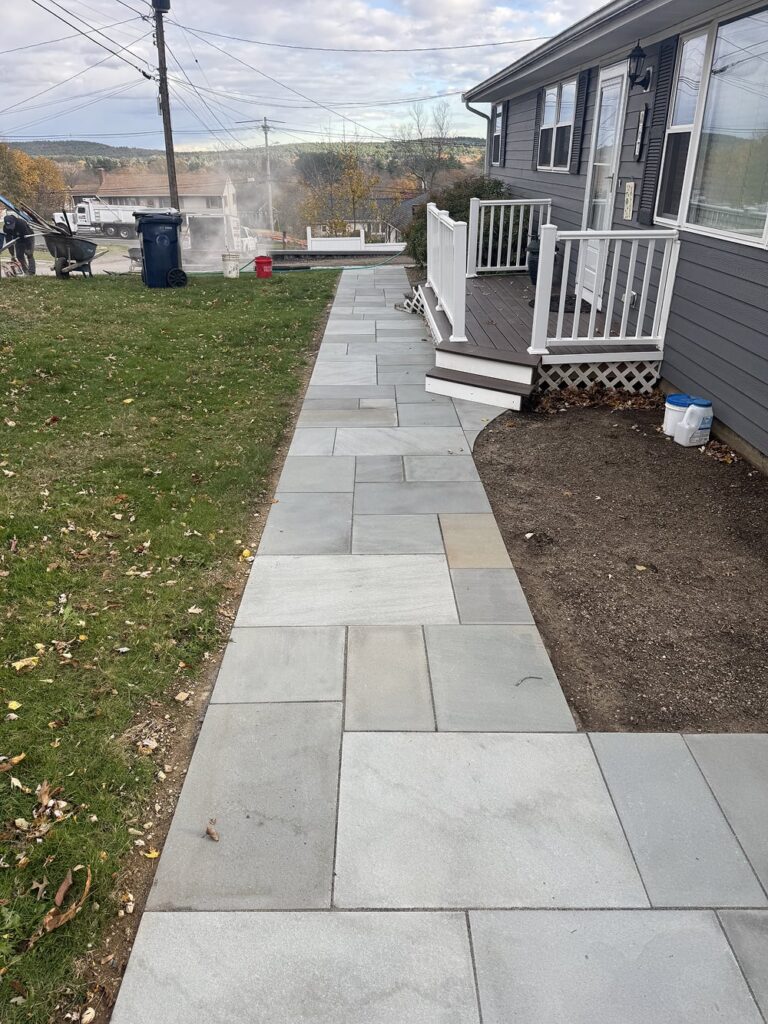
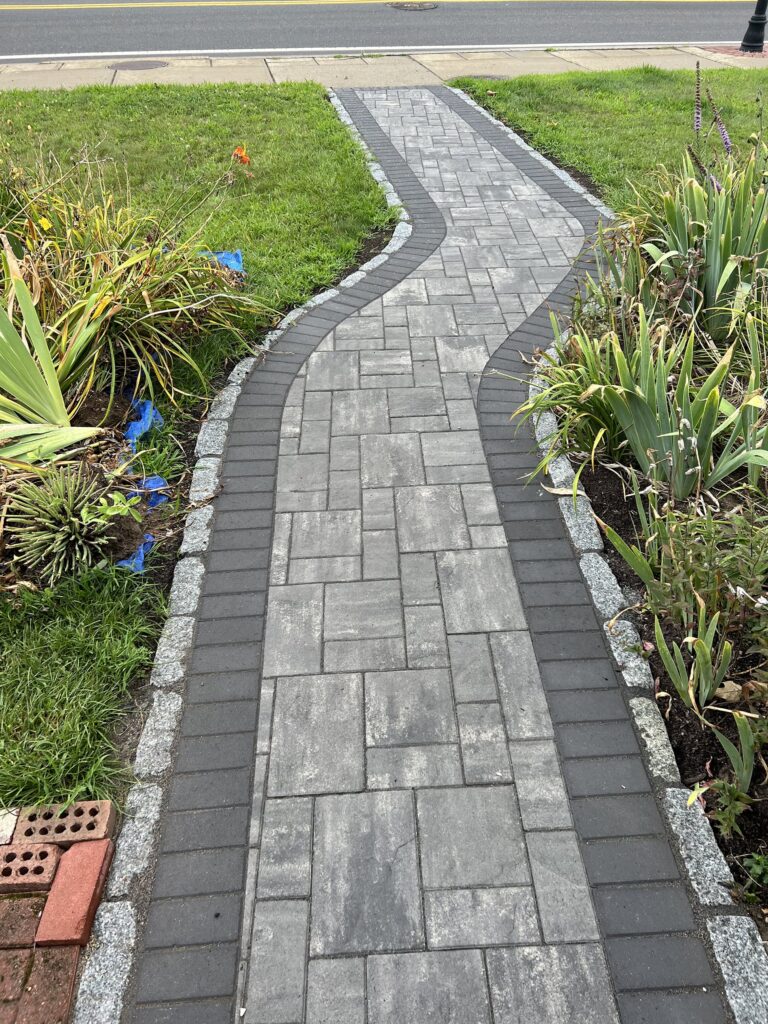
What changes from one property to the next
- Ground. Sandy, free-draining soil forgives a lot. Wet clay, or ground with a high water table, does not. The base has to be built for what is actually underneath it.
- Grade. A walk that falls toward the house is a drainage problem before it is a surfacing problem. A level, short run is a simpler job.
- Trees. Mature oaks and maples mean roots that lift surfaces and shade that keeps them damp. Some paths need to be routed around a root, not over it.
- Access. Machines and material have to reach the work. A tight lot on a narrow street is planned differently from a long open drive with room to turn a truck.
- Length and layout. A short straight walk to the door is one job. A winding path with steps and a landing is another.
None of this shows up in a photo. It shows up when someone stands on the property.
Find your town
- Natick and the towns around it. Natick, Framingham, Wellesley, Needham, Sherborn.
- Newton and the inner suburbs. Newton, Watertown, Waltham, Belmont, Brookline.
- Weston, Wayland and the western edge. Weston, Wayland, Sudbury, Lincoln, Concord.
- Norfolk County. Dover, Medfield, Walpole, Norwood, Sharon.
- Eastern Worcester County. Westborough, Northborough, Shrewsbury, Grafton, Hopkinton.
If your town is not named here, call. We have worked across Norfolk, Middlesex and eastern Worcester counties since 1988, and chances are we have been on your street or one like it.
Questions we hear about walkways
Do you need to see the property before quoting?
Pavers, natural stone or poured?
Why did my walk heave?
Can the walk match my driveway?
Will a walk under trees stay slippery?
Do you also do driveways?
Next step
Call (413) 337-3772. Tell us the town and what the walk is doing now, and we will arrange a time to see the property.