
Cobblestone Aprons and Edging in Belmont, MA
You want the place where your drive meets the street to look finished and to stay that way. On many Belmont lots that is a small piece of ground doing a lot of work. The frontage is narrow, the sidewalk sits close to the drive, and the lot often falls away steeply behind it. A cobblestone apron or a stone edge gives that transition a clear line, and it protects the surface beside it.

What Our Clients Say
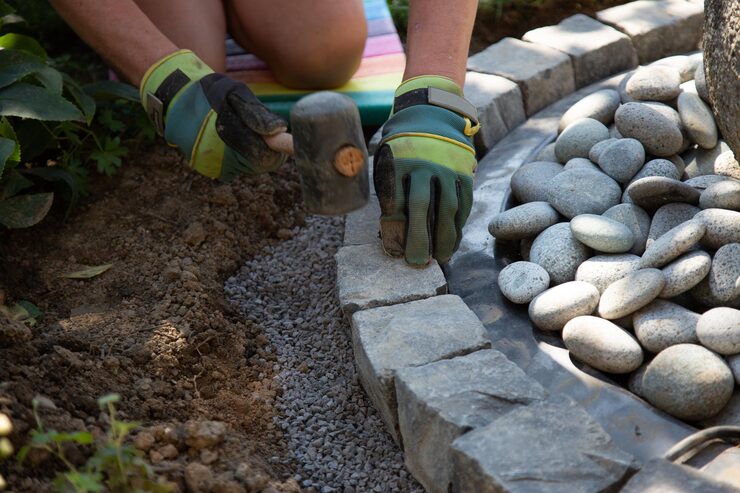
What the work involves below the surface
The stone is the last and smallest part of the job. A cobblestone apron stays flat or goes wavy depending on what is underneath it.
Excavation.
We dig out the existing material to a depth that lets a proper base go in. Topsoil and fill are left behind, because they hold water and shift.
Base.
Crushed stone goes in so water drains through and away rather than sitting. In Massachusetts, water that stays under a surface freezes, expands and lifts the stone. When it thaws, the stone does not settle back evenly. That is where waves and dips come from.
Compaction.
The base is compacted in layers, not dumped and rolled once. Loose spots settle under the first heavy delivery truck.
Bedding.
A thin, level layer of bedding material sits between the base and the stone. It levels the surface and nothing more. It is not a place to make up for a poor base.
Edge restraint.
Stone edging holds the field in place. Without it, cobbles creep outward under traffic and plow blades. On a slope the downhill edge takes the most pressure, so it gets the most attention.
Materials and the trade-offs
They are not equally good, and the right one depends on the house.
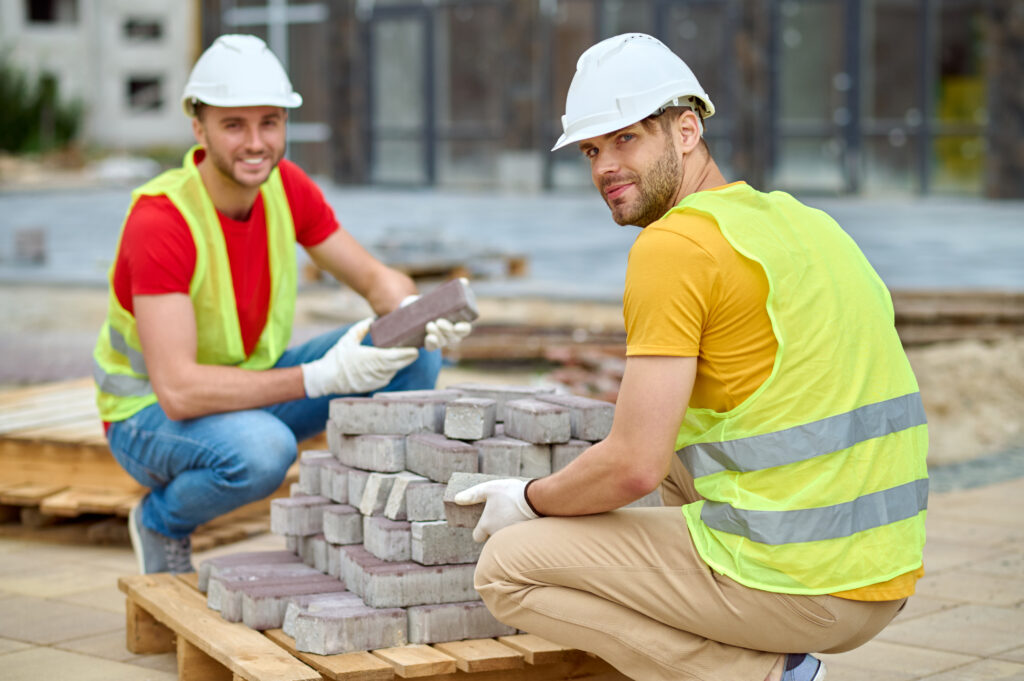
Granite cobble costs the most and is the best choice for longevity. It is dense and absorbs very little water, so freeze-thaw does little to it. It ages well, and a damaged section can be lifted and relaid. It suits older Belmont houses best.
Concrete cobble pavers cost less and are more uniform. They resemble stone at first. Over time the colour can fade and edges can chip or flake, especially where road salt reaches them. They are a reasonable choice when budget matters and the house is newer.
Brick suits many older homes and has a warm, traditional look. Quality varies a great deal. Soft brick absorbs water and flakes under repeated freezing, so we use only hard-fired brick, and only where it fits the house.
Stamped or patterned concrete is cheaper at the start but behaves differently. It is a slab, so it cracks as one piece and cannot be repaired by lifting a few units. We would rather build you something that can be fixed than something that has to be replaced.
Drainage and grade
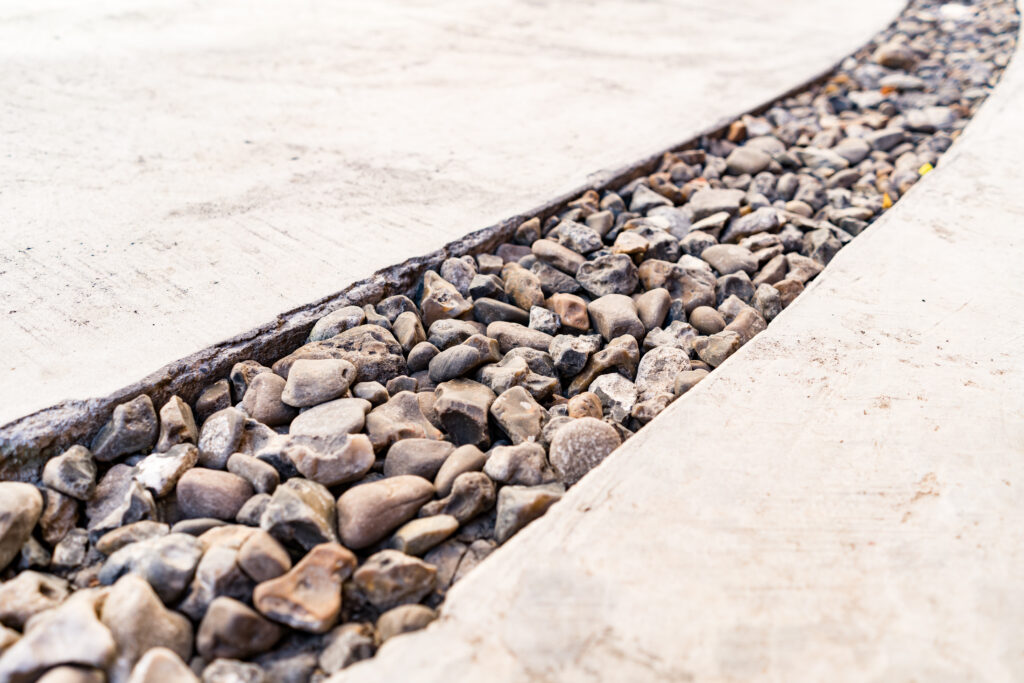
A hard surface sheds water instead of absorbing it. That water goes somewhere, and on a hillside lot it goes downhill toward your garage, your neighbour or the street. So the apron has to pitch away from the house. On a steep lot, we also plan where water leaves the surface and where it ends up, because the apron can send runoff onto the sidewalk or down a shared drive if nobody has thought it through.
Tying into what is already there
The apron has to meet the drive, the entry, any existing walls and the planting. A stone edge can sit against an old retaining wall and look as though it was always there, but only if the heights line up. Where there is mature planting, we work around root zones, since cutting too deep near an established tree damages it. For an older house, we match the colour and scale of the stone to the existing masonry rather than the other way round.
Where this suits Belmont properties
Tight frontages.
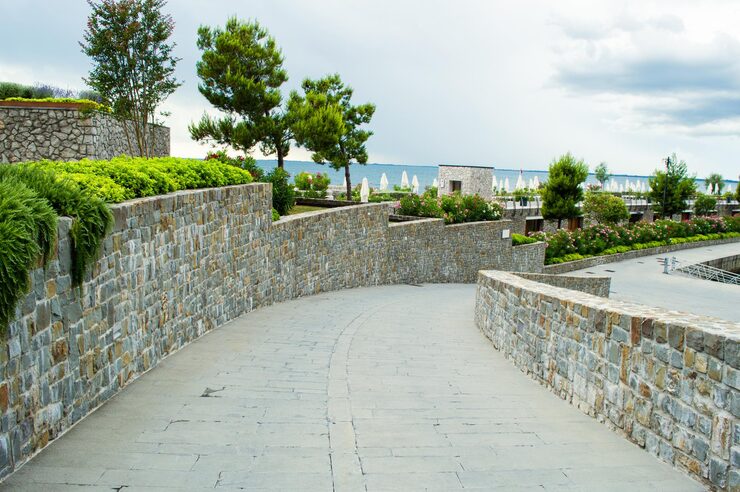
When the apron meets the sidewalk directly, a clean stone edge gives a crisp line between your property and the public walk. On a town-accepted road, the sidewalk and curb cut belong to the town, so our work stops at your property line and finishes flush against it.
Hillside lots.
Steep ground makes edge restraint and drainage more important, not less. Stone edging also holds the surface in place against the downhill pull.
Two-families with shared drives.
Both owners need to agree on where the edge line falls and what the finished surface looks like. We can build the work in stages if the owners prefer, and we set the line with both of them before any stone goes down.
So tar and chip suits a longer, gentler Belmont drive with some room around it. It is a poor match for a short, steep or shared one, or one that opens straight onto the walk.
Questions we hear
Will a cobblestone apron survive Massachusetts winters?
Yes, if the base is right. Stone handles freeze-thaw well. The base is the thing that fails when water is trapped beneath it.
Can you match an older house?
Usually, yes. Granite and hard brick suit older Belmont houses best, and we can show you sample stones against your existing masonry before you commit.
Does a stone edge stop asphalt from spreading?
It does. The edge holds the drive’s border in place so the asphalt cannot creep outward under load.
Can the apron be repaired later?
Cobble and brick can be lifted and relaid, which is a real advantage over a poured slab.
Do we need to do the whole frontage at once?
No. On a shared drive or a tight budget, the work can be phased, as long as the edge line is settled first.
Next step
Call us at (413) 337-3772. Tell us about the lot, the slope and what you want the frontage to look like. We have been working in this area since 1988, and we will tell you plainly what suits your property.