
Driveway Paving in Maynard, MA
A cracked, heaving driveway on a tight Maynard lot is a different problem than the same driveway in a town with wide, deep setbacks. If you’re looking at a surface that’s broken up near the street, or you’ve got a new build or addition with no driveway at all, you’re deciding who actually digs it out and does it right, versus who shows up with a crack filler and a truck. That decision is what this page is for.
Maynard’s older mill-town streets put a lot of houses close together on small lots, and the drives that go with them are often short, narrow, and squeezed between the house and a neighbor’s fence or wall. That changes how we plan the job before it changes anything about the asphalt itself.
What happens when you call
We come out and look at the actual drive, not a satellite photo of it. On a Maynard lot that usually means checking how close the existing edge sits to the foundation, the walkway, or a neighboring property line, and whether a truck and a paver can actually get in and turn without tearing up a lawn or a retaining wall on the way. Short, narrow drives sometimes need the work staged differently than a long suburban drive would, simply because there’s nowhere to stockpile excavated material or swing equipment.
We also look at what’s under the surface. A lot of Maynard’s housing stock is old enough that nobody alive knows what base, if any, was put down originally. Sometimes it’s a few inches of gravel over native soil, sometimes it’s whatever was handy at the time. That matters more than the cracks on top.
Why the base is the job
Asphalt is the part you see, but the base is the part that decides whether the driveway lasts. A driveway built on a thin, undersized base will crack and heave no matter how good the surface course is, especially through a Massachusetts winter of freeze-thaw cycles. On a small Maynard lot where the drive is close to the house, poor drainage in the base can also mean water working its way toward the foundation rather than away from it, which is a bigger issue than a rough driveway.
Getting the base right on a tight lot is partly a grading question and partly a space question: there has to be room to excavate properly and compact in lifts, not just scrape the top off and pour new asphalt over whatever is underneath.


What Our Clients Say
Full Replacement or Overlay
An overlay only makes sense when the base underneath is sound and the existing asphalt is tired on the surface but not failing structurally. On many older Maynard drives, decades of freeze-thaw and tree roots from street trees or old plantings have already compromised the base, so an overlay just hides the problem for a season or two before it reflects straight back through.
A sound base holds its grade, drains instead of pooling, and isn’t cracked in the same pattern repeatedly. If we see that, an overlay is a legitimate, less expensive option. If we don’t, full replacement is the honest answer, even though it costs more up front.
What Drives the Price
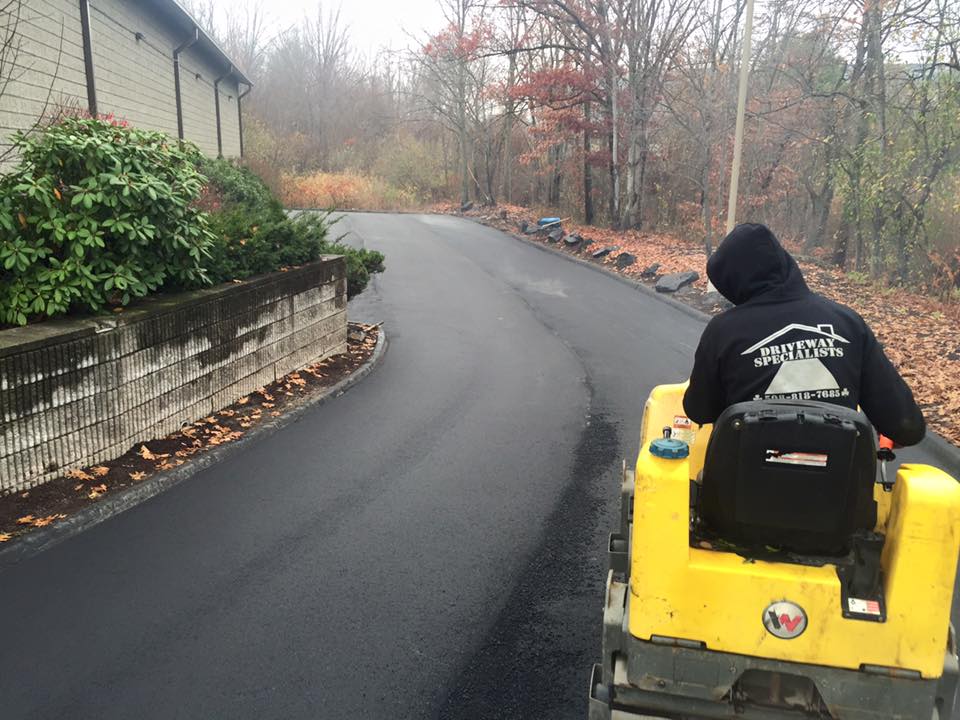
Square footage is only the starting point. On a short, narrow Maynard driveway, access often matters more than size: if equipment has to come in through a gap between houses, or material has to be wheelbarrowed instead of dumped straight in, labor time goes up even on a small job. Depth of excavation, how much old material has to be hauled out, the grade of the lot, and where water needs to go all factor in.
The apron where the drive meets the street is its own consideration, since work there touches the public way rather than just your property. Anyone who quotes a firm number over the phone without seeing the lot, the slope, and the access is guessing, not estimating.
Scheduling, Weather, and the First Season
Paving in Massachusetts is seasonal work, and that affects when a Maynard job gets booked and how the schedule fills up as the weather turns. We’ll talk through realistic timing when we see the site rather than promise a date that depends on conditions nobody controls yet.
Once the work is scheduled, your part is straightforward: move vehicles clear of the drive and the staging area, and keep foot and car traffic off the new surface for the period we tell you after the job, since fresh asphalt needs time to firm up properly. Through that first season, it will settle in and show its final color and texture. If you’re ready to get a real look at your driveway instead of a guess, call Driveway Specialists at (413) 337-3772.
What drives the price
Several things set the cost of a driveway, and each one is visible only on site.
- Square footage : The area to be paved, plus any widening, turnaround or parking pad you want added.
- Depth of excavation : How far down the old material has to come out, and how much of the base has to be rebuilt.
- Material removed : The old asphalt has to be hauled away, and the amount depends on what is there.
- Access: A paver, a roller and delivery trucks all need to get in and turn around. Tight Maynard frontages can limit what equipment fits, which changes how the work is staged.
- Grade: A steep drive is harder to prepare, harder to compact and harder to drain correctly.
- Drainage: If water needs to be moved off the drive and away from the house, that work is part of the job.
- The apron: On many Maynard lots the apron meets the sidewalk with very little room between the street and the house. How that transition is built affects both the drive and the walk, and we look at it closely.
Anyone who gives you a firm figure without having stood on your driveway is guessing. When the guess is wrong, the extra cost shows up later as shortcuts in the base.
FAQs
Can you pave a short, narrow driveway in Maynard without damaging the yard or neighboring property?
Usually yes, but it depends on the specific access. We look at how equipment and material can get in and plan the job around that before work starts, which is exactly why we assess the site in person rather than quoting blind.
My driveway looks fine on top but water pools near the garage. Is that a paving problem?
That's typically a grading or base problem showing up as a surface symptom. On tight Maynard lots where the drive sits close to the foundation, fixing the grade matters as much as the asphalt itself.
How do I know if my driveway needs full replacement instead of an overlay?
It comes down to the base. If it still holds grade, drains properly, and isn't repeatedly cracking in the same spots, an overlay can work. If the base has failed, an overlay is a short-term fix at best.
Do you handle the apron where my driveway meets the street?
We can address the apron, but because it touches the public way rather than just your property, it's treated as its own piece of the job and discussed specifically during the site visit.
Call us
If your Maynard driveway has reached the end of its life, or you are putting one in for the first time, call (413) 337-3772. We will arrange a time to see the site, measure it, and tell you what it needs.