
Walkway Installation in Belmont, MA
Most Belmont lots give you very little to work with. The house sits close to the street, or it sits up a slope, and the walk from the sidewalk to the door has to cross a grade change, a narrow strip of planting and sometimes a shared drive. A good walk makes that route easy and safe in every season, and it should look as if it belongs to the house.


What Our Clients Say
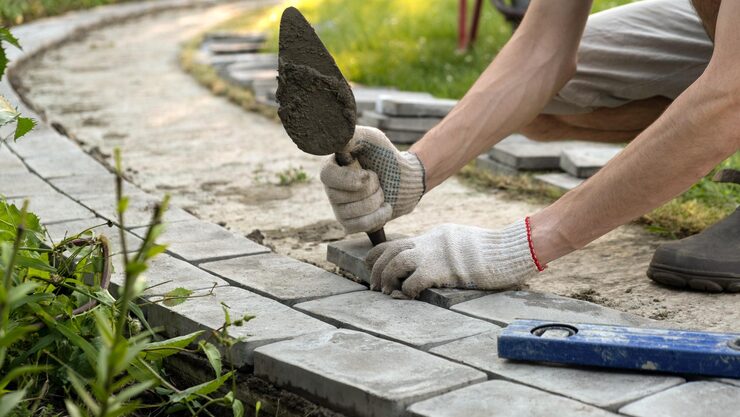
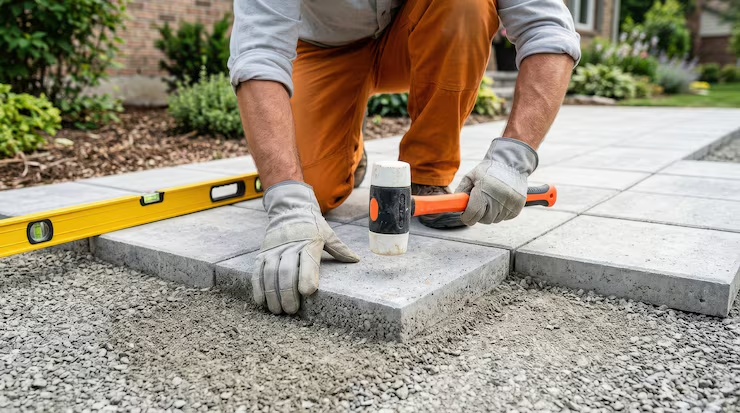
What a walkway is made of, below the surface
Excavation.
Organic soil is removed completely, because it compresses and rots. The depth depends on the soil and the material above it.
Base.
Crushed stone goes in and is compacted in layers. Stone drains and does not hold water, so there is little for frost to lift.
Bedding.
A thin, level layer of bedding material sits between the base and the stone. It levels the surface and nothing more. It is not a place to make up for a poor base.
Edge restraint.
Pavers and set stone spread sideways under foot traffic and frost. A firm edge holds the whole field together, and many failed walks have no real edge at all.
Choosing a material
The materials are not equal. Each suits some properties and not others.
Concrete pavers
Consistent in size and colour, and they interlock. Their strength is repairability: if a section settles, lift the units, fix the base and set them back. They age evenly and suit most Belmont frontages, but they depend entirely on the base and the edge.
Natural stone
Bluestone, granite and similar stone age better than anything else on this list. The surface develops character and looks more settled with time. It costs more, and irregular pieces take more skill to lay flat. Some stone is slippery when wet or shaded, which matters on steep, damp approaches.
Brick
Right for many older houses, and the colour and pattern can suit a period facade. Hard-fired brick does well. A soft or poorly chosen brick can flake and spall in freeze-thaw, so the choice of brick matters more than the laying.
Poured concrete
Plain and lasting when well made. It does not flex, so it cracks if the base moves, and a crack in a slab cannot be repaired invisibly. A pour is the cheapest way to cover a long run, but it is the hardest material to modify later. De-icing salt can also scale the surface.
Stone dust or gravel paths
Suited to secondary paths and garden routes. They need an edge and occasional topping up, and they do not suit a main entry used in winter.


Water and grade
A hard surface sheds water instead of absorbing it, so every walk moves water somewhere. That has to be a decision, not an accident.
The walk must pitch away from the house. If it slopes toward the foundation, rain and snowmelt run to the one place they should not go. The pitch is slight enough to walk on without noticing, but it is not optional.
On a steep lot the rule applies in two directions. Water must leave the walk to the side, and the runoff from above must not be directed across it. A walk built across a slope without planning for this becomes a channel in heavy rain and a sheet of ice in a cold snap.
What drives the price
A new walk has to meet several existing things cleanly.
- The entry : The walk must arrive at the door at a sensible height. The threshold sets the finished level, so the work starts at the door and runs outward.
- The drive : Where a walk meets a drive, the levels and the drainage have to agree. A mismatch becomes a trip edge or a puddle.
- Walls and planting : Existing stone walls, foundation beds and mature trees constrain the route. Roots under a path are worked around, not cut through without thought.
- An older house : Scale, colour and pattern should follow the architecture. A narrow, dark stone walk suits an old house differently than a broad paver field does.

Where this work fits in Belmont
Before you call
It helps to know:
- Where the walk starts and where it needs to end
- Whether the route crosses a slope or a shared area
- Which material you lean towards, and whether the house is older
- Where water currently runs on the property
Questions people ask
Can a walk be built on a steep Belmont lot?
Yes. The route usually changes. It may zigzag, step up in stages or include landings. The base and drainage matter more on a slope, not less.
Do I need the walk pitched away from the house?
Yes. A walk that falls toward the foundation sends water to the wrong place. The pitch is gentle and almost invisible.
Pavers or poured concrete?
Pavers can be lifted and reset if the ground moves. Concrete cannot be repaired cleanly once it cracks. Concrete is simpler for a long straight run, and pavers allow more variety and easier repair.
Can you match a walk to an older house?
Usually. Material, colour, scale and pattern all matter, and we can talk through what suits the architecture before anything is ordered.
Why does the base matter more than the surface?
Frost lifts what sits above it. A deep, well-compacted, free-draining base gives frost nothing to work with, and that is why a well-built walk stays flat.
What does a walkway cost?
It depends on length, material, slope and access. We quote after seeing the site.
Next step
Call Driveway Specialists on (413) 337-3772. We are a family-run company in business since 1988, and we will walk the route with you and talk through material, grade and drainage before anything is priced.